


Time:Oct 22,2026
By:Bailu
I. Why are home appliances inseparable from injection molding?
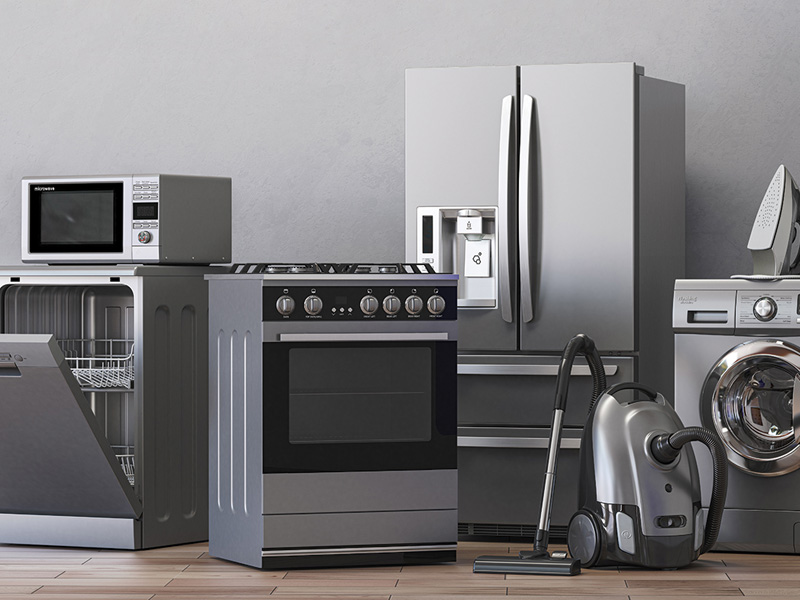
Take a casual look around your home - the outer shell of an electric rice cooker, the panel of a washing machine, the air outlet of an air conditioner, the inner liner of a refrigerator, the body of a vacuum cleaner - more than 80% of the non-metallic parts are produced through injection molding.
The reason is simple: What home appliances require is lightweight, low cost, large production volume, and exquisite appearance. Injection molding precisely meets all these requirements. Once a set of molds is invested, the cost of several tens of thousands of products can be reduced to just a few cents per piece. Metal parts simply cannot achieve this.
II. Common Injection Molding Materials for Household Appliances, Classified by Application Scenarios
Kitchen Appliances (Electric Rice Cookers/Microwave Ovens/Breaking-Down Machines)
Mainly use PP (Polypropylene), with a heat resistance above 120°C, food-grade safe, and extremely low cost. The exterior parts use ABS or PC/ABS alloy, requiring a glossy and textured appearance. The internal turntable of the microwave oven uses PPS, which remains unchanged at a high temperature of 260°C.
White Household Appliances (Washing Machines/Refrigerators/Air Conditioners)
The outer shell of the washing machine uses PP + EPDM modification, with impact resistance and moisture resistance. The inner liner of the refrigerator uses HIPS (High Impact Polystyrene), or ABS for the door handle and control panel. The outer shell of the air conditioner uses ASA, which does not turn yellow under ultraviolet rays and can withstand outdoor conditions as well.
Small Household Appliances (Vacuum Cleaners/Blow Dryers/Electric Fans)
The body of the vacuum cleaner uses ABS, with strength and a good feel. The outer shell of the hair dryer uses PC, with high-temperature resistance and strong transparency. The fan blades use PA66 + GF30, which is lightweight and sturdy, and does not deform when rotating.
III. Several Key Processes, Different from Ordinary Components
There are more and more no-spray schemes
Previously, the exterior components of home appliances needed to be painted. Now, they directly use no-spray materials (such as LG Lupoy GP-5300), and after injection molding, they become high-gloss mirror surfaces. This eliminates the painting process and has a higher yield.
Two-color injection molding and rubber coating injection molding
The buttons on the rice cooker and the rubber buttons on the remote control are both made by two-color injection molding or TPE coating - the hard part is the framework, and the soft part is the feel. They are formed in one step without the need for secondary assembly.
Ultrasonic welding replacing screws
The number of home appliance shells using screws is decreasing. Instead, ultrasonic welding is used to directly fuse two injection-molded parts together. The appearance is more concise, and the assembly efficiency is doubled.
IV. List of Typical Appliance Injection Molded Parts
Electric rice cooker: Top cover, outer shell, steam valve, measuring cup
Microwave oven: Door panel, turntable, outer shell, control panel
Washing machine: Operation panel, detergent box, door sealing ring, counterweight block
Refrigerator: Door handle, shelves, lampshade, hinge cover plate
Air conditioner: Air guide plate, panel, base, remote control housing
Vacuum cleaner: Main unit housing, dust cup, floor brush joint
The core concept of home appliance injection molds can be summarized in three words: light, efficient, and beautiful. Lightweighting reduces transportation costs, injection molding saves mold amortization costs, and the precise injection molding produces an appearance that directly replaces the texture of metal parts.
Let us brighten your life with safety, efficiency,and expert craftsmanship.
Contact Us
Phone : +86-159 0682 2387
WhatsApp/Wechat: +86-159 0682 2387
Email : info@bailusolution.com
Copyright © 2026 Huzhou Bailu Technology Co., Ltd. All Rights Reserved. Design by BONTOP.