


Time:Oct 30,2026
By:Bailu
A factory tells you the tooling takes eight weeks, so you book a launch four months out. Then the first samples arrive six weeks late and your calendar is gone. The gap between quoted and actual timelines is rarely a lie — it is a misunderstanding of where the weeks actually go. A realistic custom product development timeline China buyers can defend has five stages, and each one has a predictable cost in time. This article breaks that clock down so you can read a factory schedule and tell which dates are commitments and which are hopes.

Most factories quote a delivery window before they open your files. They do it to stay competitive, and the number they give is a range from past experience, not an estimate of your part. A housing with complex side actions takes longer than a flat panel; a material that needs long cooling runs slower cycles; a two-cavity mold adds machining time over a single cavity. The first quote is the factory's average, and your project will land above or below it depending on the details. The fix is straightforward: ask for a timeline built on your actual files rather than on a product category.
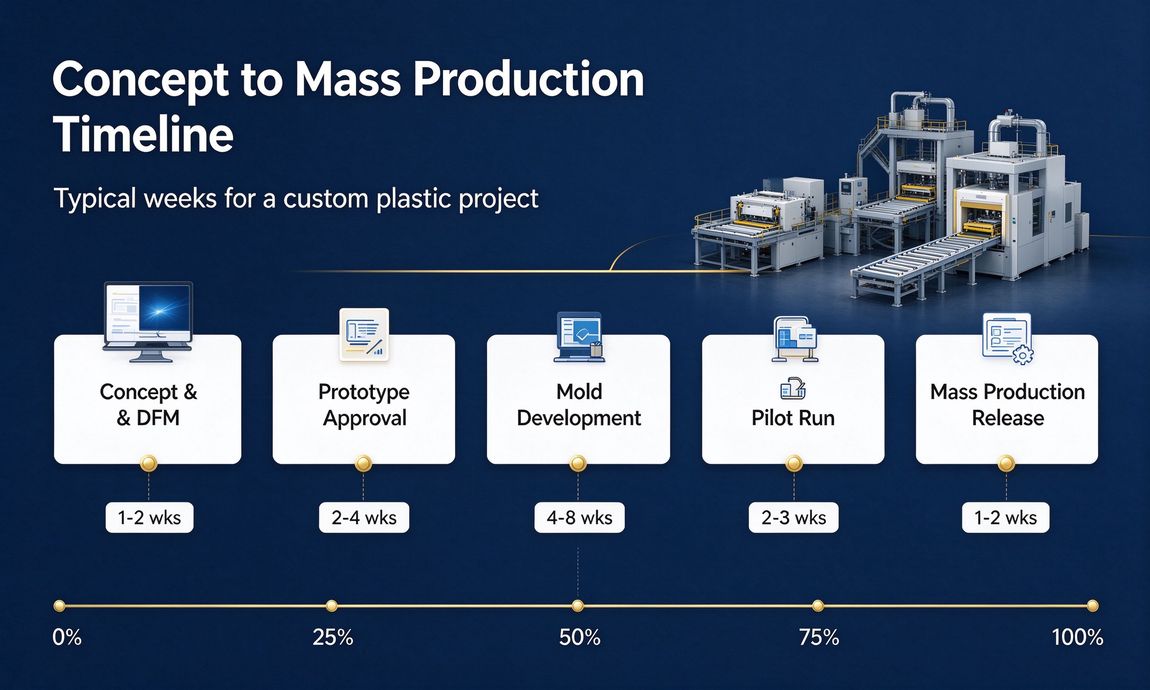
Concept and design review, one to two weeks. The factory checks your model for manufacturability, confirms the material and closes the DFM list. Prototype, two to three weeks. Samples confirm fit, finish and function before any steel is cut. Mold development, four to eight weeks. This is the long block: cavity design, steel cutting, EDM, polishing, assembly and the first trials. Pilot run, two to three weeks. The real mold runs under production conditions and the process is tuned. Mass production release, one to two weeks. The first production batch is validated, inspected and packed.
Added together, a straightforward plastic part lands at ten to sixteen weeks from an approved design. That is the honest baseline for a custom product development timeline China buyers should budget with, and it assumes files are ready on day one and decisions are made on time.
Three leaks drain most schedules. The first is design changes after tooling starts — every revision stops the mold shop, and the clock only restarts when the change is fully understood. The second is approval latency: a sample sits in a buyer's inbox for ten days while the mold waits for a sign-off that could have taken two. The third is hidden rework: polish, steel adjustments and second trials that the shop absorbs quietly and the buyer discovers in the final invoice. None of these show up in a one-line quote, which is why the quote and the reality drift apart. Bailu Tech runs a weekly milestone review on every tooling project so a delay is visible the week it happens, not the week it becomes critical.
Take a single-cavity mold for a mid-size plastic housing in standard ABS. Week one: DFM and material sign-off. Weeks two to four: prototype and buyer approval. Weeks five to ten: mold build. Week eleven: T1 trial and dimensional report. Week twelve: pilot run and sample sign-off. Weeks thirteen to fourteen: production and packing. The plan only holds if the files are frozen at kickoff — every revision moves every following date, and pretending otherwise is how launch dates get broken. If your part has side actions, inserts or a complex texture, add two to three weeks to the mold block and adjust accordingly.
Some of the biggest schedule levers sit on the buyer's side of the table. Send STEP and 2D files with the critical tolerances marked, and the factory does not have to guess. Freeze the design before tooling starts, and the mold is cut once instead of twice. Pre-approve the material and finish class, and the trial phase has fewer surprises. Answer sample approvals within two working days, and the pilot does not idle. Each of these decisions is worth days, and together they often save two to three weeks against a passive handoff. Factories notice which buyers run their side of the project, and they schedule accordingly.
Quoted timelines usually cover the manufacturing stages and quietly leave out the margins that real projects need: material procurement time, holidays, sample transit, and the decision days on your side. A supplier that quotes fourteen weeks may be quoting twelve weeks of work plus two of buffer; another quotes fourteen because that is the honest total including procurement. Neither is wrong, but they are different numbers. The reliable way to compare is to ask what is inside the quote: does it include steel procurement, the T1 trial and the dimensional report, sample shipping and the final inspection? When every supplier quotes the same scope, the numbers become comparable.
The same discipline applies on your side — decide who approves the samples and how fast, because a two-week approval gap is not a factory delay, it is a project delay that belongs to the calendar. A stage-gated timeline with the scope written into each gate makes that comparison possible.
The useful question to ask a supplier is not "how long will it take" but "what is the exit gate of each stage". A stage-gated plan names a deliverable and a decision point for every phase: a DFM report, a prototype sample, a T1 report, a pilot sign-off. If a factory can name these gates, the schedule is real; if it can only name a final date, the plan is a hope with a calendar attached. Bailu quotes tooling projects this way, and the planning notes in our news section show the format in practice. When you are ready to test the numbers against your own drawings, send the files to Bailu Tech and you will get a stage-gated timeline with the weeks attached to each phase — including the weeks that sit on your side of the decision table.
Let us brighten your life with safety, efficiency,and expert craftsmanship.
Contact Us
Phone : +86-159 0682 2387
WhatsApp/Wechat: +86-159 0682 2387
Email : info@bailusolution.com
Copyright © 2026 Huzhou Bailu Technology Co., Ltd. All Rights Reserved. Design by BONTOP.