


Time:Oct 30,2026
By:Bailu
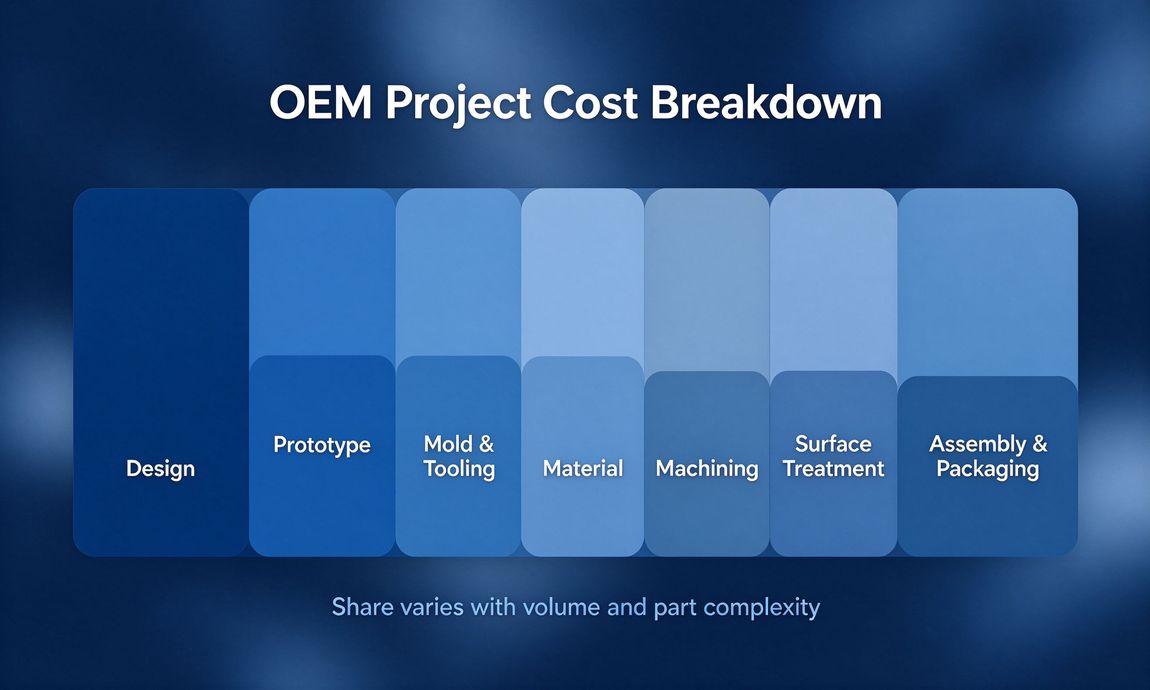
The most honest answer to how much an OEM project costs is that the price is decided by seven cost blocks, not by a single number. Design, prototyping, mold and tooling, material, machining, surface treatment, assembly and packaging each respond to different decisions you make, which is why two similar-looking parts can land at very different prices. Instead of asking for one figure, you want an OEM project cost estimation China suppliers can break down line by line, so you can see where the money goes and where it can be trimmed before you commit.

Every serious quotation separates the one-time costs from the per-unit costs. The one-time side covers design work, prototypes, mold and tooling. The per-unit side covers material, machining, surface treatment, and assembly with packaging. Confusing the two is the most common reason buyers overpay: a low unit price can hide a tooling cost spread over a tiny quantity, while a high unit price can hide a mold that is already paid off. Asking the supplier to separate the blocks does not cost anything, and it makes every later negotiation concrete. At Bailu, the seven blocks behind every OEM project cost estimation China request are split out in every quotation by default, so buyers never have to reverse-engineer the numbers.
For plastic parts, the mold is usually the largest single item on the quotation. Its price is driven by size, cavity count, steel grade, and complexity — side actions, sliders, lifters and fine texture all add cost. A simple two-plate mold for a small housing can be a modest investment; a large, multi-cavity tool with moving components is in a different bracket entirely. Tooling is also where the design has the strongest leverage: a DFM review that removes one side action saves more money than any material negotiation. For metal parts, the same logic applies to die-casting dies and stamping tooling. Ask for the mold quotation to list what is included — cavity count, steel grade, trial shots and any engineering changes — because that single line determines whether the tooling price is final or has room to grow.
Material cost follows the part weight, the grade, and the market price of the resin or alloy at the time of production. Engineering plastics such as PC, PA66 with glass fill, or flame-retardant grades cost more than commodity resins, and the difference shows up in the unit price. Machining appears when the process cannot hold a feature directly — a threaded insert, a tight bore, or a surface that molding cannot produce. Every machining step adds handling time and scrap risk, so designs that reduce secondary operations cut the per-unit price more than most buyers expect.
Surface treatment is easy to underestimate because each step looks small on its own. Painting, texture, plating, anodizing, laser marking — each adds a process, a handling step and a yield loss, and they compound across a batch. A textured mold finish is a one-time tooling cost, while per-part painting is a recurring cost that follows every order. When you compare quotations, check explicitly whether finishing is included and which standard it follows; this is the line where quoted prices diverge most between factories.
If your product is delivered as a finished assembly rather than loose parts, assembly labor, functional testing and packaging belong in the cost model. Manual assembly is reasonable for small volumes; larger volumes justify simple fixtures and semi-automated lines, which change the cost structure rather than simply lowering it. Packaging is often treated as an afterthought, yet export-grade cartons, inserts, moisture protection and labeling all carry cost, and they are non-negotiable if parts must survive sea freight. Plan them into the estimate from the start, not after the first shipment arrives damaged — the packaging spec belongs in the RFQ so the quotation covers the real delivery condition.
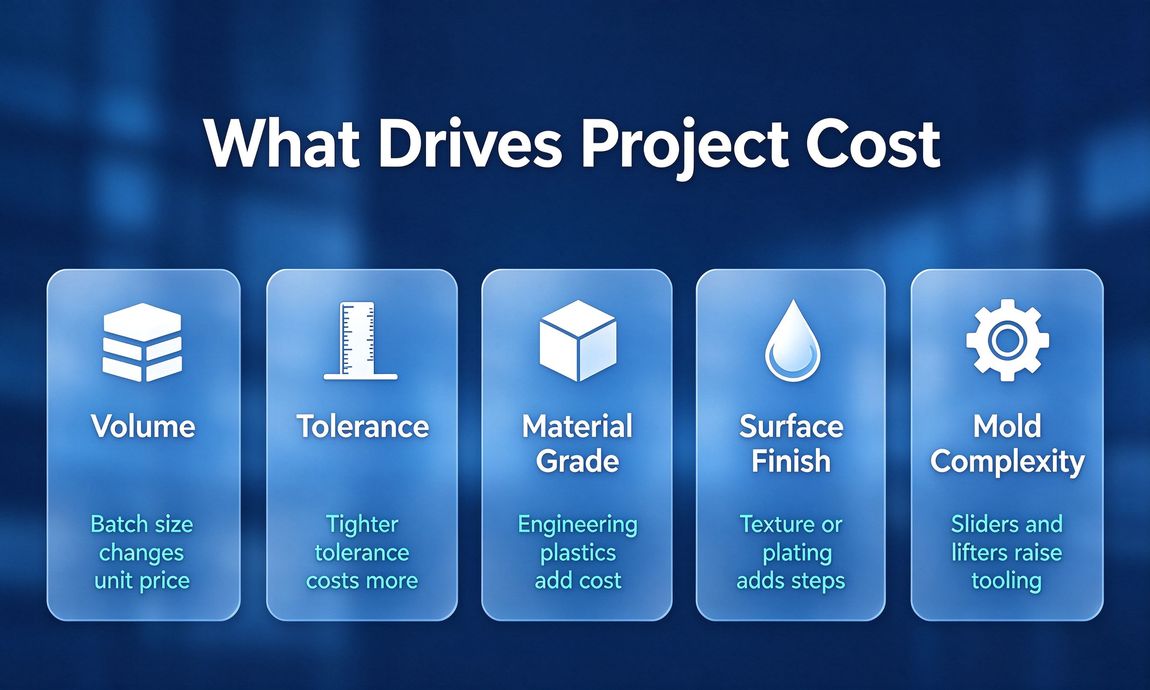
Five variables move the total more than any others: volume, tolerance, material grade, surface finish and mold complexity. Volume changes how the one-time costs are spread; tolerance changes process choice and scrap rate; material grade changes the raw input cost; surface finish adds process layers; mold complexity drives the biggest one-time line. When a quotation surprises you, check these five before questioning the factory — the answer is usually in one of them. At Bailu Tech we show buyers this exact breakdown so they can see which variable to adjust when the budget does not fit.
A reliable OEM project cost estimation China suppliers can stand behind starts with a complete RFQ — drawings or a 3D model, volume, material, finish and acceptance criteria — because an estimate built on missing information is a guess with a number attached. Ask for the seven blocks itemized, question any line that is a single lump sum, and request a sensitivity view: what changes if volume doubles, or if tolerance relaxes. If you are still comparing factories, the checklist in our guide on how to find reliable OEM ODM manufacturer in China covers the evaluation side. And when you want a cost estimate built on your actual files rather than assumptions, send Bailu the RFQ and you will get the seven blocks back in writing — including the variables you can move.
Let us brighten your life with safety, efficiency,and expert craftsmanship.
Contact Us
Phone : +86-159 0682 2387
WhatsApp/Wechat: +86-159 0682 2387
Email : info@bailusolution.com
Copyright © 2026 Huzhou Bailu Technology Co., Ltd. All Rights Reserved. Design by BONTOP.