


Time:Oct 30,2026
By:Bailu
A molded lamp housing fits the LED board neatly on the bench, and after a hundred burning hours it has yellowed, dimmed and fogged its own diffuser — the failure mode of a housing designed as a box instead of as a thermal system. Lighting fixture custom OEM parts live with heat that plastic would rather not carry, optics that forgiving surfaces cannot fix, and seals that decide whether the product survives a wet wall. This article collects the design tips that separate a housing that works in service from one that works only in the sample photo.

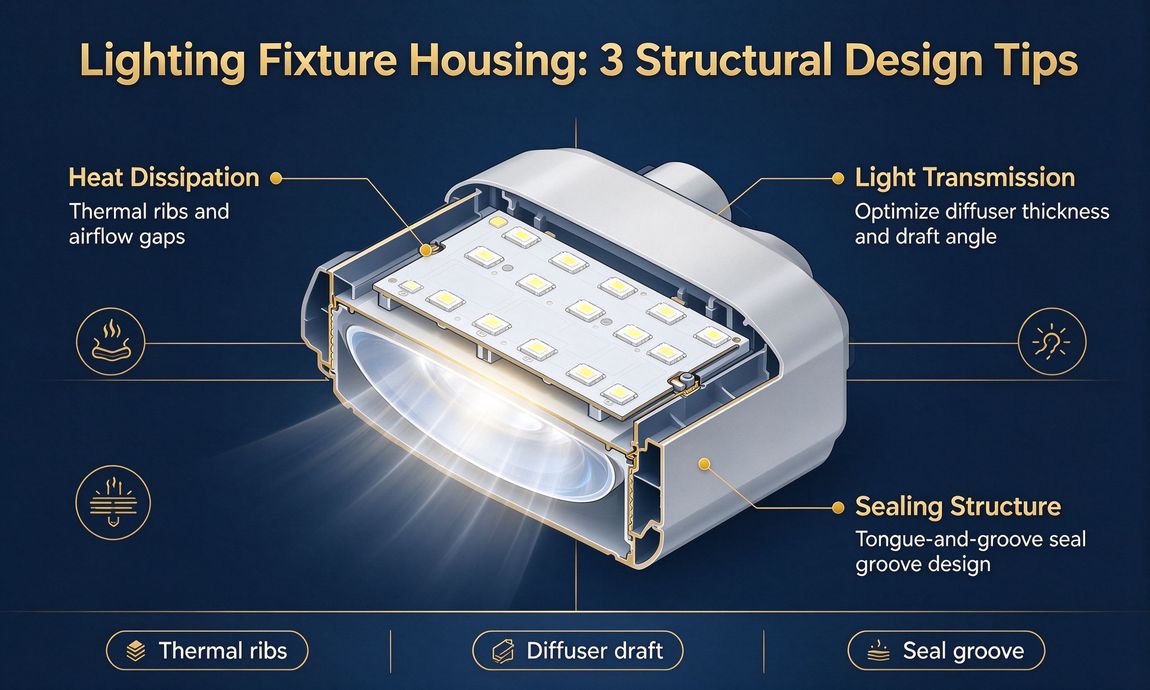
LEDs are small heaters, and every degree trapped in the housing shortens the light engine. The design response starts on the inside: provide a flat, stiff interface under the board, add thermal ribs where geometry allows air to move, and leave airflow gaps instead of sealing the chamber shut. The material choice follows from the heat budget — heat-stabilized grades for hot zones — and the whole part should be checked against the injection molding process for rib ratios and wall uniformity, because thick ribs next to thin walls warp and bend the optical axis over the product life. Where the board mounts directly to the housing, a flat metal-backed seat and a thermally conductive interface pad move heat into the ribs instead of trapping it under the LEDs. Heat-stabilized engineering blends delay the yellowing that ordinary clear materials show after months near a warm driver, which is a visible failure customers photograph and return.
The diffuser is the optical surface of the product, and injection molding makes it one of the hardest features to get right. Wall thickness should stay uniform across the lens, because varying thickness creates visible brightness bands and uneven shrinkage that warps the face. Draft angles need to be planned so the diffuser releases cleanly without scuffing, and matte or textured finishes should be chosen deliberately: they soften the light but they also change transmission and the way fingerprints read. A diffuser approved by eye on a bench often surprises on a luminance test, which is why geometry and finish should be fixed before the mold is cut.
Outdoor-rated housings need a deliberate seal path, not hope. The proven approach is a tongue-and-groove interface that locates the gasket and squeezes it evenly, screw bosses laid out so clamping pressure reaches every section of the seam, and drain and vent details planned where condensation would otherwise collect. Sharp corners in the gasket groove are the places water finds a way in, so radiused groove corners and a consistent groove depth matter as much as the gasket itself. Designing the seal groove into the early model costs nothing; retrofitting it into a finished mold costs a rework visit. Condensation deserves the same thought as rain: a housing that breathes needs a vent detail, or a drainage path at the lowest seam, so moisture that enters during temperature swings finds its way out instead of fogging the lens. Screw boss spacing should let the gasket compress evenly across every section, because a boss gap leaves a low-pressure seam that water tests exploit.
Several classic injection defects land exactly where lighting can least afford them: weld lines across the diffuser read as dark streaks, gate marks on visible faces break the look, and sink marks near bosses ripple the surface. The practical order is to place gates away from optical surfaces, keep weld lines out of the lens area, support flat faces with low-profile ribs, and set draft on every vertical wall before the tool design review. For lamp housing injection molding OEM projects, this checklist is what turns a good concept into a clean first sample. Keep ejector pins away from the optical face and the sealing flange, and control flatness on the sealing face itself, so the optical system and the seal system stay compatible. A seam that looks fine by eye can still leak when the flange waves in a molded part, which is why flatness and groove depth belong in the drawing tolerance notes.
The hot internal seat, the visible outer shell and the diffuser are three different material jobs. Internal mounts tolerate heat but not cosmetics; outer shells care about weathering, color and touch; the diffuser cares about transmission and uniformity. Matching the resin to each role, and saying so on the drawing, avoids the common mistake of buying one compromise grade for the whole fixture. When the thermal, optical and sealing requirements are written down up front, the material shortlist writes itself.
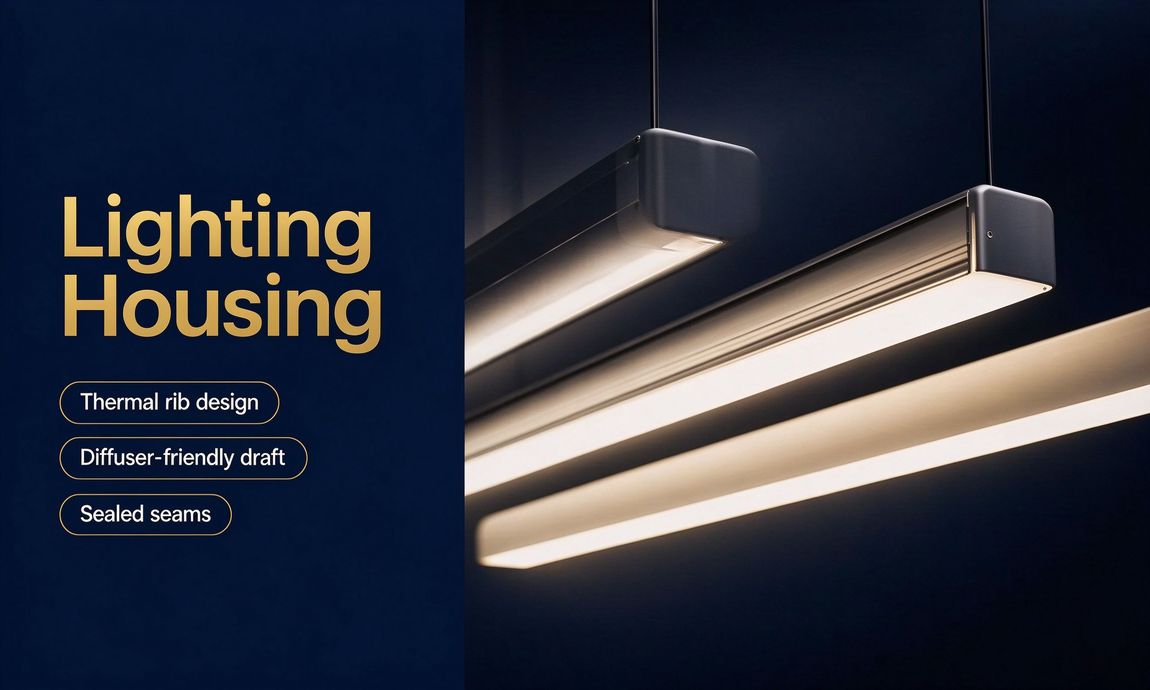
A lighting project at Bailu starts with a thermal sketch, an optical surface note and a seal-path diagram — three pages that prevent most of the expensive surprises later. The lighting fixtures project page shows the housing range the team has taken from design review through sampling. Bailu Tech treats the diffuser as an optical component rather than a free add-on, and Huzhou Bailu Technology keeps the mold parameters, witness samples and material batches tied together across the program. Ask a supplier whether they will review your seal groove and your diffuser draft before tooling — their answer tells you whether they have built lamp housings before.
Let us brighten your life with safety, efficiency,and expert craftsmanship.
Contact Us
Phone : +86-159 0682 2387
WhatsApp/Wechat: +86-159 0682 2387
Email : info@bailusolution.com
Copyright © 2026 Huzhou Bailu Technology Co., Ltd. All Rights Reserved. Design by BONTOP.