


Time:Oct 30,2026
By:Bailu
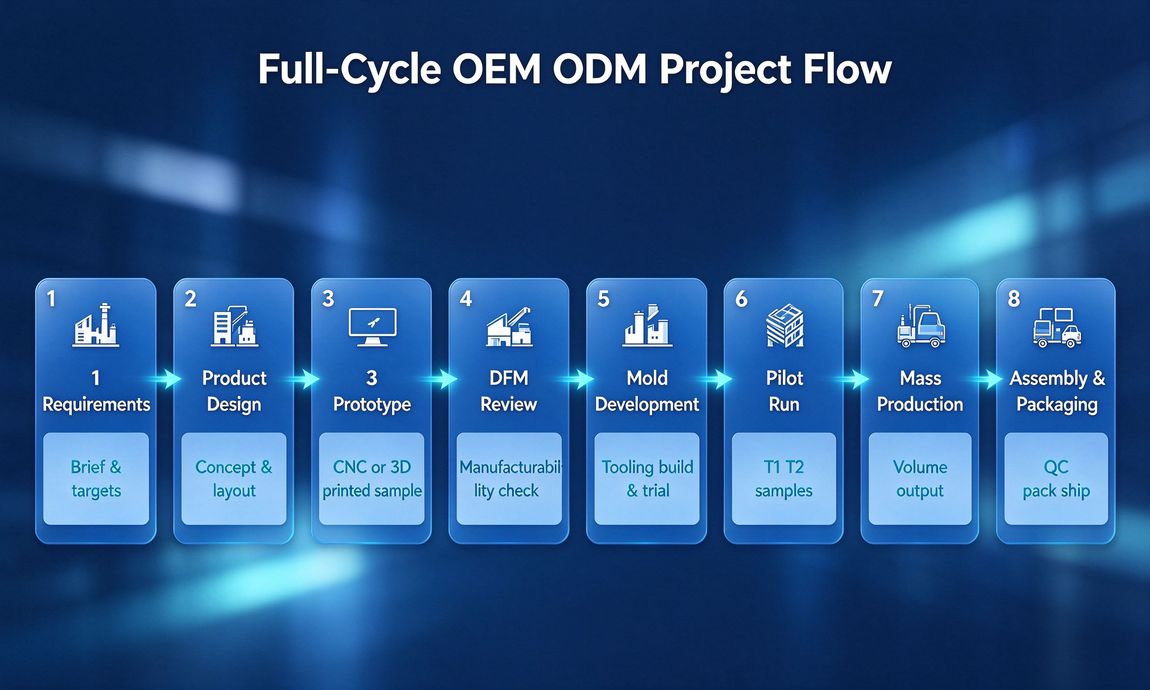
You have a product concept and a launch date on the calendar, but between your first sketch and the first pallet of finished goods sits a chain of steps that is easy to underestimate. Many buyers only discover the full sequence after they are already in production, when a missed gate costs weeks of delay. A full-cycle OEM ODM custom manufacturing project follows a fixed framework — requirements, design, prototyping, DFM, tooling, pilot run, mass production, assembly and packaging — and knowing each step before you start is the difference between a predictable project and a drifting one. Bailu Tech runs this end-to-end OEM ODM solution China importers use to move from a raw idea to volume output, and this article maps the eight stages you should expect and what happens inside each.

When a project starts, the first deliverable is not a drawing but a clear requirement sheet. Target volume, operating environment, material preferences, budget range and acceptance criteria all need to be written down, because every later decision hangs on these numbers. The design stage turns that sheet into 3D models, renders and layout studies. For most of the custom product development timeline China buyers work with, this phase takes one to three weeks depending on complexity — and it is also the cheapest moment to change your mind. Moving a boss on a 3D model costs nothing compared with moving steel in a mold, so the design phase is where the project should be interrogated hardest.
A physical prototype is where the design meets reality. CNC machining, 3D printing or a quick silicone mold can produce samples that confirm fit, appearance and basic function. This stage answers questions like whether two parts snap together cleanly, whether the wall thickness feels right in hand, and whether the color sample matches the reference. For a custom prototype to mass production service to work smoothly, the prototype stage is the point where your team signs off on the design — not later, when a steel mold is already being cut and every change carries a tooling bill. Buyers who treat the prototype as the last chance to edit the product, rather than as a box to tick, save themselves the most expensive revisions of the whole project.
Before tooling starts, the design goes through a design-for-manufacturing review. Engineers check wall thickness, draft angles, undercuts, gate positions and tolerance stack-ups, then feed the findings back into the CAD files. It sounds administrative, but DFM is where mold cost and cycle time are largely decided. A design that ignores draft may require expensive side actions; a wall that varies too much can produce sink marks that fail appearance checks. Running this review properly is part of the custom product design service Bailu delivers before production begins, and it is the step that keeps the tooling budget from leaking into rework instead of becoming product.
Once the DFM review is closed, mold development begins. The tool maker designs the cavity, orders steel, cuts the electrodes and assembles the mold, then runs trial shots. The first trial usually reveals small issues — flash at the parting line, short shots in thin ribs, or ejection problems — and the mold is adjusted across T2 and T3 rounds until parts are stable. Mold lead time typically forms the largest single block in an OEM project cost estimation China buyers should budget for, and it cannot be compressed by asking the factory to go faster without accepting risk elsewhere. A realistic tooling schedule, agreed before kickoff, protects both sides from surprise delays.
A pilot run is a short production batch made under mass-production conditions: the real mold, the real machine settings, the real operators. Its purpose is to catch problems that prototypes never show, such as cycle time instability, material shrinkage variation, or assembly issues that only appear when hundreds of parts are made together. Skipping the pilot and jumping straight to volume is one of the most expensive shortcuts in custom manufacturing. Samples approved at this stage, including signed reference parts, become the baseline for every later shipment, and they give the QC team concrete standards to inspect against.
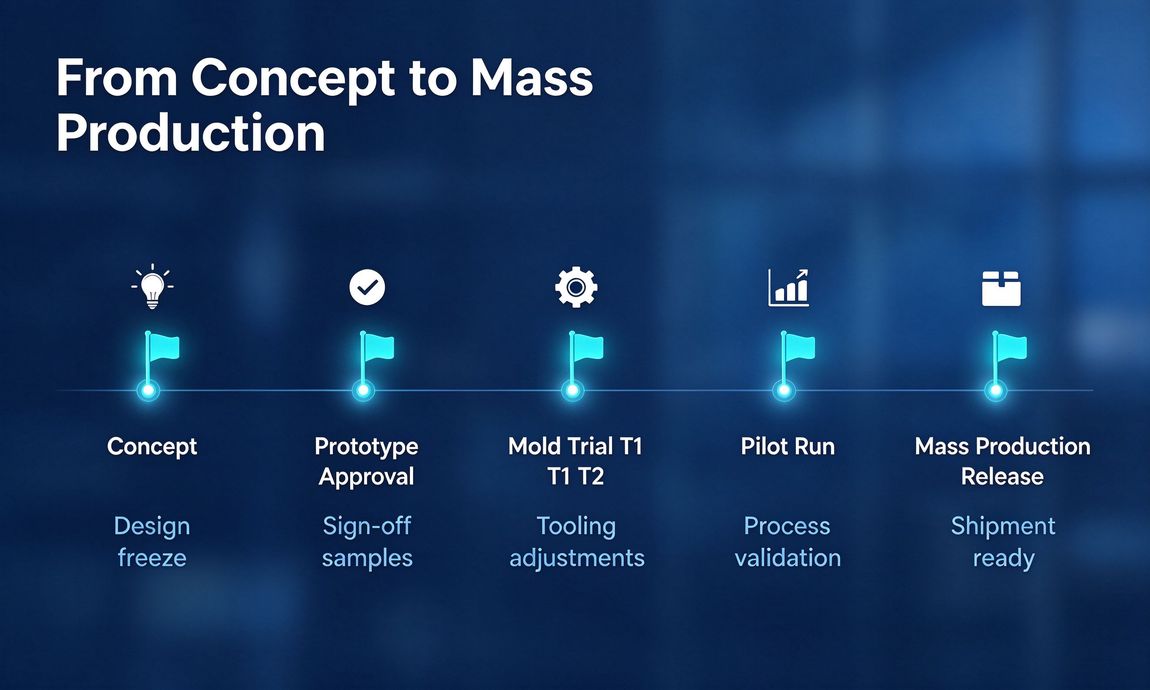
In mass production the focus shifts from making parts to making them consistently. Incoming material checks, first-article inspection, in-process patrols and final random inspection are the standard quality layers, and this is the discipline Bailu applies on every production order. If your product is an assembly rather than a single part, components are fitted, tested and packed here — the final stretch that decides whether the customer receives a working product or a box of problems. Packaging is planned in advance so parts survive sea freight, stacking and customs handling without rework on arrival, and the packing spec is agreed in the same document as the product spec, not bolted on afterwards.
The reason the eight steps belong in one framework is that they are tightly coupled. A change in the design stage propagates into the prototype, the mold and the pilot; a decision made late in one stage costs time in the next. Working with a single supplier who owns design, prototyping, mold development and production keeps the handoffs internal, so the team that built your prototype is the same team reviewing your DFM and running your pilot. When you compare partners for an end-to-end OEM ODM solution China, ask each factory to walk you through these stages in writing before you commit — the ones that can name the gate and the owner for every step are the ones that will deliver on a date instead of after it. If you want the deeper breakdown of any single gate, the buyer guides in our news section walk through them one by one.
Let us brighten your life with safety, efficiency,and expert craftsmanship.
Contact Us
Phone : +86-159 0682 2387
WhatsApp/Wechat: +86-159 0682 2387
Email : info@bailusolution.com
Copyright © 2026 Huzhou Bailu Technology Co., Ltd. All Rights Reserved. Design by BONTOP.