


Time:Oct 30,2026
By:Bailu
A molded part leaves the machine looking like plastic — uniform, matte, slightly textured. Whether it ends up looking premium or ordinary depends on the surface finishing options chosen after the mold is built. For buyers who source from an injection molding manufacturer China supplier, the finish decision matters twice: it sets the product's perceived quality, and it changes the mold, the process and the unit cost. This article walks through the main finishing routes and how to pick between them, the way Bailu's engineers work through the same choice at the DFM stage.

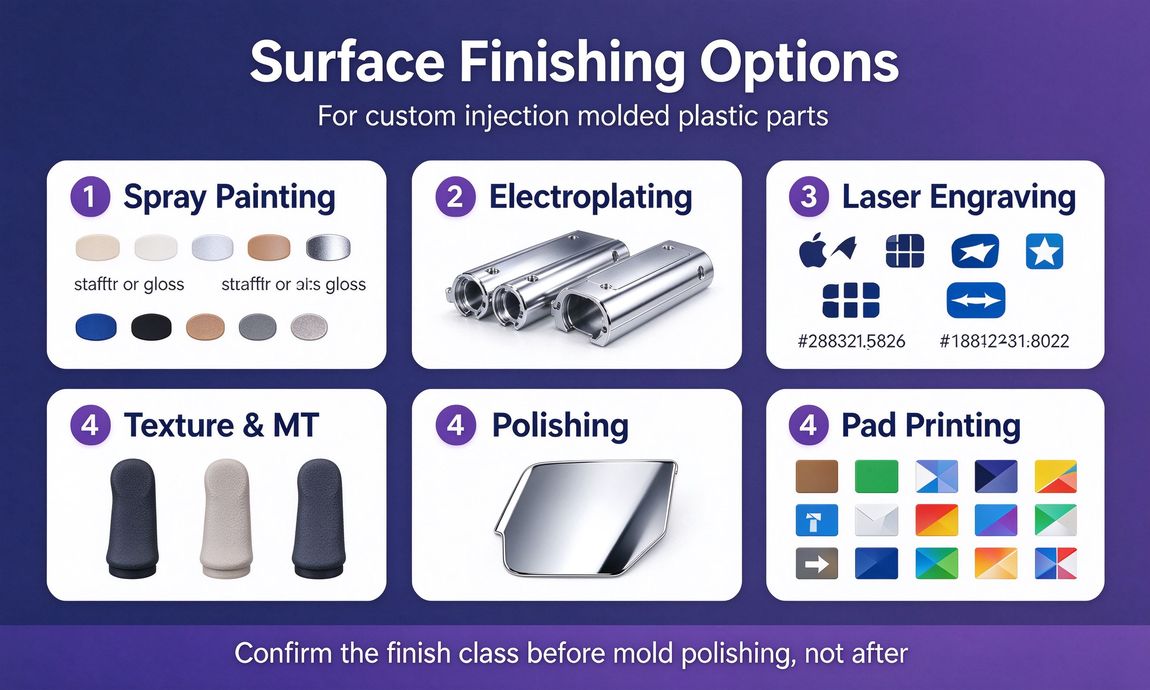
Surface finish is not a decoration added at the end; it is decided in the mold. A textured cavity produces a textured part, a polished cavity produces a glossy part, and the SPI finish class written into the mold spec determines what comes out from the first shot. Bailu quotes the finish class explicitly on every tooling project, because choosing it early avoids re-polishing steel later. The finish belongs in the DFM conversation, not in the packaging conversation.
The most common finishes come straight from the cavity: a polished steel surface gives a gloss or mirror look depending on the polish grade, while a textured cavity gives matte, leather or stipple patterns that hide fingerprints and scratches. Texturing is durable because it is part of the tool, and it is the cheapest way to change perceived quality at volume. The SPI class — A, B, C or D — is the language both sides should use when agreeing what "smooth" means, and it belongs in writing in the tooling contract.
Paint adds color, protection and feel. Matte paint hides sink marks and weld lines; gloss paint makes a statement and demands a cleaner part underneath; soft-touch coatings add grip and a premium surface. Painting happens after molding and adds a process step, so it affects both cost and lead time — but it is the fastest route to a custom color without changing the resin. If your part is painted, the finish standard and the masking plan need to be defined before the first production run.
Electroplating gives plastic a metallic chrome or brushed-metal look, common in automotive interior parts, appliances and cosmetics packaging. It changes the part's feel and light behavior dramatically, but it also changes design constraints: sharp edges and deep recesses plate unevenly, so the geometry must be plating-friendly from the start. The process is specialized, and the result is measured against the plated sample rather than the raw molded part. Plating also interacts with the material — check compatibility between the resin and the plating chemistry early.
Logos, serial numbers and multi-color graphics go on with laser engraving or pad printing. Laser engraving is durable because it changes the surface under the laser, which makes it ideal for part numbers and brand marks that must survive handling. Pad printing transfers multi-color images onto curved surfaces and is standard for button legends and decorative graphics. These are finishing steps with their own tolerances, and the artwork needs a defined file format and a color standard before the first run — a blurry logo on a sample is usually a file problem, not a printing problem.

Finishes drift faster than dimensions, because they depend on operator skill, batch consistency and the condition of the secondary equipment. The same gloss level can change across shifts, and a texture can wear in the cavity over time until the part starts to look different. That is why finish needs its own inspection gate: the signed sample, the limit sample and a visual check on every batch, with photos in the inspection record.
For painted or plated parts, the process parameters — film thickness, oven profile, plating bath condition — should be logged so a later drift can be traced. The discipline matters most for parts where the finish is the product: a housing that must look premium, a knob that must match a color standard. When the finish standard is written into the control plan, drift becomes a detectable deviation instead of a slow surprise. Buyers who check the finish on the first article and again on random later batches tend to find problems at the factory rather than at the customer — and the inspection plan is where the finish decision made at the mold stage finally pays off.
Match the finish to the part's job. A housing that lives on a shelf wants a cosmetic finish and a defined SPI class; a functional interior part wants a durable, repairable finish; a part that must hide defects wants matte or texture. Write the finish into the mold spec, confirm it on the first-article sample, and check it on later shipments — finish is the first thing customers see and the first thing to drift in production. Ask the factory that will mold your parts how the finish interacts with the process; a full-service injection molding manufacturer China partner will connect the SPI class, the material and the secondary operation in one quotation. The injection molding page covers how the finish is tied to the process, and mold development explains the SPI classes written into the tooling contract. If you are not sure which finish fits your product, describe the use to Bailu Tech and the recommendation will come with cost and lead-time impact attached.
Let us brighten your life with safety, efficiency,and expert craftsmanship.
Contact Us
Phone : +86-159 0682 2387
WhatsApp/Wechat: +86-159 0682 2387
Email : info@bailusolution.com
Copyright © 2026 Huzhou Bailu Technology Co., Ltd. All Rights Reserved. Design by BONTOP.