


Time:Oct 30,2026
By:Bailu
The drawing shows a metal component, and two processes can make it: sheet metal fabrication bends and cuts flat stock into shape, while die casting pours molten alloy into a mold. Both produce parts, but they produce different kinds of parts. Sheet metal fabrication China buyers usually find that the geometry decides the process long before the price does. This article compares the two routes so the choice is based on the component rather than on habit.

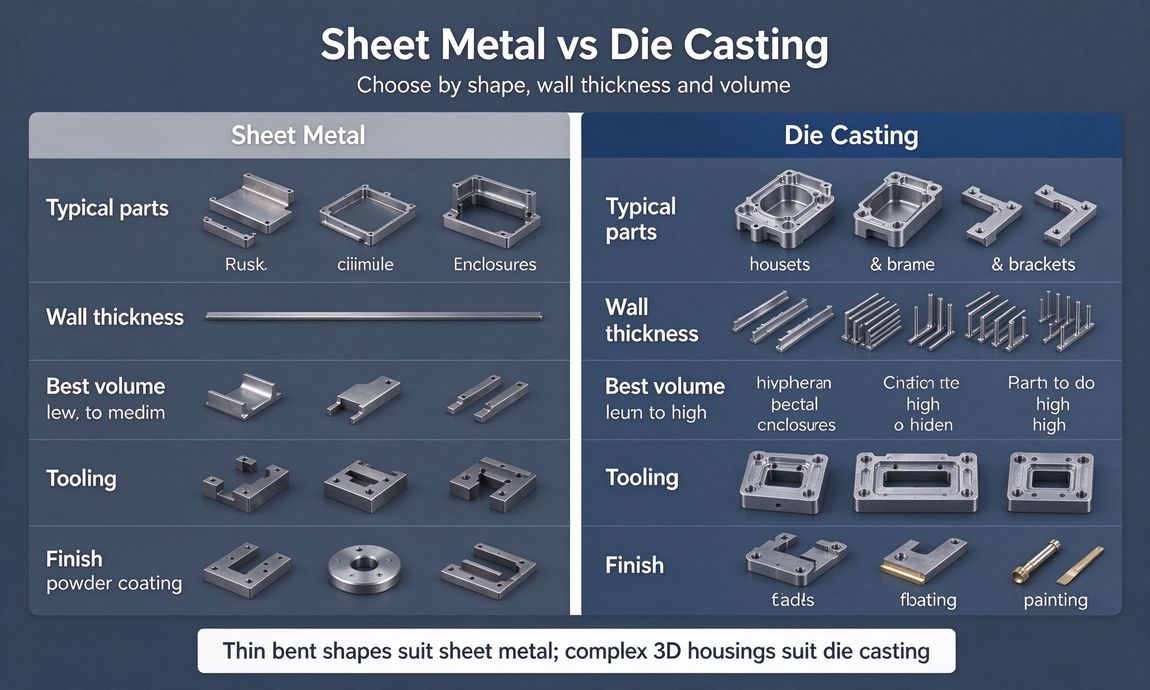
Sheet metal starts with flat material and shapes it by cutting, bending, stamping and forming. It suits brackets, enclosures, frames, mounting plates and chassis — parts defined by thin walls, bends and cutouts. Tooling is comparatively light, lead time is short, and the material is strong relative to its weight because you are bending solid stock rather than casting it from scratch. If your part looks like a folded shape, sheet metal is the natural starting point, and the entry cost is low enough that prototypes and early volumes are practical without a heavy tooling investment.
Die casting injects molten aluminum or zinc alloy into a steel mold under pressure. It produces complex three-dimensional shapes in one piece — housings, structural brackets, parts with ribs, bosses and fine detail that would take many sheet metal pieces to assemble. Die casting shines when the geometry is thick and sculptural, when the volume is high enough to spread the die cost, and when the part needs a surface that can be plated or painted to a cosmetic standard. If the design asks for detail in three dimensions, casting earns the higher tooling entry cost.
The quickest way to choose is to ask what the part looks like in section. Thin, uniform and folded — sheet metal. Thick, variable, ribbed and three-dimensional — die casting. A housing with walls of one to three millimeters and a sculpted exterior is a die casting; a chassis with right-angle bends and mounting holes is sheet metal. Parts that mix both characters can be designed as an assembly, and a good supplier — a full-service sheet metal fabrication China partner like Bailu — will say so instead of forcing one process on the whole component.
Sheet metal tooling is light and flexible: a set of press brakes and dies gets you started at low volume, and progressive tooling becomes economical as quantity grows. Die casting needs a proper die up front, which is expensive, but the per-part cost at volume is low and the cycle is fast. For medium volumes with simple folded parts, sheet metal usually wins on entry cost; for high volumes with complex geometry, die casting usually wins on the unit price curve. The crossover deserves real numbers from a supplier who does both; Bailu quotes metal projects across both lines, so the numbers come from process data rather than a sales sheet.
The two processes finish differently. Sheet metal parts are typically powder coated or plated, and the finish covers edges and welds; die castings take plating, paint and anodizing to a higher cosmetic standard straight from the die. Assembly matters too — die castings can integrate bosses and threaded inserts into the casting, while sheet metal parts rely on hardware like PEM studs and nuts. Think about what the part has to hold and how it will be finished: the process should match the fastening and finishing plan, not the other way around. For sheet metal, the finish is also the corrosion protection, so the coating spec is part of the material decision rather than a decoration chosen at the end.
The two processes also differ in how tolerances behave. Sheet metal holds thickness and bend angles well but accumulates tolerance across the bend sequence; die casting holds complex features in one cavity but depends on shrinkage control and die condition. The acceptance criteria should be written for the process: which dimensions are measured, how often, and against what limits. For sheet metal, the critical checks are hole positions and bend angles, because those decide assembly fit; for die casting, the checks are wall thickness, draft and the feature details that the die reproduces.
Quality control differs too — sheet metal runs through laser, stamping and finishing, so inspection follows the sequence; die casting inspects at the die and again after trimming. Both processes need first-article reports and sampling, but the measurement focus is different. A buyer comparing the two should ask each supplier what they inspect and why, because the answer reveals how well they know their own process. When the control plan is written for the specific process, the quality comparison becomes fair — and the choice between sheet metal and die casting can be made on geometry and cost rather than on quality assumptions.
Run the geometry test, put real quantities on the tooling comparison, and ask how the part will be finished and assembled. Most components answer clearly once those three questions are answered. For metal components that mix features, a hybrid approach — die-cast body with a sheet metal bracket — is common and often the better total cost. The sheet metal fabrication page and the die casting processing page show the two lines Bailu runs side by side, so the recommendation on your part can come from a single factory with the tooling math for both processes rather than from a vendor who sells one of them.
Let us brighten your life with safety, efficiency,and expert craftsmanship.
Contact Us
Phone : +86-159 0682 2387
WhatsApp/Wechat: +86-159 0682 2387
Email : info@bailusolution.com
Copyright © 2026 Huzhou Bailu Technology Co., Ltd. All Rights Reserved. Design by BONTOP.