


Time:Oct 30,2026
By:Bailu
You need a plastic part, and the first question arrives before any quote: should it be injection molded or 3D printed? The right answer is not a preference — it is a calculation of quantity, geometry, material and budget. Injection molding manufacturer China suppliers run both technologies in many cases, and the honest advice is usually the same: the two processes solve different problems. This article compares them across the factors that actually decide which one fits your part.

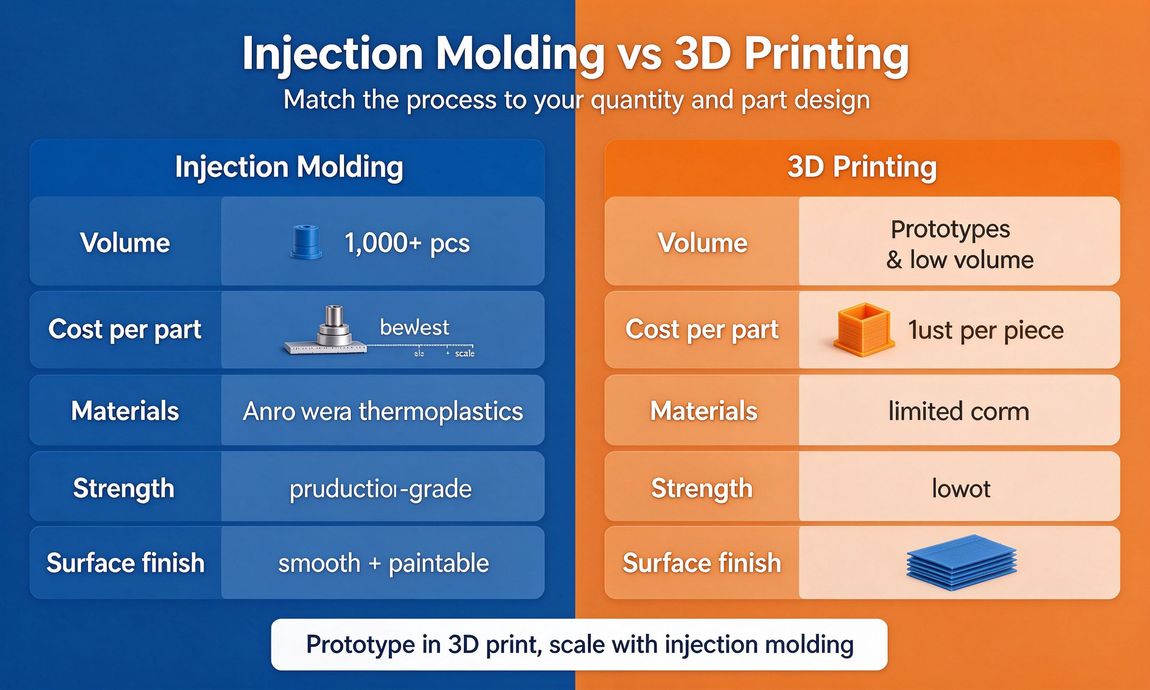
Injection molding is a production process. Once the mold exists, parts come out in seconds with consistent dimensions, production-grade material properties and a smooth surface that can be painted, plated or textured. The economics favor it when the quantity is high enough to spread the tooling cost — for most custom parts the crossover sits in the low thousands. Above that point, per-part cost drops fast and stays flat, which is why the process dominates consumer, automotive and appliance production. A buyer working with a serious injection molding manufacturer China supplier should be able to name the tonnage, material and target cycle time for their part in one sentence.
3D printing earns its place before production exists. A printed part arrives in days without tooling, which makes it ideal for design validation, fit checks and small functional tests. It also handles geometries that molds struggle with — internal lattices, one-off brackets, features that would force expensive side actions in a tool. The limits are equally clear: per-part cost stays high, printed material properties are not identical to molded grades, and layer lines can compromise both appearance and strength. Printing is a tool for decisions, not a route to volume.
The crossover point depends on your part. A simple flat part with a low-cost mold crosses over at a few thousand pieces; a complex part with a heavy mold may need tens of thousands to justify the tooling. The useful habit is to ask for two numbers: mold cost plus per-piece cost at your quantity, and the printed per-piece cost. Where the two lines cross is your crossover. Asking for the same quote in both processes is also a fair test of a supplier's honesty, because the answer is not necessarily the process they prefer to sell. The same discipline applies to lead time — ask for the tooling build period and the printing turnaround separately, because the two respond to very different constraints.
Some parts simply do not fit one process. Thin uniform walls, snap fits and high-volume features belong to molding; lattice structures, enclosed cavities and very low volumes belong to printing. Material matters just as much: if your part must survive heat, impact or repeated stress, a molded engineering grade is usually the safer specification, and the printed equivalent may not carry the same datasheet. State your operating environment and mechanical requirements in the RFQ, and let the process be chosen by the requirements rather than by habit.
The most common path is to use both: print prototypes to validate the design, then move to molding once the design is frozen. The sequence de-risks the tooling spend, because the design that reaches the mold has already survived physical testing. For buyers comparing suppliers, the practical question is whether the factory can do both and manage the transition. Bailu runs prototyping and mold development in the same house, which keeps the sequence tight — printing your samples where your mold will be built removes a handoff and preserves the design intent.
One comparison detail that gets skipped is what happens after the part comes out of the machine. Molded parts can be painted, plated, textured or printed; printed parts face the same options but with a different base surface, and layer lines change how the finish behaves. For a glossy cosmetic part, the molded surface takes paint or plating more predictably than a printed one, which matters when the finish is part of the product identity. For a functional part, secondary operations like inserts, heat-staking or sonic welding attach hardware either way.
The practical question is to add the secondary operations to the comparison: quote the finished part, not the bare part, because a cheap bare part with an expensive finishing path can cost more than a slightly dearer one that finishes cleanly. The same logic applies to lead time — finishing adds days, and printing plus finishing can approach molding plus finishing for small volumes. When the comparison includes the finished state, the crossover moves, and the choice becomes more honest.
If the quantity is a handful and the geometry is complex, print it and move on. If the part is headed to production and the quantity is in the thousands, mold it and let the unit cost fall. For everything between, run the crossover calculation with real numbers from a factory that does both. The injection molding page and the tooling side of mold development show the range Bailu covers — and if you send the part file to Bailu Tech, the recommendation comes with the cost math attached, not a preference for whichever process is easier to sell.
Let us brighten your life with safety, efficiency,and expert craftsmanship.
Contact Us
Phone : +86-159 0682 2387
WhatsApp/Wechat: +86-159 0682 2387
Email : info@bailusolution.com
Copyright © 2026 Huzhou Bailu Technology Co., Ltd. All Rights Reserved. Design by BONTOP.