


Time:Nov 02,2026
By:Bailu
The tool is already cutting steel when your client asks for a slightly deeper recess and a revised logo position — and now the delivery date, the unit price and the mold all need a second conversation. Engineering change requests, or ECRs, are a normal part of custom OEM manufacturing, but they become expensive the moment production has started. Overseas buyers who treat every change as a quick message usually end up paying twice: once for the rework, and again for the schedule slip. This article explains how to run changes through a controlled process so the product improves without the project unraveling.

A change before tooling is cheap: you edit the CAD file and move on. A change after the mold, the jig or the material lot is locked is a project in itself. The geometry is already cut into steel, the process parameters are tuned, and the operators have a documented routine. Altering one feature means re-cutting the tool, re-validating the process and often scrapping parts already made. Buyers underestimate this because the drawing edit looks the same on screen. The difference is that in production the design is no longer a file — it is embodied in hardware, recipes and worker habits. Recognizing that gap is the first step toward managing changes instead of reacting to them.
Every engineering change request should be evaluated on three axes before anyone approves it. Cost: what rework, scrap and re-tooling does this add, and who absorbs it? Lead time: how many days slip, and does that collide with a retail date or a shipping window? And the mold itself: which changes are a simple edit and which demand new tooling, new gates or a new cavity? A recess depth change may be a small CNC touch-up, while a new undercut or a relocated gate can mean opening the mold again. The supplier that can separate those three answers clearly is worth more than the one that quotes a single change fee and hopes. An end-to-end OEM ODM solution China buyers use internally runs those three checks on a shared form, so nothing is decided over a chat message.
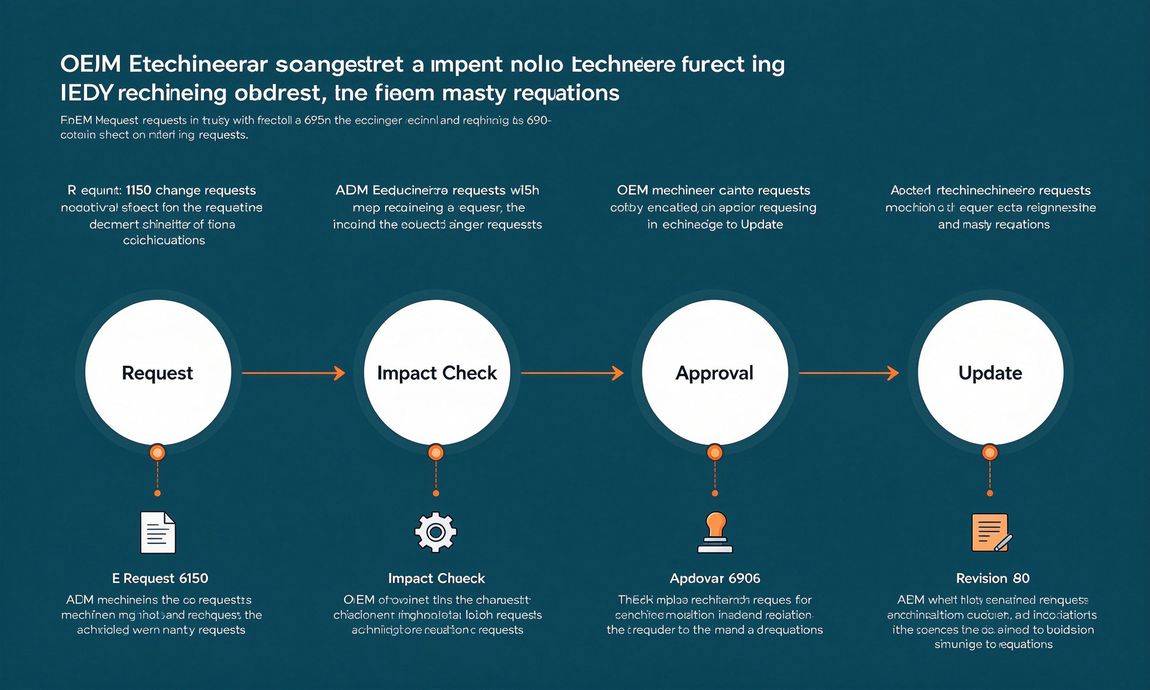
A repeatable ECR workflow has four stations. First, the request: the buyer writes what changes, why and which drawings or samples are affected. Second, the impact check: the supplier returns cost, lead time and tooling effect in writing. Third, the approval: both sides agree on the revised price, date and any re-sample requirement. Fourth, the document update: the drawing, the inspection standard and the packaging spec are all revised together before the floor resumes. Skipping the fourth station is where trouble hides — a part that changed on the floor but not on the inspection sheet will fail incoming QC at the buyer's warehouse weeks later. The service process Bailu follows keeps those four stations visible, so a change does not move into production on an oral agreement, even when the buyer is in a hurry and the clock is running.
The cheapest change is the one you prevent. Most ECRs late in production trace back to a weak early review: appearance decisions made without a CMF sample, tolerances guessed instead of measured, or a client whose requirements were not frozen before the tooling stage. A buyer who locks the design, the material and the finish before tooling starts, and who seals a reference sample at the pilot stage, faces far fewer surprises. It also helps to agree in advance on a change-numbering system and a response window — how long the supplier has to return an impact estimate, and how long the buyer has to approve. That rhythm prevents the slow, ambiguous back-and-forth that drags on for days across time zones.
Not every change deserves a slot in the schedule. A buyer should weigh the change against the launch date and the margin it protects. A cosmetic tweak that adds two weeks and re-opens a mold may not be worth it when the product is otherwise ready. This is a commercial judgment, not a technical one, and the supplier can support it with numbers rather than opinions. Having a clear standard — which changes are accepted in the pilot, which after tooling, and which are deferred to the next revision — turns the ECR process from a negotiation into a rulebook. Buyers who want that kind of transparency can read the latest project notes on the news page to see how similar change decisions played out.
Bailu treats engineering change requests as a normal workflow, not an emergency. Each request gets a written impact review, a re-sample where the geometry moved, and a redrawn inspection sheet before the next batch runs. That discipline keeps cost and lead time predictable across revisions, and it means the buyer is not surprised by a part that changed on the line but not on paper. A controlled change process does not make a product right on the first shot — it makes the second, third and tenth batch behave the way the approved sample did. For overseas buyers, that predictability is what turns a tense production run into a repeatable reorder.
Let us brighten your life with safety, efficiency,and expert craftsmanship.
Contact Us
Phone : +86-159 0682 2387
WhatsApp/Wechat: +86-159 0682 2387
Email : info@bailusolution.com
Copyright © 2026 Huzhou Bailu Technology Co., Ltd. All Rights Reserved. Design by BONTOP.