


Time:Nov 02,2026
By:Bailu
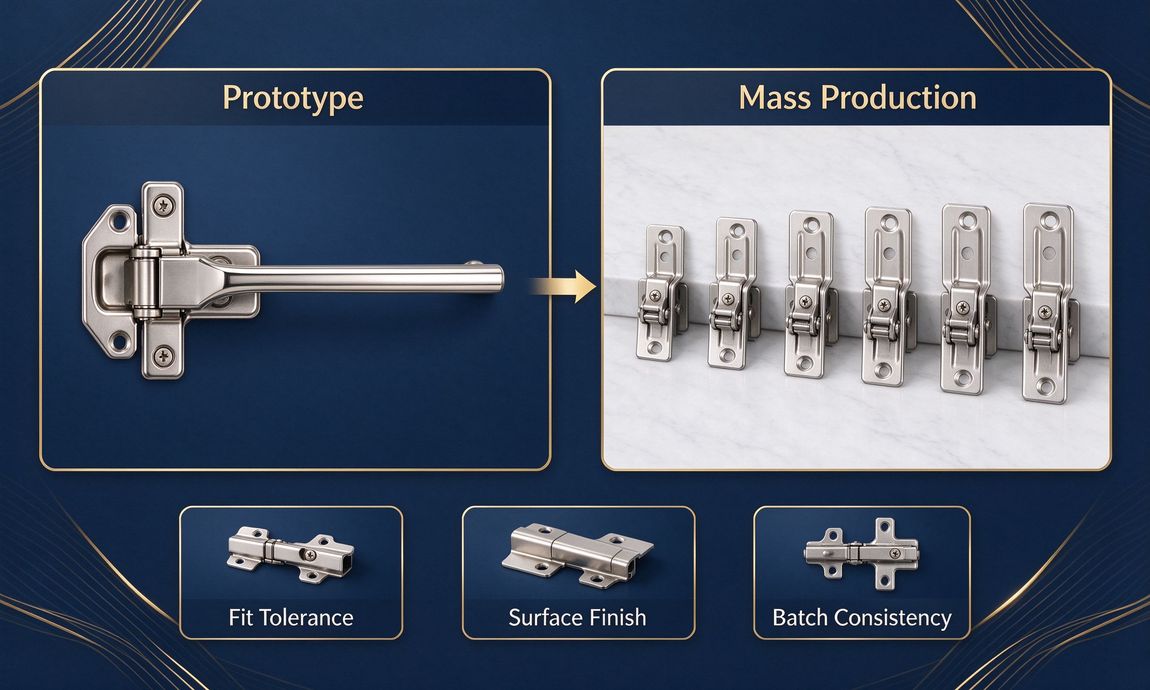
Your drawer hinges pass the hand sample, then bind when installed on the fifth batch of cabinets — a familiar headache when you source custom furniture hardware accessories overseas. Furniture hardware looks like simple brackets, handles and hinges, but it carries the load, the opening motion and the wear of daily use for years. When a buyer moves from a single prototype to mass production, the issues that show up are rarely about the drawing itself; they are about fit, surface finish and batch consistency. This article walks through the recurring problems and the controls that resolve them before the order reaches your factory floor.

A hinge or a bracket mates with parts the buyer has already made — a wood panel, a plastic socket, a welded frame. The drawing may call out a single dimension, but the real requirement is the gap between assembled parts. A pin that runs free in a CNC sample can feel tight once it is plated, and a bracket that bolts flush on a flat table can sit proud against a slightly warped cabinet side. Furniture hardware is a fit problem more than a form problem. The useful habit is to define the assembly interface — the hole pattern, the pin diameter, the mating wall thickness — as the controlled feature, and leave purely cosmetic dimensions looser. Huzhou Bailu Technology reviews those interfaces at the DFM stage so the tolerance stack is visible before any metal is cut.
A polished handle looks identical in the showroom and on the production line, but the finish that survives a desk test may not survive five years of finger contact, sunlight and cleaning spray. Furniture hardware lives in living rooms and kitchens, so scratch resistance, corrosion resistance and color stability matter more than the initial shine. The issue is that a one-off sample can be hand-finished to a level no plating line repeats at volume. Electroplating, powder coating, anodizing and polishing each have a different consistency curve, and the buyer who chooses a finish for looks without asking about batch variation is the one who reorders in a panic after the first season. Ask the supplier to define the finish process and the abrasion or salt-spray limit the batch must meet.
The most expensive problem in custom furniture hardware is not a bad part — it is the part that is slightly different from the approved one. A screw hole that shifts half a millimeter, a plating shade that drifts, a hinge torque that loosens after the first hundred units: none of these fails a single inspection, but together they slow assembly and raise field complaints. Consistency comes from fixed tooling, a controlled material lot and a defined inspection point, not from a line on the purchase order. When a project runs through a production route such as sheet-metal fabrication, the tooling itself is what repeats the geometry cavity after cavity. Bailu treats the first trial batch as a consistency check rather than a mere sample approval, so drift is caught while it is cheap to correct.
Many furniture hardware problems are avoidable at the drawing stage. Standardizing hole patterns reduces setup changeover between runs. Designing radiused corners instead of sharp stamped edges cuts burr rework. Choosing a plating process matched to the use environment avoids the shock of a glossy finish that discolors within a year. Keeping the number of fasteners low simplifies both assembly and the bill of materials. The home furniture accessories custom OEM path works smoothly when the buyer sends not only the part drawing but the mating product — the cabinet, the door, the sofa frame — so the supplier checks the interface directly. Bailu reviews home furnishing projects against the real assembly rather than the isolated part, which is why buyers exploring the home furnishings category come back with fewer fit surprises on reorders.
Before committing a full order, ask four things. Which process makes each part — stamping, CNC, casting — and what tolerance does that process naturally hold? Which surface treatment is specified for the intended indoor or outdoor use, and is there a written test limit? How is the first batch sampled and inspected, and who keeps the sealed reference sample? And what is the reaction plan if a whole lot drifts from the approved part? These questions move the conversation from price to control. A supplier that runs forming and plating under one roof, as Bailu does, can answer with process data rather than reassurance. For the underlying forming route, the sheet metal fabrication page shows the stamping, welding and finishing steps behind the brackets buyers usually see first.
A furniture hardware failure rarely destroys a product — it erodes the buyer's margin and reputation. A binding hinge means a cabinet returned from a retail partner. A discolored handle means a rework campaign before launch. A loose bracket means a warranty claim that eats the profit on the whole order. The issues that appear after mass production are usually traceable to a missing interface check, an over-promised finish, or a tooling decision made to save a small upfront amount. Spotting those early is the difference between a smooth reorder and a fire drill. Bailu sequences prototype, pilot and production so each stage retires one of those risks, and the part you approve is the one that repeats cleanly across the batch.
Let us brighten your life with safety, efficiency,and expert craftsmanship.
Contact Us
Phone : +86-159 0682 2387
WhatsApp/Wechat: +86-159 0682 2387
Email : info@bailusolution.com
Copyright © 2026 Huzhou Bailu Technology Co., Ltd. All Rights Reserved. Design by BONTOP.