


Time:Oct 30,2026
By:Bailu
Your product looks convincing in the render and starts falling apart at the first prototype — and the reason is usually that industrial design and mechanical design were treated as one job instead of two. For a custom OEM product, both disciplines exist for different reasons: one decides how the product feels and looks, the other decides whether it can be built, assembled and shipped at the cost you planned. This article draws the line between them so you know which questions belong to which discipline, and why the order matters.

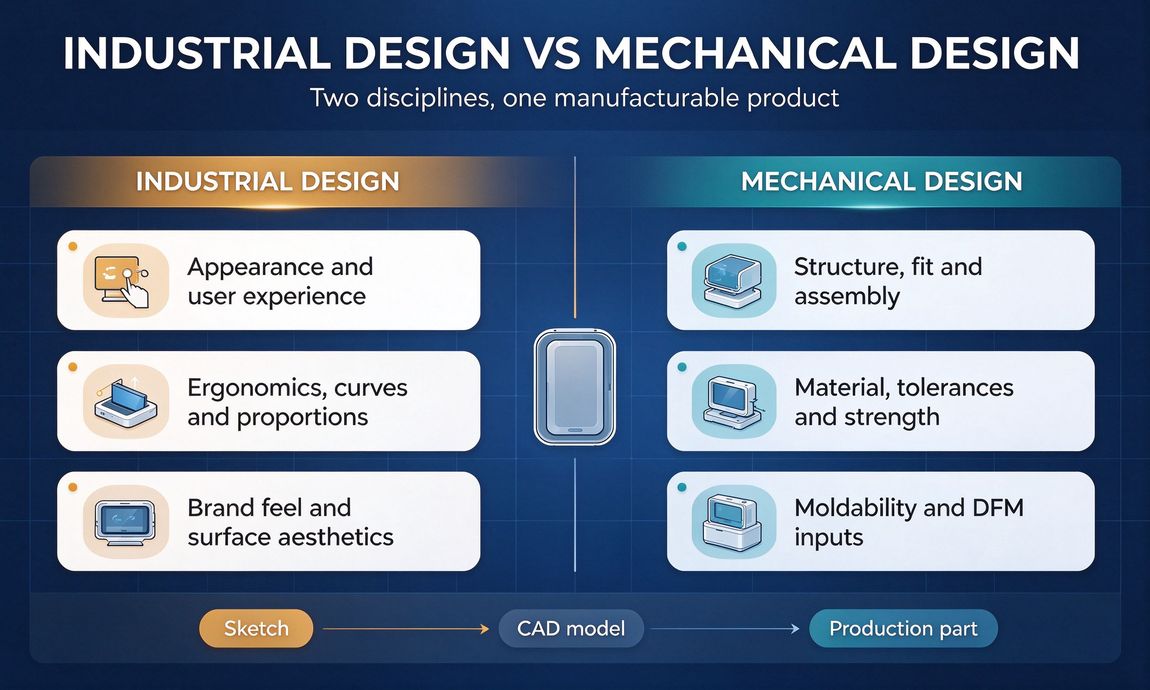
Industrial design starts with the person who will use the product. It defines the overall shape, the proportions that make the object feel right in the hand, the placement of buttons and displays, and the color, material and finish that carry the brand. A good industrial design brief answers questions like how the product should feel when held, where the user's fingers land, how the surface should read at arm's length, and what emotional impression the object gives. These decisions are visual and tactile, and they are the reason buyers often say a product feels premium or cheap before they ever check a specification.
Mechanical design starts with the physics of the product. It defines the internal structure, wall thickness, ribs, bosses, snap fits, screw posts, seals and the sequence in which parts go together. It selects materials with the right strength, temperature resistance and cost, sets tolerances that the factory can actually hold, and makes sure the assembly can be repeated thousands of times without drift. Mechanical design is also where manufacturability enters: every feature has to be moldable, removable from the tool, and consistent across cavity after cavity. If industrial design asks how it should look, mechanical design asks how it will stand up and come apart.
Most custom product problems appear in the space between them. A slim, elegant housing wall may be too thin for the mold to fill reliably. A seamless one-piece look may force a parting line across a visible surface. A comfortable rounded grip may hide an undercut that complicates the tool. None of these conflicts means either discipline is wrong — it means the two sets of requirements were not compared before the design was frozen. The collisions are normal; the expensive version is discovering them after tooling has started.
The classic failure looks like this: a studio delivers beautiful renders and a single hero prototype, the buyer approves the look, and then the engineering team discovers that the geometry cannot be molded, the PCB does not fit, or the battery cavity leaves no room for the screw posts. The breakdown usually happens because the two teams worked in sequence instead of together. Renders communicate appearance but carry no wall-thickness information; a hero prototype proves the concept but not the production process. When the handoff contains only visuals, the mechanical work starts from a shape that was not tested against manufacturing reality.
The bridge between the two disciplines is a design-for-manufacturing review, and it should happen while the design can still change cheaply. A DFM review checks the geometry against the intended process: wall thickness uniformity, draft angles, parting line placement, gate and ejector locations, tolerance achievability and the cost impact of each feature. For an overseas buyer, a DFM review service China suppliers offer early in the project is the point where the pretty shape meets the practical mold — and where a few days of analysis can save weeks of mold modification later. The review output is a marked-up list of changes, each one traceable to a cost or risk reason.
To keep the two disciplines working from the same facts, a buyer should send more than a picture. The useful package is: the CAD model, a render or CMF sample for appearance, the functional requirements including operating environment and expected loads, the target annual quantity, and the acceptance criteria for the finished part. With that input, a supplier can translate the industrial intent into mechanical reality and flag conflicts early. If you are buying a custom product design service that covers both disciplines under one roof, the translation happens inside the project instead of across a contract boundary.
The order that survives contact with reality is: sketch and render to fix the concept, CAD to fix the geometry, mechanical and DFM review to fix the manufacturability, prototype to validate the combination, then tooling. Bailu runs product design and prototyping in the same flow, so the handoff between appearance and engineering does not lose information. When the industrial and mechanical work converge before the mold is cut, the prototype that gets approved is also the part that can be produced — which is the whole point of the exercise. A buyer who understands the difference between the two disciplines asks better questions, and better questions are what keep a custom project on schedule.
Before you commit to a supplier for design work, ask how the two disciplines communicate in their process. Who reviews the industrial design for manufacturability, and at which stage? What happens to the appearance when the wall thickness has to change? Can you see a DFM report before the design is locked? The product design page explains the design-to-production scope Bailu covers, and the prototyping service shows how a concept becomes a physical sample. Bailu Tech treats industrial and mechanical design as two stages of one project rather than two vendors, which is why the answers to those questions tend to be specific rather than vague.
Let us brighten your life with safety, efficiency,and expert craftsmanship.
Contact Us
Phone : +86-159 0682 2387
WhatsApp/Wechat: +86-159 0682 2387
Email : info@bailusolution.com
Copyright © 2026 Huzhou Bailu Technology Co., Ltd. All Rights Reserved. Design by BONTOP.