


Time:Oct 30,2026
By:Bailu
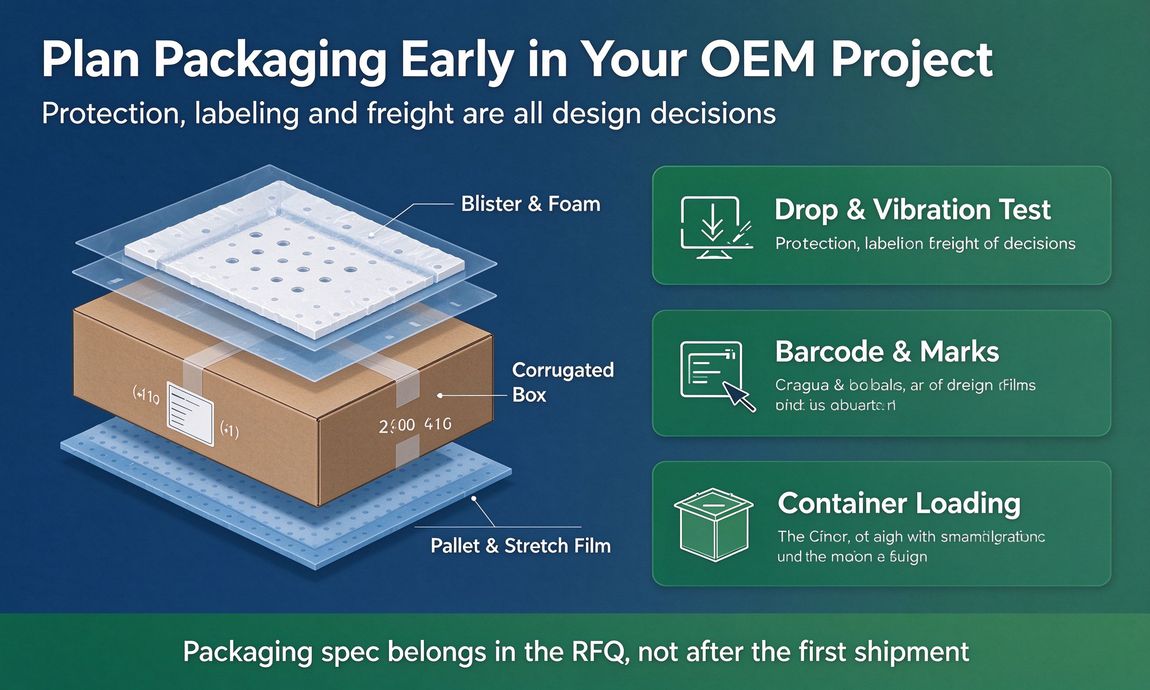
Packaging is usually the last thing on the project list and the first thing to fail in transit. A product designed for months can be undone by a box chosen in an afternoon, because protection, labeling and freight are all design decisions with their own requirements. Planning packaging at the RFQ stage, rather than after the first damaged shipment, is the cheapest insurance in an OEM project. This article covers what a custom packaging service for OEM product should include and when each decision needs to happen.

The packaging spec belongs in the quotation because it changes the cost: box size and material, inner protection, labeling, palletization and freight all have a price attached. If the packaging is not specified, the supplier will pack to its own default, and the default is rarely the one that survives your route. Sending the packaging requirements with the product RFQ means the quote covers the real delivery condition — and it gives the factory the chance to flag cost or transit risks before the contract is signed, which is the conversation Bailu opens on every new product enquiry.
The protection layer has to match two things: how fragile the product is and how rough the journey will be. A glossy cosmetic part needs cushioning against impact and surface contact; a heavy metal component needs load distribution and edge protection; electronics need static and moisture control. The design should be tested — a drop test or a vibration test on the packed sample — because the pack that looks right on paper fails in ways that only physical testing reveals.
Labels carry two audiences: the logistics chain and the end customer. Transit labels handle barcodes, country of origin, marks and handling instructions; product labels carry branding, specifications and compliance information. The labeling requirements belong in the packaging spec with the artwork and the placement defined, because a missing label on a customs declaration is a delay, and a wrong label in retail is a return. The earlier the artwork is finalized, the cheaper it is to correct.
Above the carton sits the pallet: how many cartons per layer, how many layers, how the load is stabilized with stretch film or corner boards, and how it fits the container. Palletization decides the freight cost per unit, and it is where small packaging decisions multiply into large logistics numbers. A carton that is one centimeter wider than optimal can cost a row per pallet and a pallet per container — the kind of loss that does not appear on the packaging invoice but shows up in the freight one. Container dimension planning is part of the same step, because the pallet pattern and the container grid are designed together.
Three documents make packaging manageable: the packaging specification covering materials, dimensions and protection; the labeling artwork and placement guide; and the loading plan covering pallet pattern and container utilization. When these exist before production, the factory packs to a standard, inspection can verify the packing against the spec, and a damaged shipment can be analyzed against the plan instead of against guesses. This document set is what turns packaging from a default into a controlled process — the format Bailu uses across its assembly and packing lines.
Packaging has a per-unit cost that belongs in the price comparison, and it is one of the easiest places to save money by accident and to lose it by accident. A lighter carton grade, a smaller box, a different pallet pattern — each choice moves the per-unit packaging cost and the freight cost, and the two move against each other: a smaller pack lowers freight but may need stronger protection, a cheaper carton may survive the warehouse but not the ocean leg. The useful discipline is to price the packaging as a line item: carton material and grade, inner protection, labeling, pallet and freight per unit. With the numbers visible, the trade-offs become decisions instead of surprises.
For ocean freight especially, the volume is the currency — a carton design that fits more units per pallet and per container reduces the freight share of every unit, often more than the carton itself costs. That is why packaging expertise pays: the same product can ship at different landed costs depending on the pack. The practical step is to ask the supplier for the packaging cost breakdown alongside the product price, and to compare landed cost rather than unit price alone. When packaging is priced and planned early, it stops being an afterthought and becomes part of the margin calculation.
The practical sequence is simple: define the packaging requirements in the RFQ, validate the pack with a sample test, freeze the specification before mass production, and audit the packing on the first shipments. A custom packaging service for OEM product that includes this sequence protects the margin that packaging is silently eating. Product assembly and the packaging line are often one continuous operation, and the product assembly page plus the logistics and shipping page show how Bailu treats packing as part of the production flow rather than an afterthought — send the product details and the destination market, and the packaging proposal will come back with the carton, pallet and freight plan attached.
Let us brighten your life with safety, efficiency,and expert craftsmanship.
Contact Us
Phone : +86-159 0682 2387
WhatsApp/Wechat: +86-159 0682 2387
Email : info@bailusolution.com
Copyright © 2026 Huzhou Bailu Technology Co., Ltd. All Rights Reserved. Design by BONTOP.