


Time:Oct 30,2026
By:Bailu
You have a part file and a deadline, and the prototype shop offers four different ways to make it — so which one actually answers the question you are asking? The mistake is choosing a technology before deciding what the prototype is for. A part that proves your concept, a part that confirms the fit, and a part that tests real strength are three different jobs, and each one is better served by a different method. This article matches the four common prototyping technologies to the stage of your custom product project.

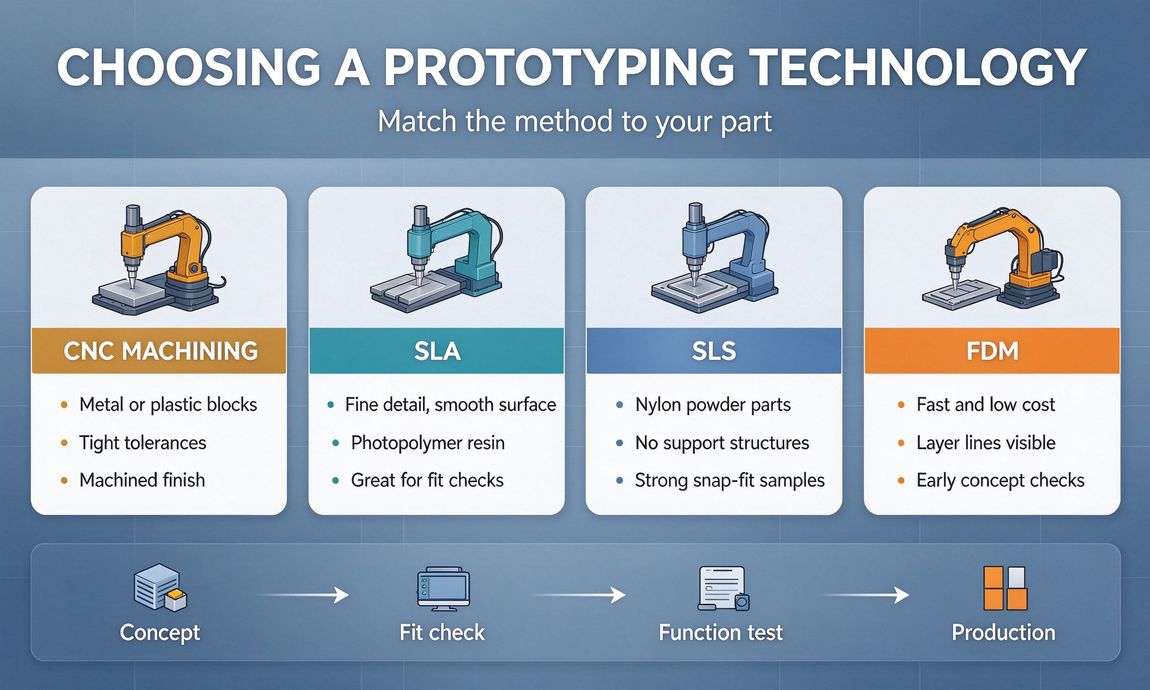
Every prototype is built to retire a specific risk. Early in the project you want to test the concept: does the shape work, does it feel right, does anything obviously conflict? A little later you want to check the fit: do the parts mate, does the PCB slide in, do the snap fits engage? Closer to production you want functional evidence: does the material survive the load, the heat, the repeated cycles? The four technologies below map onto these stages, and choosing by stage is what keeps prototyping cheap instead of impressive.
CNC machining cuts the part from a solid block of the actual production material — aluminum, steel, ABS, nylon or acetal, whatever the drawing specifies. That makes it the choice when material properties and dimensional accuracy matter more than geometry freedom: brackets, metal housings, threaded features, parts that will be vibration-tested or load-tested. The limits are equally real: internal cavities are hard to reach, sharp internal corners are nearly impossible, and cost climbs with complexity. Use CNC when the prototype must behave like the production part, not just look like it.
Stereolithography builds the part in a photopolymer resin cured layer by layer, and it delivers the finest detail and smoothest surface of the printing family. That makes SLA the natural choice for appearance models and precise fit checks — thin features, sharp edges, mating surfaces that need to be dimensionally honest. The trade-off is material: printed resin is more brittle than a molded engineering plastic, so an SLA part is not the right witness for impact or sustained load. Treat it as the part that proves the geometry and the look, and keep it out of the strength argument.
Selective laser sintering fuses nylon powder, which gives the printed part a level of toughness and flexibility that resin cannot match. SLS needs no support structures, so living hinges, snap-fit arms and enclosed features print cleanly — which is exactly why SLS is the default for functional prototypes that will be clicked, snapped and cycled by hand. The surface is slightly grainy compared with SLA, and fine cosmetic details are not its strength. When your prototype has to survive being treated like a real product for a few weeks, SLS is usually the answer.
Fused deposition modeling lays down molten filament and is the fastest and cheapest way to turn an idea into something you can hold. It is ideal when you expect to iterate: print, look, change, print again, five times in a week. The surface shows visible layer lines, accuracy is the loosest of the four, and strength depends heavily on print orientation, so FDM is a poor witness for final appearance or final load. It is a tool for killing bad ideas early — which, done right, is the most valuable thing a prototype can do.
Roughly, the hierarchy works like this: FDM is the cheapest and fastest per part, SLS and SLA sit above it, and CNC is the most expensive because it ties up a machine and a machinist. Lead time follows a similar slope, though geometry matters more than the label — a simple CNC block can beat a complex print to your desk. The useful habit is to ask for price and lead time against your specific file rather than a generic rate, and to quote the same part in two technologies when the choice is close. The factory's answer tells you which cost driver dominates your part.
A practical pattern for a custom product project: start with FDM or rough prints to explore the concept, move to SLA for the fit and appearance round, switch to SLS when snap fits and function enter the picture, and bring in CNC when the design uses production materials or needs real tolerance. Many projects touch three of the four before the design is frozen. The point is not to pick one technology and defend it — it is to spend a little money early on the right question instead of a lot of money later on the wrong assumption. A factory that runs all four methods, as Bailu does, can quote the same part two ways and show you where the cost and lead time actually land.
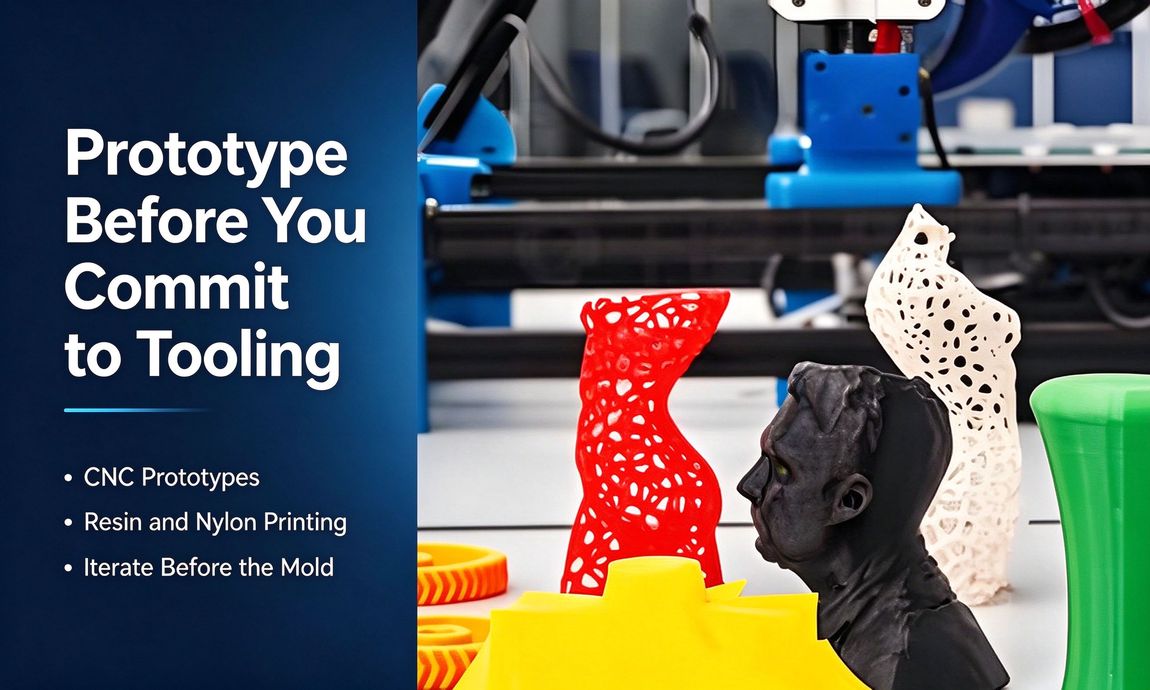
Prototyping earns its keep only when the results flow into the production decision. A printed part proves geometry and function, but it is not the molded part: production material, gate positions and cooling affect the outcome in ways a prototype cannot fully show. The transition matters, which is why a supplier that runs prototyping and molding together can carry the learning across. A product prototyping service China suppliers offer should include the handoff conversation — what the prototype proved, what it did not, and what the mold must replicate. Bailu keeps that sequence inside one project: the samples you approve are printed in the same facility that will quote the tool, so the jump from prototype to production is a step rather than a gamble. Start with the prototyping service to validate the design, and move to product design support when the geometry needs refinement before tooling. Bailu Tech will tell you which method answers your question honestly, even when the answer is not the cheapest one.
Let us brighten your life with safety, efficiency,and expert craftsmanship.
Contact Us
Phone : +86-159 0682 2387
WhatsApp/Wechat: +86-159 0682 2387
Email : info@bailusolution.com
Copyright © 2026 Huzhou Bailu Technology Co., Ltd. All Rights Reserved. Design by BONTOP.