


Time:Oct 30,2026
By:Bailu
A design can look flawless in the render and fail on the factory floor — thick sections sink, thin ribs short-fill, and parts without draft stick in the cavity. DFM, or design for manufacturing, exists to catch these problems while the product is still a file. For anyone buying custom OEM manufacturing in China, DFM is not a consulting extra; it is the step that decides whether your tooling budget becomes product or becomes rework.

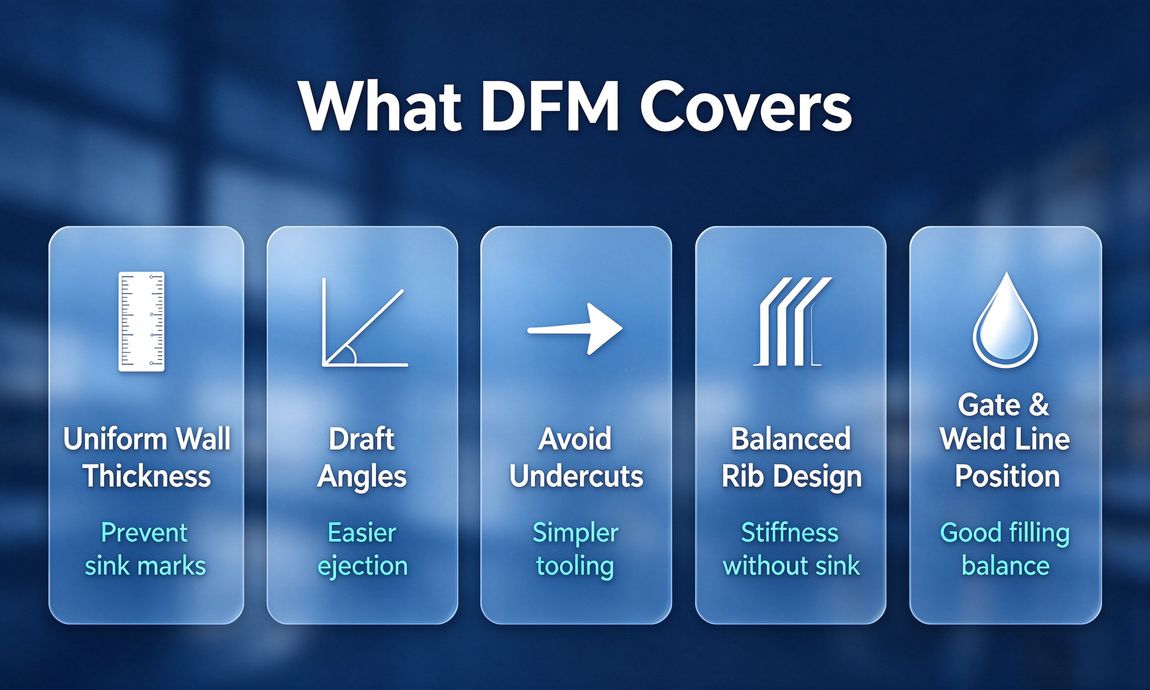
DFM reviews the design against the process that will produce it. For injection molding, the reviewer looks at wall thickness, draft angles, undercuts, ribs, bosses, gate location and tolerance feasibility. For sheet metal, the focus moves to bend radii, hole-to-edge distances and forming sequences; for die casting, wall uniformity and draft lead the list again. The output is a list of findings: what to change, why it matters, and what it saves. For a supplier that bundles DFM into its custom product design service, the review is the point where design work ends and production work begins, and Bailu produces this report in a fixed format so the findings survive every handoff. A good review separates must-fix items from nice-to-have suggestions, so the design team knows where to spend its limited effort.
Three rules cover most plastic part problems. Keep wall thickness as uniform as possible — thick sections cool slower, shrink more, and create visible sink marks on the opposite face. Add draft to vertical faces so the part releases from the mold without damage; one degree per side is a common starting point, and textured surfaces need more. And design ribs and bosses with proportion in mind, roughly 60 percent of the adjacent wall thickness, so they add stiffness without creating sink lines on the visible surface. Designs that follow these rules flow better, fill more evenly and produce parts that pass appearance checks at the first trial instead of the fifth.
Metal components have their own DFM rules. In sheet metal, tight bend radii cause cracking on some alloys, and holes placed too close to a bend edge distort during forming. In die casting, uneven wall thickness invites porosity, and sharp internal corners concentrate stress. Reviewing these features before tooling avoids secondary machining operations added later, which is where unit cost quietly climbs. A DFM review that covers metal as well as plastic catches the expensive assumptions on both sides of a mixed-material product.
The financial effect of DFM is easiest to see in the mold. Eliminating one side action can cut tooling cost by a meaningful percentage; simplifying a rib layout can shorten cycle time; standardizing wall thickness can reduce the number of trial rounds. Every finding that reaches the design before steel is cut converts directly into lower tooling cost, fewer trials and a shorter path to stable mass production. That is why manufacturers treat DFM as part of a custom product design service rather than a separate consultancy fee — it pays for itself on the first mold.
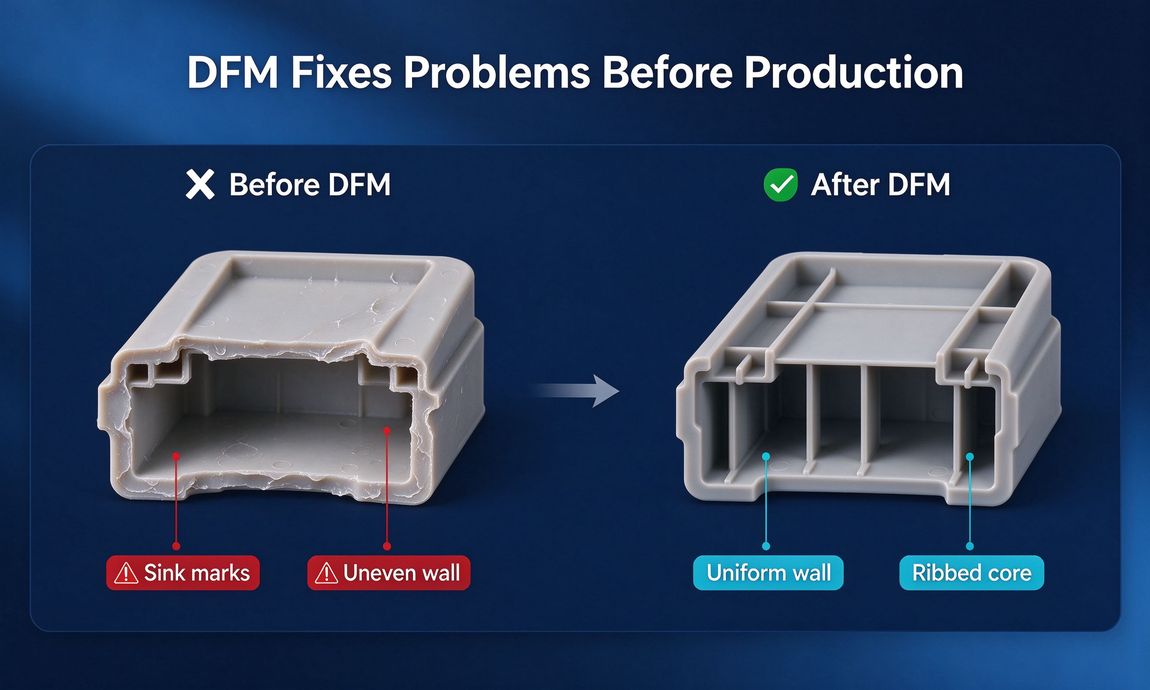
Take a plastic housing with a deep mounting boss on the inside. In CAD it looks harmless, but the boss connects to a wall three times thicker than the surrounding material. During molding, the thick junction cools slower than the thin walls around it, and the surface opposite the boss sinks into a visible depression. A DFM review flags the boss, suggests coreing it out or adding a hole to balance the section, and estimates what the change saves: a cleaner surface, a shorter cooling phase, and fewer rejected parts in appearance inspection. The same pattern repeats across ribs, bosses, hinges and snap features — each one is a small geometry choice that decides whether the first trial passes or fails. This is why DFM is a practical activity rather than a theoretical one: it trades an hour of file-level changes for weeks of trial-and-error on the machine. At Bailu, this kind of finding is the norm rather than the exception, which is why our tooling kickoffs rarely start with a surprise.
The ideal timing is after the first functional prototype and before tooling starts. At that point the design is still flexible, but there is already physical evidence of how the parts fit and work. If the review happens earlier, some findings will be invalidated by later design changes; if it happens later, the fixes are more expensive. Bailu Tech sequences the DFM review between prototype sign-off and mold kickoff on most projects, and runs a lighter version during the design stage for complex products, so findings arrive while changes are still cheap to make.
A proper review ends with a written report, not a verbal assurance that things will be fine. The report lists each finding, the reason behind it, the suggested change, and the expected impact on cost and lead time. It also flags the trade-offs — sometimes a feature that violates a rule is acceptable if you accept the risk, and the report should say so instead of forcing a change. With that document in hand, you can approve the design knowingly, and the supplier can be held accountable to the process that follows — which is exactly what a custom product design service should put in your hands. If you are evaluating a China OEM partner, ask to see a sample DFM report before you sign — it tells you more about their engineering depth than any sales page, and it shows whether their DFM review service China buyers can actually rely on.
Let us brighten your life with safety, efficiency,and expert craftsmanship.
Contact Us
Phone : +86-159 0682 2387
WhatsApp/Wechat: +86-159 0682 2387
Email : info@bailusolution.com
Copyright © 2026 Huzhou Bailu Technology Co., Ltd. All Rights Reserved. Design by BONTOP.