


Time:Oct 30,2026
By:Bailu
A new appliance shell leaves the mold looking identical to the render, and three months later it has warped next to a heating element — the kind of failure that appears in a customer's kitchen instead of at sample approval. For home appliance custom parts OEM projects, plastic components live close to heat, voltage and years of repeated use, which is why a part that looks right on day one can still be the wrong part. This article walks through the mistakes buyers and designers make most often with custom appliance components, and where each one should have been caught before the steel was cut.

A domestic appliance looks like a friendly white box, but inside the plastic components sit next to motors, compressor housings, drying ducts and control boards. Heat radiates into surrounding parts, cooling and reheating cycles build internal stress, and the materials also see detergents, grease, sunlight through the window and fingers that press the same buttons every evening. A general-purpose housing that survives a bench test may not survive a laundry room or a kitchen shelf. That gap between bench conditions and real conditions is where most appliance component problems begin.
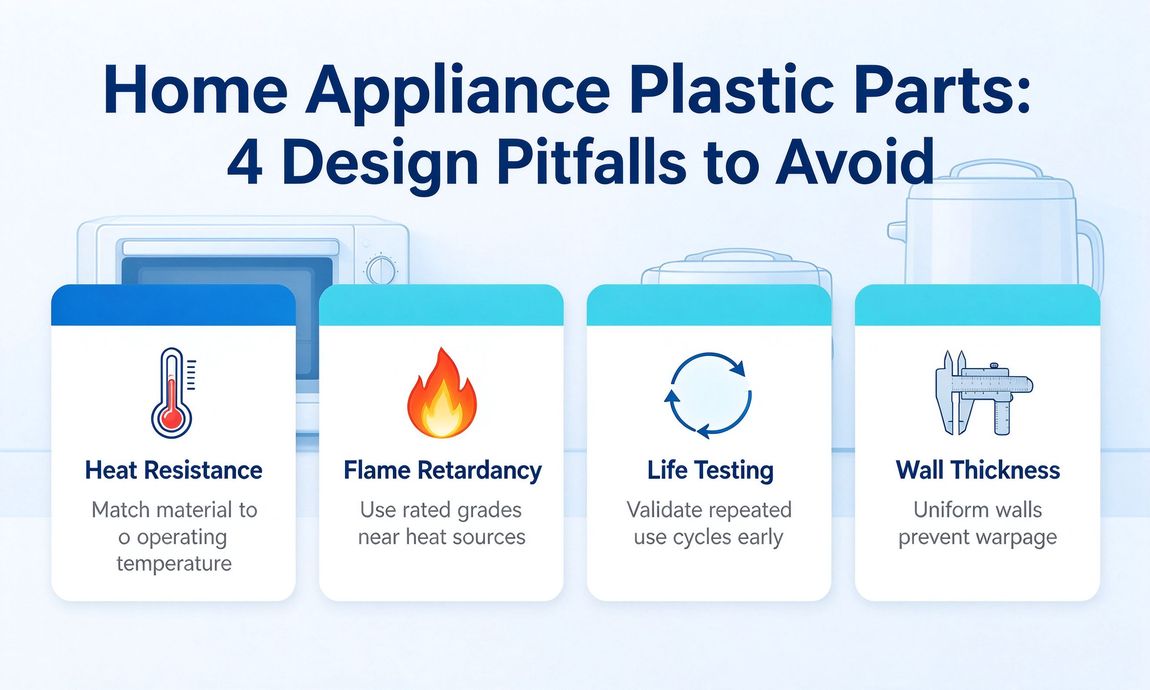
The cheapest resin quote usually comes from the general-purpose grade, and it fits a warm appliance well enough — until the designer places it within a few centimeters of a heating element or a compressor. The useful move is to map the product sketch into temperature zones: the hot zone near moving and heating parts, the temperate zone around the electronics, and the cosmetic outer zone. Each zone gets a resin shortlist matched to its deflection temperature, and near electrical connections the design uses materials with flame-retardant ratings from the supplier's datasheets. The factory advises on which grades suit each zone; the buyer's own compliance work stays with the buyer. Treating one material as valid for the whole product is the fastest route to a field failure.
Injection molding punishes uneven walls. A boss that grows from a thin wall without a taper pulls sink marks on the visible face; a rib thicker than the wall it sits on shrinks differently and warps the whole panel. The practical rules are straightforward: keep nominal wall as uniform as possible, hold rib thickness to about half of the wall, taper bosses toward their base, and place gates so the flow path does not fight thick and thin sections at once. When the designer draws the part without these rules, the mold maker pays for them later as weld-line defects, dimension drift and endless tuning trials. A review against the injection molding process catches these on paper instead of in steel.
Snap-fit covers get opened and closed daily. Control buttons get pressed thousands of times per year. Door seals and hinges bend with every cycle. A dimensional sample proves that the part fits; it does not prove that the part survives. The habit that separates stable appliance programs from surprise failures is asking, before tooling starts, which features move, how often they move in a home, and whether the material and geometry are chosen for repeated motion. Living hinges, snap hooks and sliding covers should be validated on sample parts cycled in the workshop, not assumed from datasheet numbers. The cost of a short cycle test during sampling is a fraction of the cost of a recalled door panel.
A part that performs well but shows gate marks on the control panel gets rejected as ugly, and a part that looks good but hides a sharp parting line near a grip area collects complaints. The two concerns belong together: gate locations should land where seams and textures can cover them, visible parting lines should follow product design lines, and textured surfaces should be chosen early because texture hides flow marks but changes shrinkage and assembly clearance. On the home appliances project page, the recurring pattern is that cosmetic decisions made late in a redesign are the ones that force mold modifications. Cosmetics set early, function checked against them, is the cheaper order.
A design-for-manufacturing review for an appliance component should produce a short checklist: a temperature-zone map with a resin shortlist per zone, wall thickness and rib ratios drawn into the model, gate and ejector positions marked against visible surfaces, a draft-angle note on every vertical face, and a mini life-cycle plan for every moving feature. When this review happens while the geometry is still on screen, the supplier can flag conflicts in days rather than after the first sampling round. Bailu runs the design review, the sampling and the molding in one flow, so the checklist answers stay attached to the part that finally ships.

The useful buyer package is smaller than people think: a CAD model, a short note on where heat sources sit, the target annual quantity, the expected use environment, and the finish level for visible surfaces. With that, a supplier can translate the appliance design into a toolable geometry and raise the temperature-zone question before the buyer knows it matters. Bailu Tech treats appliance parts as thermal and life-cycle problems first and appearance problems second, which keeps the first sampling round close to the shipped part. Huzhou Bailu Technology keeps the DFM report, sample records and molding parameters together for the whole program, so each redesign builds on what the last round proved rather than starting over. Ask your supplier which of the four common mistakes they caught on your project — the answer tells you how seriously they treat the job.
Let us brighten your life with safety, efficiency,and expert craftsmanship.
Contact Us
Phone : +86-159 0682 2387
WhatsApp/Wechat: +86-159 0682 2387
Email : info@bailusolution.com
Copyright © 2026 Huzhou Bailu Technology Co., Ltd. All Rights Reserved. Design by BONTOP.