


Time:Oct 30,2026
By:Bailu
A toy sample passes the desk check, the mold gets cut, and then the buyer realizes the chosen resin was not intended for children's products — a fix that costs a finished tool and a launch date. Toy custom OEM manufacturing china buyers run into this more often than they expect, because toy components are judged by rules that ordinary plastic housings do not face: material contact rules, edge geometry rules, and small-parts rules that change from one overseas market to another. This article explains what a parts factory should build into the design and production flow, while staying clear about where the supplier's job ends and the buyer's own testing and certification work begins.

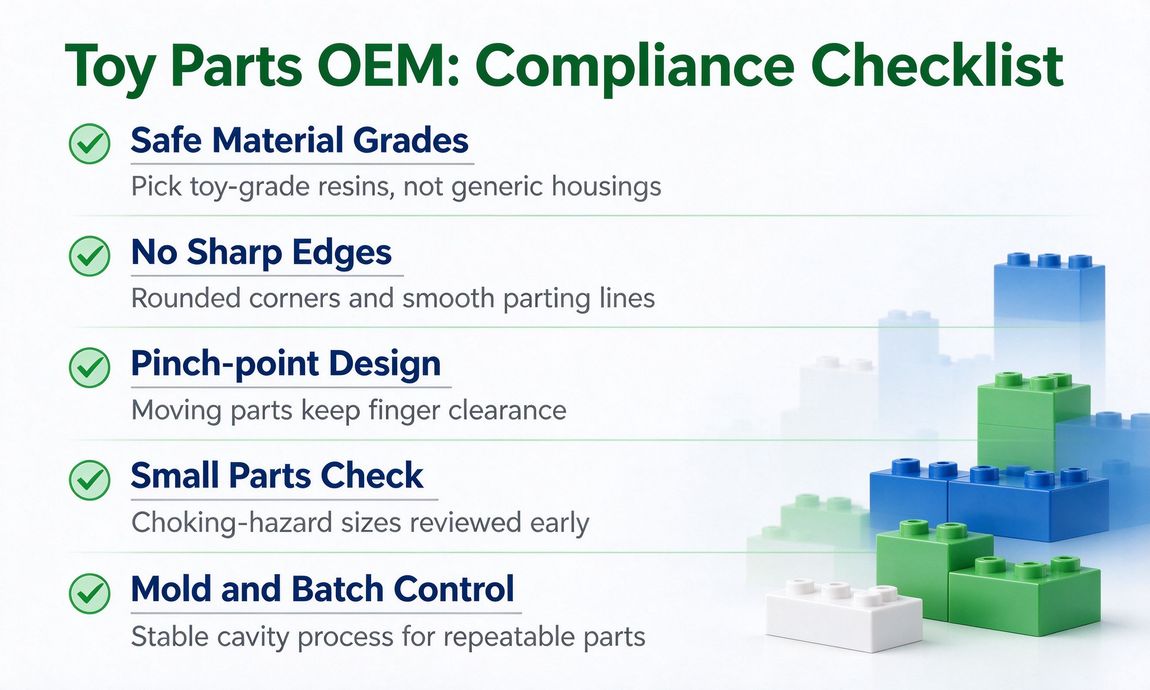
Every overseas market for toys carries its own material expectations, and the buyer is the one who knows which market the product enters. The factory's role is narrower but essential: confirm that the resin grades quoted are the toy-grade, contact-suitable variants, pull the datasheets, keep batch traceability, and avoid substituting cheaper generic housings at sampling. Paint, plating and printed logos add their own material-contact questions, and they should be specified on the drawing rather than chosen on the floor. A quote that looks suspiciously low usually comes from a material list written without the target market in mind. Watch the quote list for silent substitutions: a supplier may switch resin families to match a lower price, and the change shows up as different shrinkage, texture or impact behavior during sampling. Color masterbatch and recycled-content percentages deserve the same attention, because they alter the contact-suitability claims the buyer is making to the market. The drawing should name the resin family and grade, and any change should come back as a question rather than a surprise on the production floor.
Toy geometry is an exercise in controlled softness. Visible edges should carry generous radii, parting lines should sit flush so they cannot nick skin, and corners that fingers wrap around should feel rounded rather than crisp. Moving parts deserve special attention: where two pieces slide or rotate against each other, the gap should keep fingers out of the pinch zone, and decorations that snap onto the main body need enough holding strength to resist pulling. These rules are cheap to apply on screen and expensive to add after the mold exists, which is why they belong in the first design review rather than in a rework visit.
Small detachable pieces are where toy programs get delayed. The practical design response is to avoid loose decorative parts altogether by welding, sonic-fixing or molding decorations into the body, and where a small feature must exist, to prove its pull-out strength with witness samples rather than hoping. Assembly choices also matter: snap joints that children can separate are different from joints meant for the factory only, and the drawing should say which category each joint belongs to. Buyers who leave these questions to sampling learn them at third-party labs instead of in their own design room. When a small feature cannot be avoided, the proof is a witness sample pulled repeatedly by a normal adult finger, enough times to expose joint weak points before the mold is locked. A pull-out check on a sampling part costs hours rather than weeks, and it converts a lab failure into a design change.
Toy parts live or die on consistency: flash at the parting line is both a sharp-edge risk and an eyesore, color shift between cavities undermines brand trust, and gates placed on grip surfaces become hand-feel complaints. Good mold development answers all three: tight parting-line fit, balanced cooling across cavities, and gate positions routed away from contact surfaces. Because cavity layout and gate routing are decided during mold development, these choices should be reviewed against the toy checklist while the steel is still soft. Steady cavity-to-cavity color and dimension matter because a reject batch in toy work is disproportionate to the cost of the part itself: one failed sample at a distributor stops the whole shipment. The production answer is tighter in-process checks and first-article approval against the checklist, rather than relying on final inspection alone to catch drift.
Nobody credible hands over a toy certification from a parts factory. What the factory can do is make the testing campaign smooth: produce witness samples in the exact production material and tool, hold aside batch records so test results trace back to a known lot, and deliver parts in the finish the lab will see. Buyers who ask their supplier for test-ready samples, batch traceability and production-material prototypes clear weeks off their own compliance timeline. The supplier's commitment is repeatability of geometry and material, not a certificate that belongs to the importer.
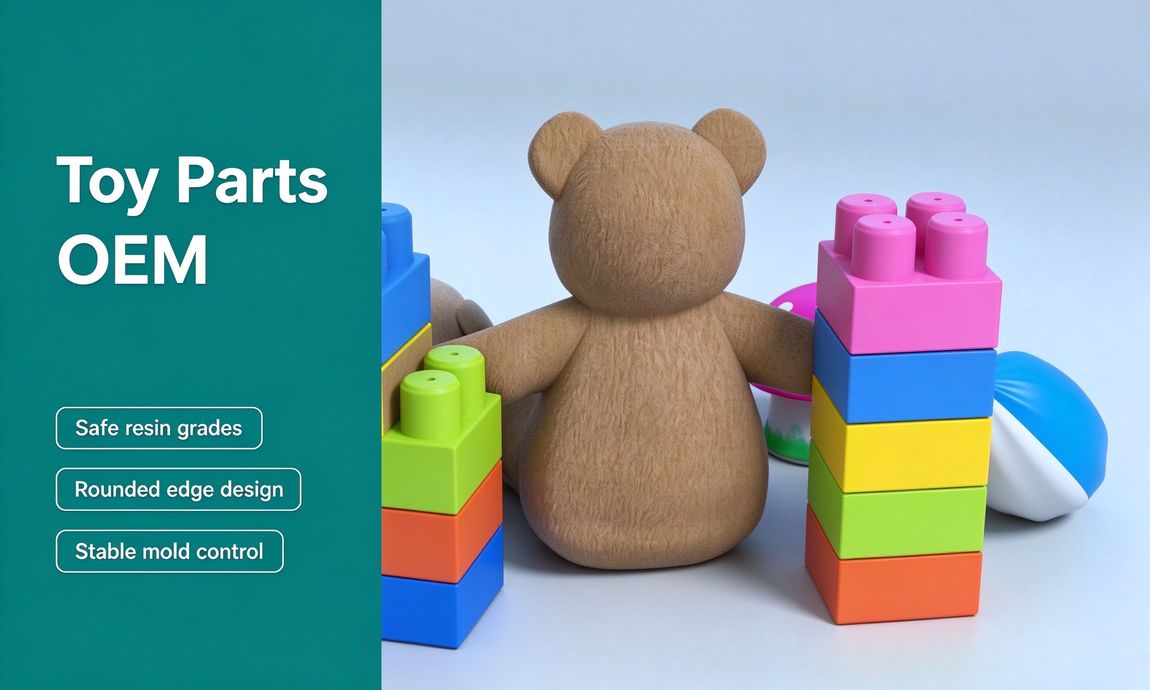
Toy work suits suppliers who run the geometry review, mold development and sampling inside one team, because the edge radii, gate positions and material grade all interact. Bailu reviews a custom toy plastic parts design against a short internal checklist — contact-suitable resin, radiused edges, pinch-point gaps, small-parts handling, cavity consistency — before tooling starts, and keeps witness samples tied to the molded batch. The toys project page shows the component range Bailu Tech has produced for overseas buyers, from small detailed pieces to larger housings. Huzhou Bailu Technology treats toy orders as compliance-aware manufacturing: the factory delivers repeatable parts and documentation, and the buyer keeps the certification decision in its own hands. When both sides know where the line sits, the launch moves faster.
Let us brighten your life with safety, efficiency,and expert craftsmanship.
Contact Us
Phone : +86-159 0682 2387
WhatsApp/Wechat: +86-159 0682 2387
Email : info@bailusolution.com
Copyright © 2026 Huzhou Bailu Technology Co., Ltd. All Rights Reserved. Design by BONTOP.