


Time:Oct 30,2026
By:Bailu
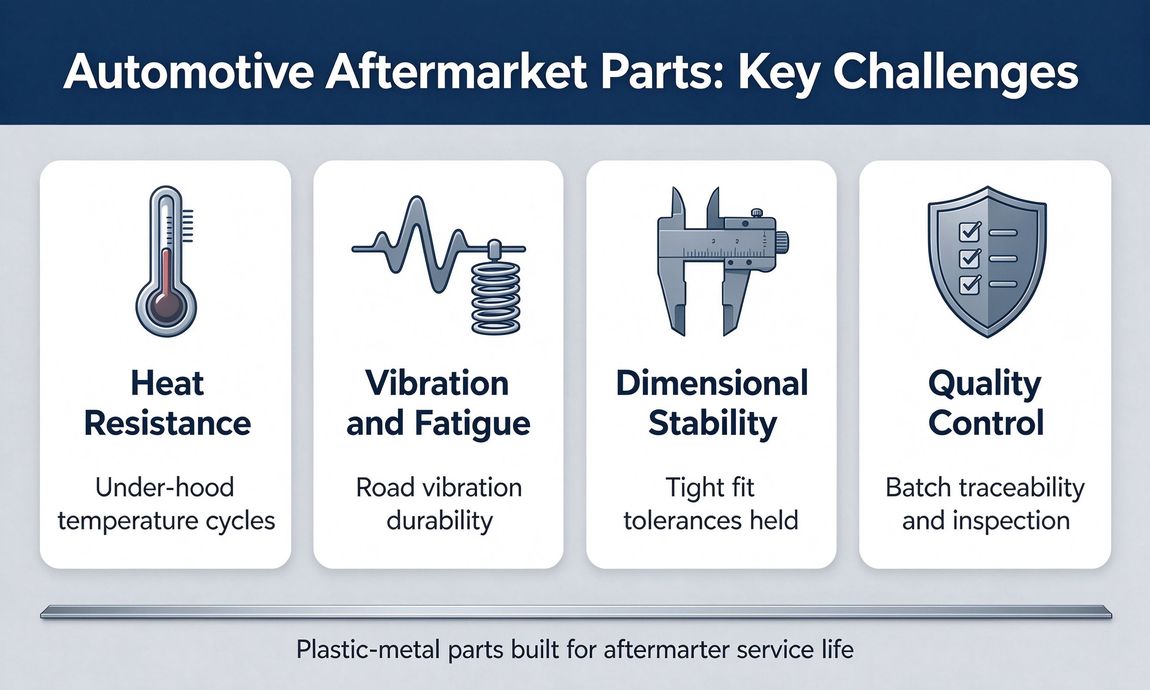
An aftermarket bracket, vent trim or sensor housing has to hold up under the hood, on a hot exhaust-adjacent panel, or bouncing over rough roads for years — and the buyer needs it to fit the first time. That is why a custom automotive parts OEM manufacturer is judged on process control rather than on price alone. Aftermarket plastic-metal parts live in a harsh environment, and the manufacturing challenges come from four directions: heat, vibration, fit tolerance and traceability. This article covers the part-level challenges and the quality control that addresses them, without touching whole-vehicle certification — which stays with the vehicle maker and its authorized network. The aftermarket buyer is responsible for the finished part itself: the material choice, the process control and the inspection that make it fit and last in real service.

Under-hood parts do not just get warm; they cycle between cold start and sustained high temperature, and some sit near exhaust systems. A plastic that softens over summer or becomes brittle in winter will fail in service. Material choice starts here: heat-stabilized engineering resins for the plastic components, and die-cast or sheet-metal alloys for the load-bearing parts, chosen to hold strength at the expected operating temperature. The mold and the process also matter, because uneven cooling leaves internal stress that releases when the part heats up, causing warpage. A supplier that quotes material by temperature range rather than by generic plastic grade is the one that has thought through the service life. It also helps to ask how the part is dried and molded, because moisture in the resin shows up as surface marks and weaker parts once the heat cycles begin.
Road vibration is constant and low-amplitude, and over years it loosens parts that were fine on the day they left the line. Plastic-metal assemblies have to resist that fatigue: snap fits and clips need a design that does not creep open, threaded metal inserts need to be installed so they do not spin, and joints between plastic and metal need enough contact area to stay tight. The manufacturing step that addresses this is controlled insertion torque and a post-process check on the clips, not a test on a single sample. Parts expected in the cabin are less demanding, but under-chassis and under-bonnet components are where vibration fatigue shows up first. This is also where the plastic-metal joint has to be designed honestly, since a thin boss around a metal insert will loosen long before the metal itself shows wear.
An aftermarket part has to fit an existing vehicle, so the tolerance is tight and the mating surface has to land exactly. That demands dimensional control through the process: consistent wall thickness in the molded parts, controlled draft and gate locations, and inspection of the fit features — the clip positions, the screw holes, the sealing surfaces. The challenge is that plastic moves with temperature and moisture, so the dimensions that read fine on the inspection bench may drift in service. Holding the critical dimensions across cavity after cavity, and across batches, is what separates a supplier that can deliver repeat fit from one that ships parts that sometimes rattle. This means checking the mating surfaces on the first article, monitoring drift in production, and holding a sample from each lot for comparison. Bailu sets the critical dimensions on the drawing and checks them against the first-article sample before production runs.
Automotive aftermarket work expects traceability: which batch a part came from, what material was used, and what was inspected. This means batch records for the resin and the alloy, inspection records for the fit features, and a sampling plan tied to the production run. It is process control rather than a paperwork exercise, because the records exist to find the cause if a field issue appears. The records also tell the buyer which lot to pull from when a design change is made, so updated parts ship without mixing in old stock. For a custom automotive parts OEM manufacturer, this record-keeping is part of the quote, not a surcharge. Bailu runs the material, process and inspection steps as one controlled flow, so a part in the field can be traced back to the lot that made it.
The challenges above are solved upstream, at material selection and process design, rather than at the inspection station. The right resin and alloy, a mold or tool built around the critical dimensions, and a controlled assembly step produce a part that holds fit through temperature cycles and vibration. A buyer comparing an auto parts OEM manufacturing China supplier should ask for the material grade by temperature range, the critical dimensions on the drawing, and the batch record process. Those three answers reveal whether the factory controls the process or merely ships parts and hopes. The auto and motorcycle parts page shows the part categories Bailu runs, and the die casting processing page explains how the metal components are produced. Huzhou Bailu Technology keeps plastics and metal processing in one controlled flow, so a plastic-metal part arrives already matched to the environment it will serve. That single-flow control is also what makes the batch records traceable, because resin, alloy and assembly steps do not cross between disconnected suppliers.
Let us brighten your life with safety, efficiency,and expert craftsmanship.
Contact Us
Phone : +86-159 0682 2387
WhatsApp/Wechat: +86-159 0682 2387
Email : info@bailusolution.com
Copyright © 2026 Huzhou Bailu Technology Co., Ltd. All Rights Reserved. Design by BONTOP.