


Time:Oct 30,2026
By:Bailu
Your engineer asks whether the new product should run on a manual bench or an automated line, and the wrong answer shows up either as wasted tooling cost or as a labor bill that grows every quarter. There is no single right choice for OEM custom orders, because the balance depends on order volume, product complexity and how often the design changes. A product assembly service China buyers compare across suppliers is usually the one that matches the method to the order instead of pushing the same line for everything. This article lays out when manual assembly wins, when simple automation earns its cost, and how to stage the decision as volume grows. The answer changes as the product matures, so the question is less one right method and more the right method for this order, at this moment in the product's life.

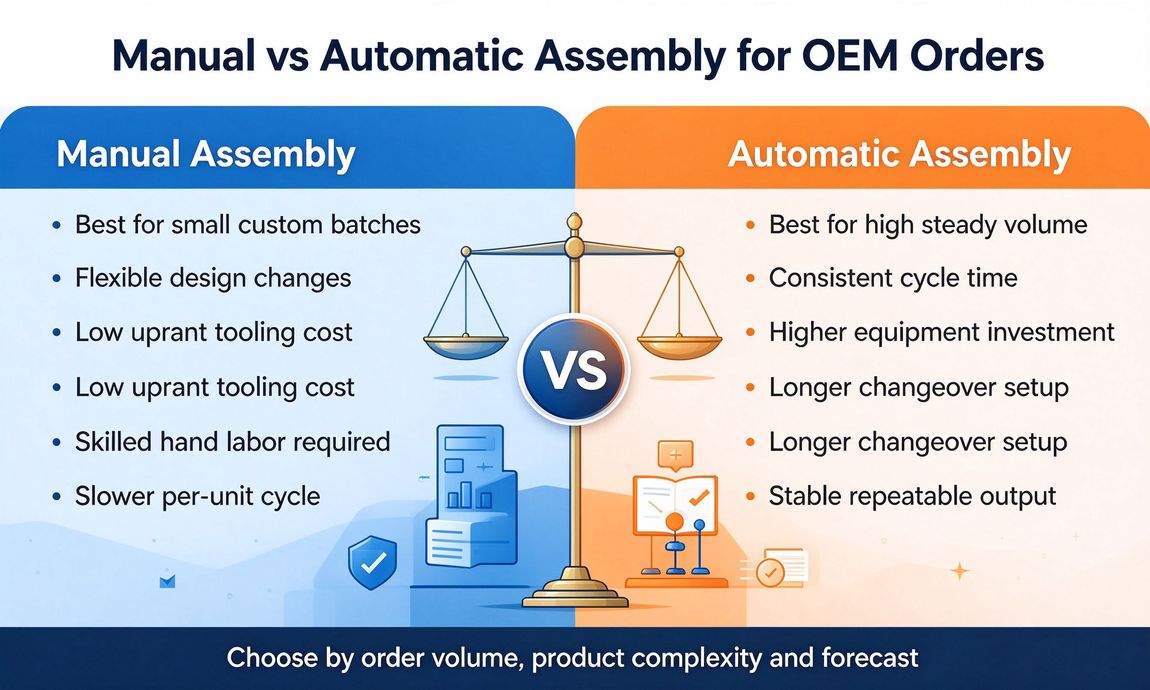
Manual assembly is the default for custom and low-volume work, and for good reason. It needs little upfront tooling, so a new product can start within days of the parts being ready. It absorbs design changes gracefully: a revised bracket, a longer cable, a different button layout is handled by the operator adjusting the sequence, not by rebuilding a machine. It also handles the awkward operations that automation finds expensive, such as routing flexible cables, aligning soft gaskets, or assembling parts that only fit in one orientation after a small amount of feel. The trade-off is per-unit labor cost and cycle time, which climb as the order grows and as operators repeat the same motion thousands of times. For a few hundred to a few thousand units, manual is the practical answer.
Simple automation — a screwdriving station, a press-fit jig, a screw-feeding system, a light-guided pick station — pays back when the operation is repeated at steady volume. It removes the variation between operators, shortens cycle time, and frees people for the tasks that still need a hand. It also improves consistency at the functional test, because a torque applied by a machine lands the same way every cycle. The catch is that automation is built for a specific product: the fixture is shaped around one housing, the feeders handle one screw length, and a design change means retooling. Automation also carries a setup cost, so it only makes sense when the forecast covers enough units to divide that cost down. Many custom orders sit below that line, and forcing automation on them raises the price without raising quality.
The simplest way to frame the balance is by annual volume and product stability. Under a few thousand units a year and with an evolving design, manual assembly with basic jigs is the lower-risk choice. Above roughly ten thousand units of a stable design, the labor saving from one or two automated stations starts to beat the retooling cost. In between is the gray zone, where a light-guided workbench or a semi-automatic press gives consistency without a full machine. Bailu quotes both ways for the same product so a buyer can see where the cost crossover actually lands, instead of being pushed toward whichever line the factory happens to own. That comparison is the heart of the decision. It also removes the most common mistake in custom assembly: choosing the method before knowing the real forecast, then paying either for unused automation or for labor that automation could have cut. A buyer who shares a three-year volume plan gets a recommendation that matches growth instead of a one-size line.
Volume is not the only factor. A product with many variants — colors, bundle options, regional certifications — changes often, and automation built for one variant becomes a blocker the moment the SKU list grows. Complex products with mixed materials, soft parts or unpredictable tolerances also resist automation, because the machine expects the part to behave the same way every time. In these cases, keeping the assembly manual with good work instructions and jigs is the mature choice. Automation earns its place on the operations that repeat exactly, not on the whole product. A supplier that separates the two — automated screwdriving, manual cable routing — is the one that has thought through the balance rather than the slogan. Bailu reviews each operation on the product and automates only the ones that repeat exactly, which keeps the line flexible enough for the next design change while still removing the most error-prone steps.
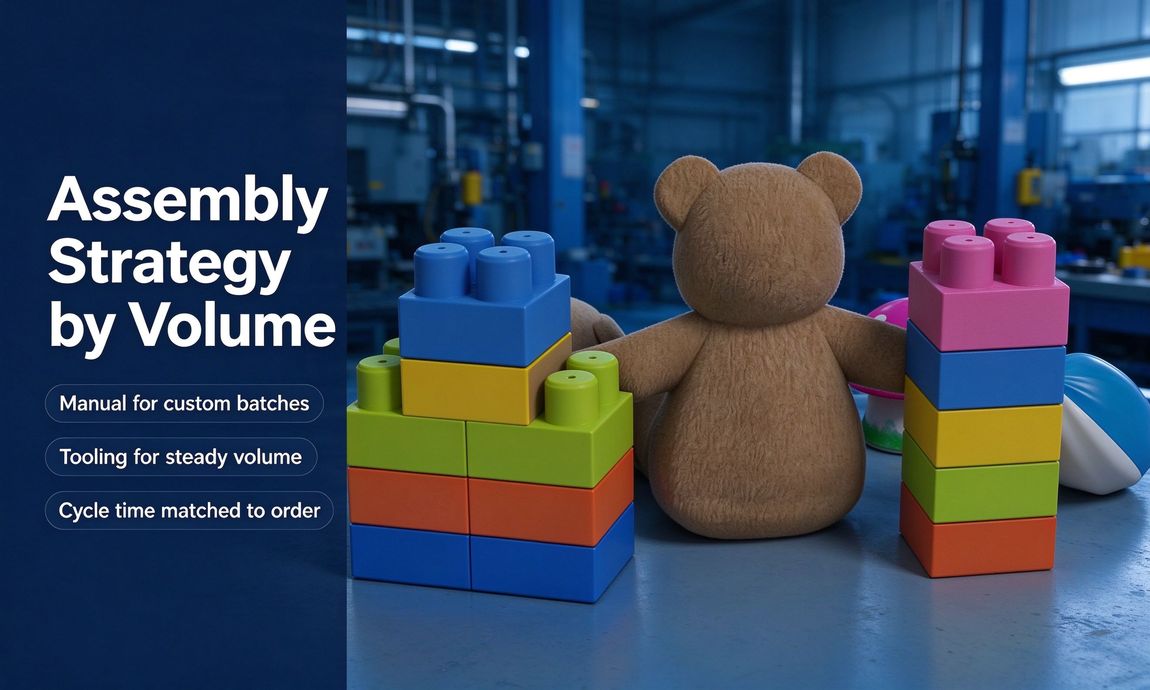
The realistic path for a custom OEM product is staged rather than all-or-nothing. Launch with manual assembly and basic jigs while the design is still settling and the order book is small. Add a single automated station for the most repeated, most error-prone operation once volume proves out. Then expand tooling only when the forecast is firm. This protects cash at launch and invests in automation when the demand is real. If you are comparing suppliers, the product assembly service page explains how stations are planned, and the logistics and shipping page shows how finished units are cartoned after the test. Bailu Tech keeps the tooling investment proportionate to the order, so a growing product moves from manual to semi-automatic step by step instead of in one expensive jump.
Let us brighten your life with safety, efficiency,and expert craftsmanship.
Contact Us
Phone : +86-159 0682 2387
WhatsApp/Wechat: +86-159 0682 2387
Email : info@bailusolution.com
Copyright © 2026 Huzhou Bailu Technology Co., Ltd. All Rights Reserved. Design by BONTOP.