


Time:Oct 30,2026
By:Bailu
Your components arrive on Monday, the line is planned to start on Tuesday, and by Wednesday the first units are coming back loose or short — and the cause is rarely the assembly itself but the preparation that was skipped. A product assembly service China buyers can rely on is judged by what is ready before the first screw is turned, not by how fast the line runs later. Three things have to arrive together: parts in spec, tooling that holds them, and a test that catches defects early. This article walks through the preparation work that separates a smooth first run from a week of rework and finger-pointing.

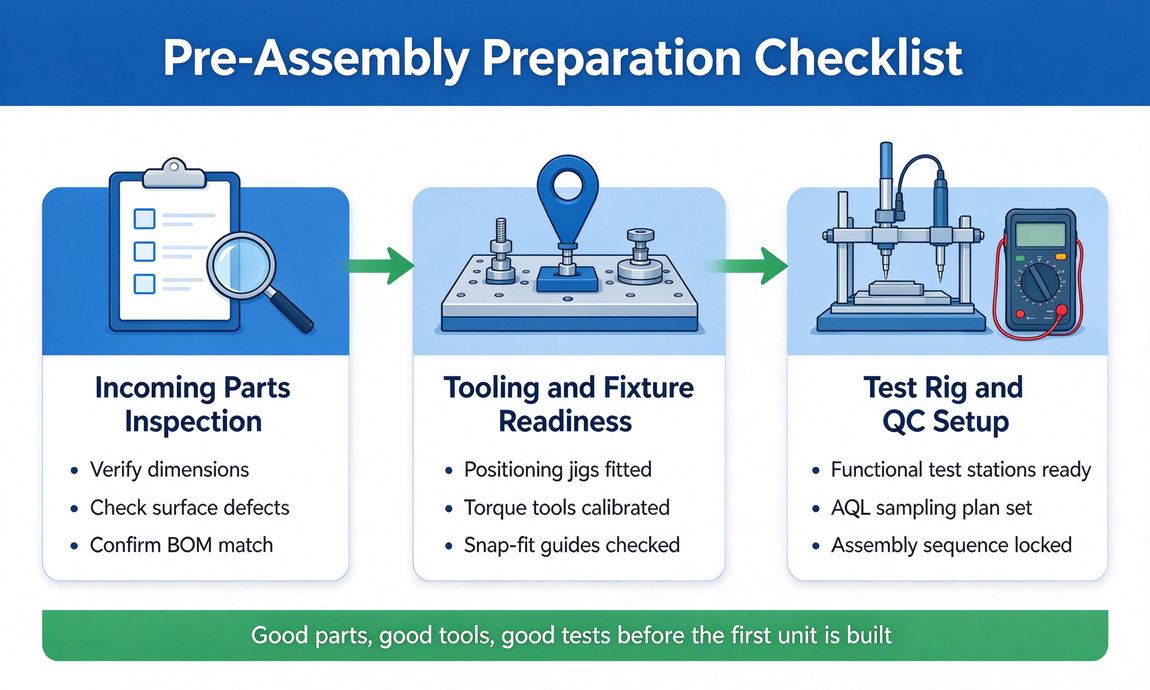
The most common reason for assembly trouble is not a flawed design but parts that were not checked against the drawing before assembly began. Before any unit is built, every batch should be counted against the packing list, sampled for critical dimensions, and inspected for the defects that show up at the fit points: bent pins, scratched contact surfaces, flash left on snap fits, and color mismatch on visible housings. When incoming material is accepted as-is, the assembler spends the first days arguing about whether a small gap is a normal tolerance or a real defect. A short incoming QC step focused on the features that mate — screw bosses, clips, hinges and seals — removes that debate before work starts. Bailu treats incoming inspection as the first assembly station rather than a paperwork step, because a bad part accepted into the line costs ten times what it costs to reject at the dock.
Hand assembly is flexible, but flexible does not mean free. Without simple jigs, two operators build the same product slightly differently, and that difference appears at the functional test instead of being prevented. Before the run, prepare the positioning fixtures that hold the housing square while screws are driven, the torque tools that stop over-tightening and cracked bosses, and the small guides that seat connectors and snap fits in the correct orientation. These tools cost little next to the injection molds or die-casting tools, yet they are the difference between a repeatable process and a line that depends on one skilled worker who happens to be in that day. A buyer sending kits to a contract assembler should ask which jigs the factory will build, because the answer shows how seriously the order is being taken. The cost of a few simple fixtures is small against a single batch of scrapped units, and it is recovered in the first week of steady production.
Testing after assembly is where a hidden defect becomes a finished-product failure, so the test should be defined before the line is set up: what functions must pass, which points are sampled, and what the clear pass-fail criteria are. A simple test station — power-on, switch press, fit check, leak check where relevant — catches a reversed connector or a loose screw at the station instead of at the customer. For Bailu, the test rig is part of the assembly quote rather than an add-on, and the test plan feeds straight into packing: units that passed can move into the carton without waiting on a shelf. This is also where a custom packaging service for oem product fits in, because tested and untested units should not share the same tray.
A finished product is built in a fixed order, and the order itself is a decision. Which sub-assembly goes in first, where the cables are routed before the top cover closes, and which step needs both hands and a free bench — these are worked out in a short assembly sheet before the first unit. The sequence also flags the operations that are hard to redo, such as gluing, heat staking or sealing, so a mistake does not mean starting the unit over. For overseas buyers, sharing a draft assembly sequence early lets the factory suggest the order that suits its stations, which shortens the ramp-up and reduces the number of trial units that have to be scrapped. A documented sequence also trains new operators faster when the order repeats months later.

Before an order kicks off, ask the supplier three questions. How will incoming parts be sampled and against which drawing features? Which jigs and torque tools will be built for this product, and who owns the cost? And what does the functional test look like, with what pass-fail criteria? The answers tell you whether the factory has done this preparation work or expects to improvise on the line. The product assembly service page shows how these stations are organized, and the logistics and shipping page shows how tested units move straight into cartons. Bailu Tech keeps assembly, test and packing under one roof so a defect stops at the station that caused it, rather than traveling overseas and showing up in a customer complaint. Preparation is not exciting work, but it is the work that keeps a repeat order coming. A buyer who sends the drawing, the critical features and the expected order volume ahead of time makes that preparation easier, and the supplier responds with a smoother first run and fewer surprises at the test station.
Let us brighten your life with safety, efficiency,and expert craftsmanship.
Contact Us
Phone : +86-159 0682 2387
WhatsApp/Wechat: +86-159 0682 2387
Email : info@bailusolution.com
Copyright © 2026 Huzhou Bailu Technology Co., Ltd. All Rights Reserved. Design by BONTOP.