


Time:Oct 30,2026
By:Bailu
Your parts pass the assembly test, the cartons are sealed, and two months later the customer opens the container to find scratched housings and a cracked display — because the box was designed around the product, not around the journey. A custom packaging service for oem product earns its keep by protecting against what actually happens between the factory and the buyer, and most of that risk is logistics: vibration, stacking and inspection. This article walks through the factors a buyer should put on the table before the packaging structure is drawn, so the box survives the route instead of failing at the dock or at the customer's receiving bay.

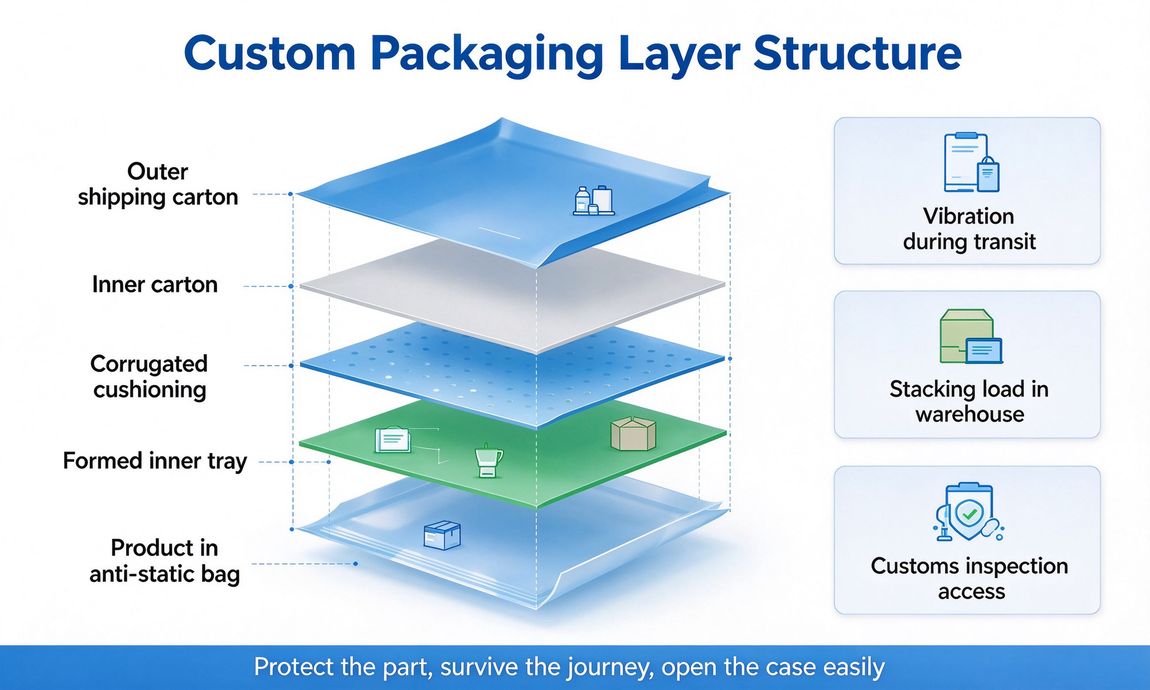
A product does not move gently from factory to warehouse to container. Trucks shake, trailers roll, containers are lifted and set down, and long sea voyages expose the contents to continuous low-frequency vibration. Packaging has to absorb that motion rather than let the product bounce against the inside of the box. The practical choices are a formed tray that locks the product in position, cushioning material between the product and the wall, and blocking that stops the unit shifting within the carton. Fragile or high-value parts also benefit from an anti-static bag where electronics are involved. The goal is that a product in its box feels held, not loose — a simple shake test on the sample carton tells you quickly whether the layer structure is working. This test costs minutes but prevents a container of units that rattle against each other for weeks, which is a common cause of hidden scratches on visible surfaces that only appear once the customer unpacks.
Cartons do not travel alone; they sit on pallets under other cartons for weeks. The outer box has to hold the stacking weight above it without crushing the inner cushion and the product. This means choosing a corrugated grade that matches the expected stack height, sealing the box in a way that distributes load across the flaps, and marking the stacking limit on the carton. A box that is flimsy at the bottom of a stack will show up as crushed corners and compressed foam long after shipment. For heavy or dense products, the carton size and board weight are decisions made together with the freight plan, because a small, heavy carton survives stacking better than a large, light one. Bailu also packs cartons to a stated stack height and prints the limit on the outside, so warehouse handling does not crush the units below.
Export cartons are opened in transit, whether by customs, by a freight forwarder or by a warehouse handoff. Packaging that is hard to open invites rough handling, and packaging that is resealed poorly invites loss. Design the box so the inspector can see what is inside without destroying the cushion — a printed label, a sample opening, or a box that opens and closes cleanly. Include the packing list and a clear product label on the outside so a pallet can be sorted without being unpacked. This is a logistics detail that buyers underestimate, and it shows up as a small number of missing units or opened cartons in almost every large shipment. A reusable or resealable inner pack also helps, because it lets the inspector look inside without the contents spilling into the outer box.
Protective packaging is built in layers, and each layer has a job. The product sits in an anti-static bag where electronics are involved, then in a formed inner tray that locates it in three dimensions. Corrugated cushioning around the tray absorbs impact, an inner carton holds the contents together, and the outer shipping carton faces the world of pallets and forklifts. Bailu designs these layers together with the assembly line, because a product assembly service china factories offer should hand finished units straight into a known tray rather than a generic box. When the tray shape is decided during assembly planning, the cushion fits the product exactly instead of being a loose filler. A fitted tray also reduces the labor of packing, because the operator places the unit and closes the box without measuring or cutting padding on the bench.
Stronger packaging costs more, and so does weaker packaging once damage is counted. The right target is protection matched to the real route, not the heaviest box on the shelf. Also remember the person who unpacks at the other end: packaging that is hard to open, or that leaves behind a pile of loose foam, costs goodwill and handling time. A balance of durable outer carton, fitted inner tray and clean labeling usually lands the cost in the middle while cutting damage sharply. It also reduces the claims cycle, because a customer who receives an intact unit on the first shipment is a customer who reorders without a discount negotiation. The product assembly service page shows how finished units move from the test station into the tray, and the logistics and shipping page shows how cartons are palletized for the route. Bailu Tech treats packaging as part of the product, not an afterthought — the box survives the journey the way the product was built to work inside it.
Let us brighten your life with safety, efficiency,and expert craftsmanship.
Contact Us
Phone : +86-159 0682 2387
WhatsApp/Wechat: +86-159 0682 2387
Email : info@bailusolution.com
Copyright © 2026 Huzhou Bailu Technology Co., Ltd. All Rights Reserved. Design by BONTOP.