


Time:Oct 30,2026
By:Bailu
A part is "acceptable" only if someone has said what acceptable means. Without defined acceptance criteria, every shipment is a negotiation and every quality complaint is an argument about interpretation. The criteria are a small document with a large effect: they decide what the factory inspects, what you pay for, and what you can reject. This article walks through the acceptance criteria every custom OEM quote from China manufacturer should come with, and how to write them so they hold up through production.

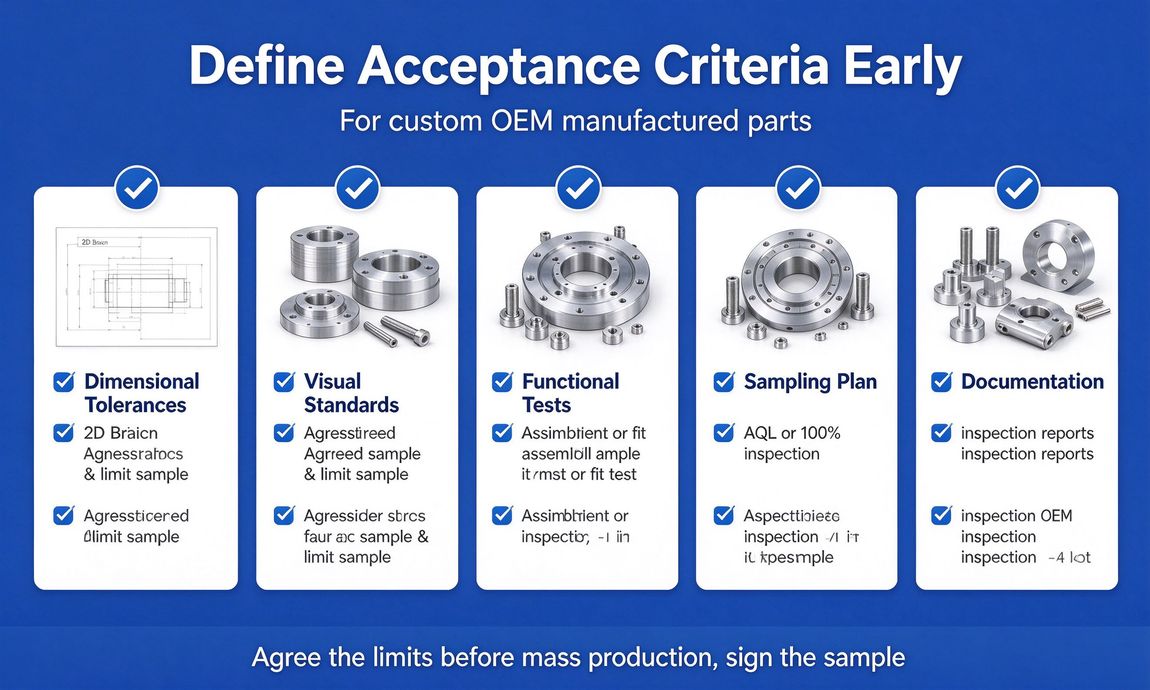
The drawing is the primary reference: every dimension with a tolerance is a potential acceptance point. The practical step is to mark which dimensions are critical — the ones that interact with mating parts, the ones that affect function — because inspecting everything to the tightest tolerance costs time without adding protection. Critical dimensions get measured on the first article and sampled in production; cosmetic dimensions get visual checks. The tolerance list is the first thing both sides should agree on, because every later inspection traces back to it.
Adjectives like "smooth" or "nice" cannot be inspected. The workable visual standard is physical: a signed sample that defines the acceptable appearance, plus a limit sample that defines the worst appearance still accepted. Color, gloss, texture, weld lines, gate marks and minor blemishes are all judged against these references. The samples should be kept by both sides and re-checked whenever the process changes, because visual standards drift if nobody re-confirms them — the practice Bailu follows on every appearance-critical part. The limit sample matters as much as the approved one: it sets the boundary that keeps the factory from polishing every part to a standard that was not agreed.
Beyond dimensions and appearance, the part must do its job: snap together, fit, move, seal, conduct. Define the functional test in the acceptance criteria — an assembly test, a fit check, a torque requirement, a leak test — and state the pass condition in numbers. A functional test is what turns a complaint from "the part feels wrong" into "the insert torque falls below 1.2 N·m on sample 3 of 8", and that precision is what makes a dispute resolvable. Without the number, the complaint is a matter of opinion.
Checking every part is expensive and often unnecessary; checking almost none is risky. The sampling plan answers how many parts get measured and how often, usually by AQL classes or a defined percentage with a lot-size rule. The plan should name the batch size, the sample size and the accept and reject numbers before production starts. A sampling plan is a negotiation between cost and confidence, and both sides should accept the result in writing rather than discovering it during a dispute.
The criteria mean nothing if the results are not recorded. Each shipment should carry the inspection records: measured values against the tolerance, the sampling result, the functional test outcome, photos of the visual check. This is the layer that lets a third party reconstruct what happened months later, and the layer Bailu ships with every production order. OEM quality control for custom manufactured parts becomes audit-able the moment the criteria and the records are linked.
Acceptance criteria have a quiet cost either way: weak criteria look cheap until the first dispute, strong criteria cost a little time to write and save the project repeatedly. Without them, a shipment that fails to meet your expectation becomes a negotiation about what was reasonable, and the negotiation is slower and more expensive than the criteria would have been. With them, the same situation is a comparison against a written standard — fast, factual and resolvable.
The cost of writing the criteria is hours at the start of the project; the cost of not writing them is measured in rejected shipments, delayed launches and relationships that sour over interpretation. For buyers, the discipline also changes the quotation: when the criteria are part of the RFQ, the supplier prices the inspection against them and the quote covers the real work. For suppliers, written criteria remove the ambiguity that makes them defensive — they know exactly what to measure and what to stand behind. The practical recommendation is to treat the acceptance criteria as a deliverable of the quoting phase, not of production: draft them with the RFQ, refine them with the sample, and freeze them with the order. That sequence is the difference between a project where quality is agreed and one where it is argued.
Start from the drawing and the sample, name the critical dimensions, define the visual standard physically, add the functional test, and fix the sampling plan — then write it all into the order before the quotation is accepted. When the criteria travel with the contract, a custom OEM quote from China manufacturer is complete: the price, the schedule and the standard of acceptance all sit in one document. If the supplier pushes back on written criteria, that is useful information before you commit. Our buyer guides include a template for acceptance criteria you can adapt, and Bailu Tech will walk through the criteria for your part in the quotation itself — the standard is part of the quote, not an argument to be had later.
Let us brighten your life with safety, efficiency,and expert craftsmanship.
Contact Us
Phone : +86-159 0682 2387
WhatsApp/Wechat: +86-159 0682 2387
Email : info@bailusolution.com
Copyright © 2026 Huzhou Bailu Technology Co., Ltd. All Rights Reserved. Design by BONTOP.