


Time:Oct 30,2026
By:Bailu
Medium volume is the awkward zone of metal manufacturing: too many parts for hand fabrication, not enough for expensive automation. Sheet metal stamping sits exactly in that band, and for a wide range of metal components it is the route with a good balance of tooling cost, lead time and part consistency. This article explains what custom sheet metal stamping brings to medium-volume parts and how a sheet metal fabrication China supplier can use it to keep your per-part cost sensible.

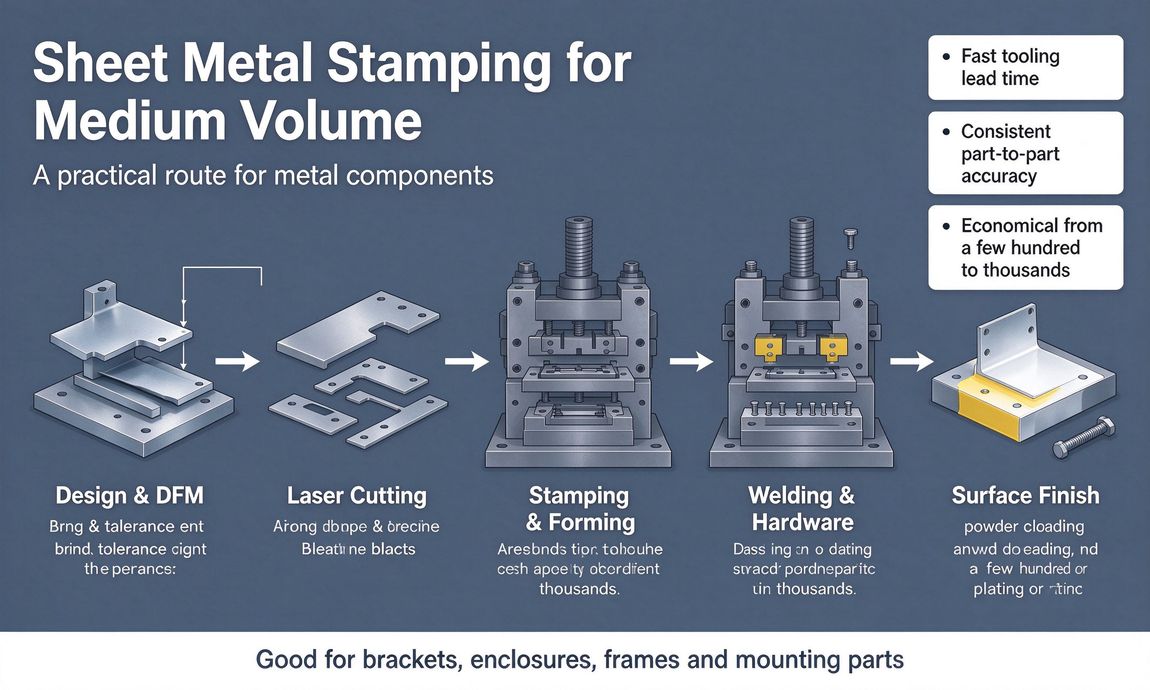
At low volume, bending on a press brake or cutting by hand is fine — the labor cost is acceptable because the quantity is small. At very high volume, progressive dies and full automation pay for themselves. In between — typically from a few hundred to a few tens of thousands of pieces — stamping with simple dies or staged tooling delivers consistency that hand work cannot, at a tooling cost that full automation cannot justify. That is the band where stamping wins, and it is a wide band for most brackets, enclosures and mounting parts — the parts Bailu stamps in highest volume.
Hand fabrication drifts with the operator; stamping does not. Once the die is set, every hit produces the same bend radius, the same hole position and the same flatness, which means the first article and the thousandth part match. For parts that assemble with other components, that consistency is the difference between a smooth assembly line and a daily fight with tolerances. Dimensional repeatability is the quiet advantage of stamping that shows up in your assembly cost rather than in the part price. For a part that stacks or nests, that repeatability is the property that keeps the line moving without sorting.
Compared with a die-casting die, stamping tooling is simpler and faster to build. Simple dies for a bracket or mounting plate can be ready in a few weeks, which shortens the whole development clock. For a buyer, this matters twice: the prototype and first-article parts arrive sooner, and the design can still be adjusted with a smaller penalty because the tooling is less complex. When market timing is part of the product plan, tooling speed is a business metric, not just a shop metric.
Stamping works across a practical range of metals — steel, stainless steel, aluminum, copper — and thicknesses from thin foils up to several millimeters. The process suits parts defined by flat features, bends and cutouts, and the material choice is broad enough that corrosion, strength and cost requirements can usually be met without changing process. The main constraint is geometric: if the part needs complex three-dimensional detail, stamping will require multiple forming steps or hand work, and the economics change.
Stamping rarely ships bare. Powder coating, plating, anodizing and silk screening follow, and the stamped part accepts these finishes well because the surface is clean and consistent. Hardware is added too — studs, nuts, brackets — often with automated insertion. For a full-service supplier, the stamped part is the middle of the story: the finish and the hardware complete the component, and the same factory can own all three stages — the sequence Bailu runs on most stamped components. The sequence also affects the schedule: finishing and hardware add days, so the stamping quotation should carry the full route from blank to packed part, not just the press time.
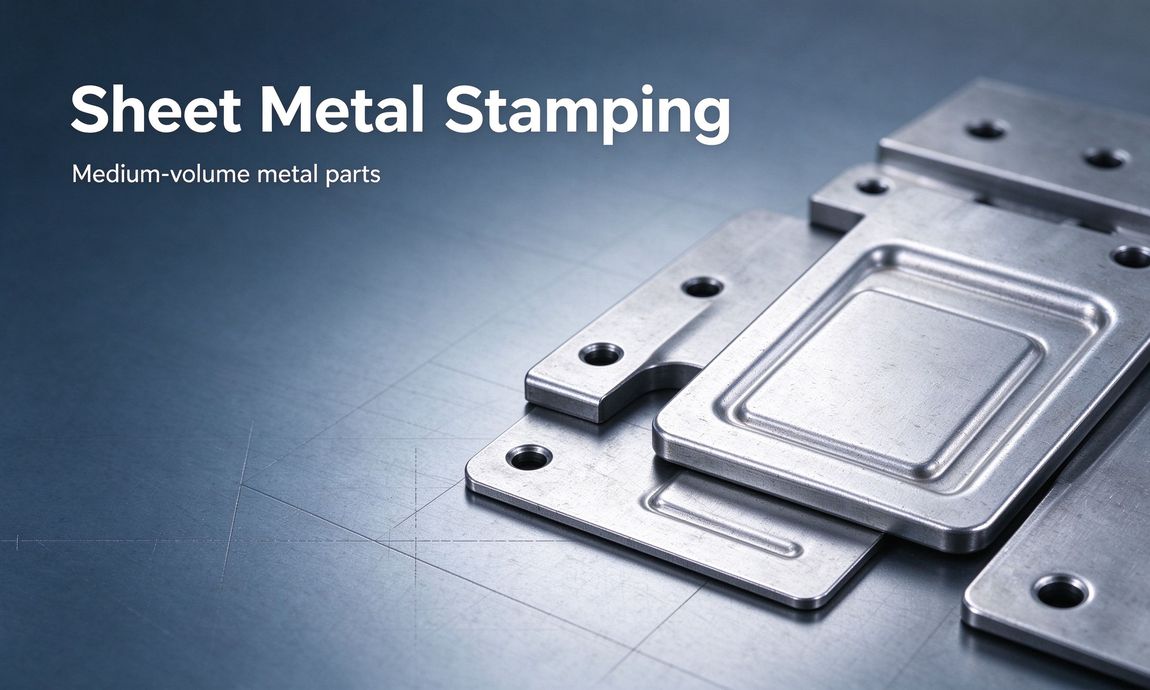
One distinction worth making inside sheet metal is between laser cutting and stamping, because the two overlap at medium volume. Laser cutting cuts blanks from flat sheet with high flexibility — ideal for prototypes, complex outlines and low volumes, where the per-part cost stays flat because there is no die to amortize. Stamping takes over when the quantity justifies a die, because once the tool exists the cycle is seconds and the per-part cost falls. The crossover is usually in the hundreds to low thousands of pieces, depending on part complexity and the die cost.
Many projects use both: laser-cut prototypes to validate the design, then a stamping die for production. The practical question for a buyer is where your quantity sits on that curve, and whether the supplier offers both so the transition is a continuation rather than a change of vendor. Stamping also wins on repeatability for features like hole patterns and formed tabs, where a die holds position far better than a repositioned laser cut. When quoting, ask which route the supplier recommends at your quantity and why — the reasoning reveals whether the advice is technical or commercial. The right recommendation at medium volume is often a staged plan: laser for the first runs, stamping as the volume confirms.
To get a useful stamping quotation, give the material and thickness, the quantity band, the tolerance on critical features and the finish requirement. Ask how the tooling is staged — simple die, compound die or progressive — because the staging decides the tooling cost and the per-part price. A sheet metal fabrication China supplier with both stamping and finishing in-house can quote the whole component rather than just the stamping, which removes a handoff and its risk. The sheet metal fabrication page and the die casting processing page show how Bailu stages metal projects across the two routes, and a stamped-part enquiry gets a tooling-versus-volume recommendation with the numbers shown.
Let us brighten your life with safety, efficiency,and expert craftsmanship.
Contact Us
Phone : +86-159 0682 2387
WhatsApp/Wechat: +86-159 0682 2387
Email : info@bailusolution.com
Copyright © 2026 Huzhou Bailu Technology Co., Ltd. All Rights Reserved. Design by BONTOP.