


Time:Oct 30,2026
By:Bailu
The first samples arrive and the part looks wrong: a dip on the surface, a line of extra plastic at the edge, a bubble inside the wall. Defects in injection molded parts are not random — they are symptoms with known causes, and most of them are preventable in the design or the process. This article names the common defects a buyer working with an injection molding manufacturer China supplier should recognize, what causes them, and where the fix actually lives.

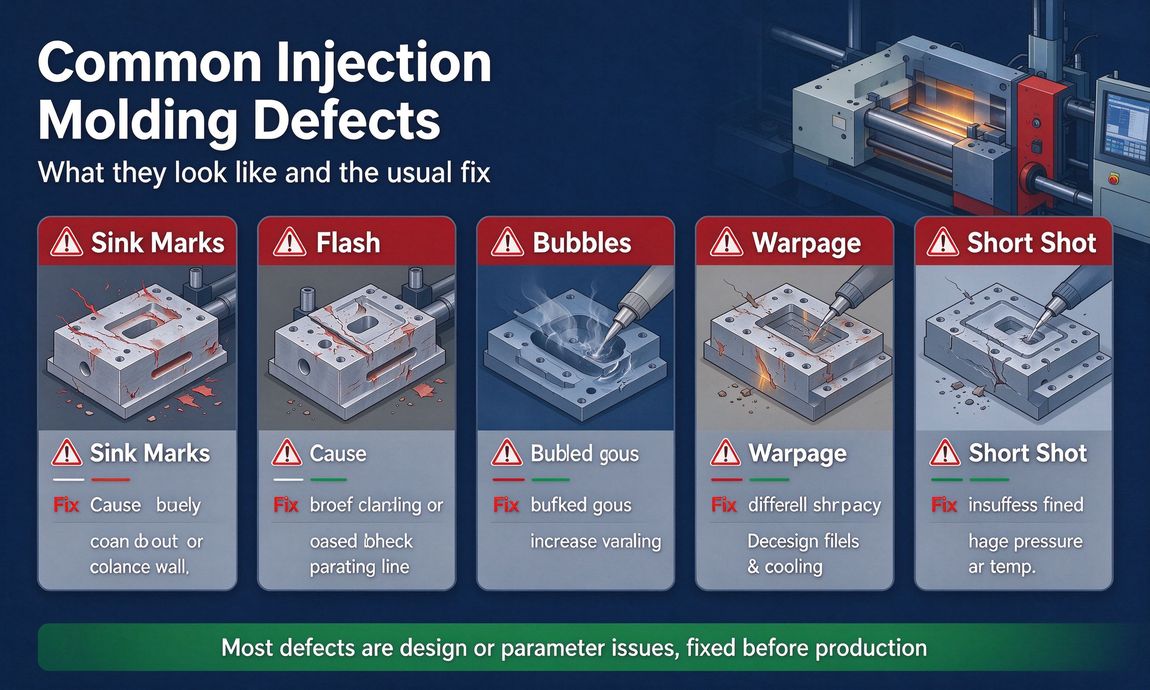
Sink marks are shallow depressions that appear where a thick section of the part cools slower than the surrounding thin walls. The cause lives in the geometry: thick walls, and ribs or bosses that are too heavy relative to the surrounding material. The fix is mostly in the design — core out thick sections, balance the wall thickness, and keep ribs at a fraction of the adjacent wall. A DFM review catches this before the mold is cut, which is why sink marks are the classic example of a design defect rather than a machine defect — and the first thing Bailu's DFM review looks for in thick-walled parts.
Flash is a thin film of plastic that escapes at the parting line, usually where clamping force meets cavity pressure. The causes sit in the process and the tool: insufficient clamping force, worn or damaged parting surfaces, or injection pressure that exceeds what the mold can contain. The fix is a combination of process tuning and mold maintenance. If flash appears suddenly during production, it usually signals tool wear or a shift in process parameters rather than a design problem — which makes it one of the defects most worth reporting immediately rather than accepting.
Bubbles inside the wall or at the surface come from gas that cannot escape: air trapped in the cavity, or moisture in the feedstock that vaporizes during injection. The fix lives in venting, material drying and process settings. Gas traps often follow the geometry — deep ribs and blind pockets are where venting is hardest. If the material is hygroscopic, drying discipline is part of the answer, which is why a supplier's material handling matters as much as its machines. This defect is also the one where production conditions, not just the mold, carry most of the responsibility.
Warpage happens when different regions of the part shrink at different rates during cooling. Uneven wall thickness, poor cooling layout and directional shrinkage in the material all contribute. The fix is design and tooling work: balanced walls, ribs to stiffen flat areas, and cooling channels placed to equalize the temperature across the part. Warpage is the defect most likely to require mold changes, so catching the tendency in the trial phase is far cheaper than discovering it in the first production batch — by then the fix carries a schedule cost.
A short shot leaves the mold incompletely filled — a missing edge, a thin rib that is not there. The cause is insufficient fill: low injection pressure or temperature, restricted flow, or a gate that cannot deliver material fast enough. The fix is process tuning and gate design, and it is usually one of the simplest defects to correct once it is seen. A short shot in the first trial is often just the starting point for setting the machine, which is why trial reports should record the parameters used rather than only the result.
The trial report is the most informative document in a molding project, and its quality tells you how the factory thinks. A useful report names the parameters used — melt temperature, pressure, cycle time — the results measured against the drawing, the defects observed, and the change proposed for the next round. A weak report says "samples OK" and leaves the thinking to the reader. When you receive a trial report, check three things: whether the measured values are listed against the tolerance, whether the defects are diagnosed with causes rather than just named, and whether the next round has a clear objective.
A factory that reports this way is running trials as experiments; one that reports vaguely is running them as rituals. The report is also where the process knowledge is captured — the settings that produced the good part need to be written down, because they become the baseline for production. Buyers who read trial reports carefully tend to ask better questions, and the questions are what keep the mold converging instead of drifting.
The pattern behind these defects is that each one points to a specific cause, and the cause decides where the fix lives: geometry in the design, venting and cooling in the mold, drying and parameters in the process. When a defect appears, the productive question is not whose fault it is but which of the three layers needs to change. A reliable injection molding manufacturer China partner reports the diagnosis with the fix — the cause, the adjustment and the re-trial result, in the format Bailu uses on every trial report — rather than quietly re-running parts until one passes. The injection molding page covers the process side, and mold development explains the tooling decisions that prevent these defects before the first shot. If you have a part with a recurring defect, send the photos and the drawing to Bailu Tech — the diagnosis will come back with the specific change, priced if it touches the tool.
Let us brighten your life with safety, efficiency,and expert craftsmanship.
Contact Us
Phone : +86-159 0682 2387
WhatsApp/Wechat: +86-159 0682 2387
Email : info@bailusolution.com
Copyright © 2026 Huzhou Bailu Technology Co., Ltd. All Rights Reserved. Design by BONTOP.