


Time:Oct 30,2026
By:Bailu
A design change during mold development is not a failure — it is normal. What separates a smooth project from a costly one is how the change moves through the supplier: whether it is documented, priced and timed, or whether it happens quietly in the background of emails. The discipline matters more than the change itself — a small revision late in the program can cost more than a large one early, which is why Bailu's mold shop asks for the revision in writing before quoting it. This article lays out a change-control flow that keeps the mold project on a defensible schedule and the cost visible.

The cost curve of a change is simple: cheap in CAD, expensive in steel. Moving a boss on a 3D model takes minutes; moving it in a hardened mold takes machining time, steel and trials. That is why the process matters more than the change itself — a small revision late in the program can outweigh a large one early, and the late one arrives when the schedule has no slack. The first goal of change control is not to stop changes but to make them happen at the right time and with the right visibility.
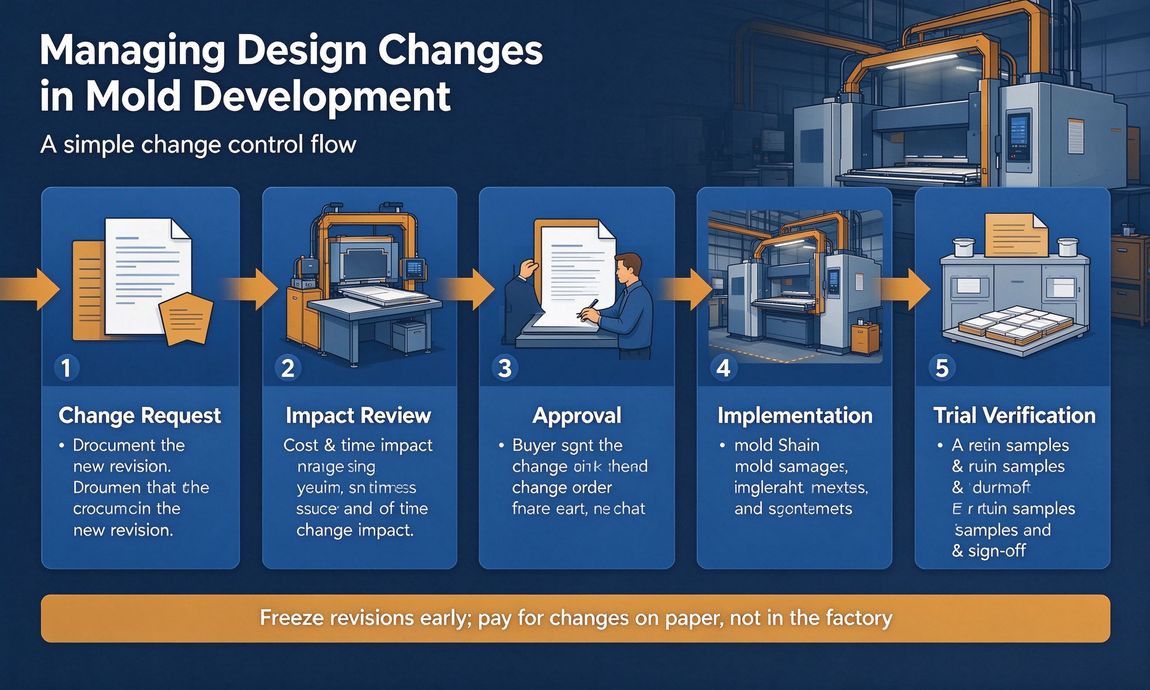
Every change should start as a written request: the new revision, the reason, the affected dimensions. Writing it down forces precision — "adjust the rib height" becomes "rib height changes from 4.0 to 4.8 mm on the gate side" — and precision is what lets the mold shop price the impact. Verbal changes on a phone call are where the schedule and the budget quietly drift, because nobody can reconstruct later exactly what was agreed. A written log also protects both sides when the next person joins the project.
Before any work starts, the supplier reviews the impact: machining hours, steel, added trials and the effect on the delivery date. The result is a change order with numbers, not a promise. Buyers should insist on this step because it converts an emotional conversation into a technical one — "this change costs this much and moves delivery by this many days". A plastic mold development manufacturer China buyer who sees the impact before approval is a buyer who controls the project, because the numbers force the question: is this change worth its price?
Once the change order is signed, the mold shop schedules the work and updates the drawings, tool paths and documentation together — the revision should change everything that references the old state, not just the cavity. Implementation is also the moment to update the trial plan: a revision needs a re-trial, not a hope that the previous trial result still holds. If the change touches the inspection plan or the acceptance criteria, those documents change at the same time, so nothing downstream is measured against an obsolete baseline.
After implementation, a trial verifies that the change actually did what it promised, and the new sample becomes the baseline. This closes the loop: the change is not done when the steel is cut but when the part is measured and signed off. Keeping the baseline current matters for everything downstream — the inspection plan, the acceptance criteria and the first-article report all follow the latest revision. A project that accumulates changes without re-baselining is a project that loses track of what it is actually building.
The revision history is not just a log — it is the proof that the mold you receive is the mold you approved. When the project ends, the buyer should be able to reconstruct the chain: the original design, every change request, each impact review, the approved revisions and the trials that verified them. That history protects both sides at the final handover, because it answers the questions that would otherwise become disputes: which revision is in production, which changes were approved, and what was tested against what.
It also protects the next stage — the inspection plan and the acceptance criteria follow the latest revision, and the first-article report for production is only valid if it matches the approved state. Ask the supplier to deliver the revision log with the mold documentation at handover; if the log is incomplete, the handover is incomplete. Suppliers who maintain the log as a matter of course make the final audit a formality. Buyers who check the log at kickoff, at trials and at handover keep the project honest at every stage — and the discipline costs little compared with the disputes it prevents.
A supplier that treats changes as a normal, documented flow is protecting your schedule; one that treats them as an exception is hiding them. Ask how changes are logged, whether change orders carry cost and time impact, and how many revisions the typical project absorbs. Bailu runs this change-control flow on every mold project, and the log is shared with the buyer so the revision history is transparent from kickoff to sign-off. When the flow is in place, changes stop being emergencies — they become line items on a shared record. The mold development page describes the tooling process the flow sits inside, and the injection molding page shows how revisions carry into production. If you want to test the flow, send Bailu a file with a likely revision scenario and see how the impact comes back priced and scheduled — the way a plastic mold development manufacturer China partner should handle it.
Let us brighten your life with safety, efficiency,and expert craftsmanship.
Contact Us
Phone : +86-159 0682 2387
WhatsApp/Wechat: +86-159 0682 2387
Email : info@bailusolution.com
Copyright © 2026 Huzhou Bailu Technology Co., Ltd. All Rights Reserved. Design by BONTOP.