


Time:Oct 30,2026
By:Bailu
Medical-related components are not just stricter versions of consumer parts — they carry a different set of expectations around precision, traceability and documentation. The challenges start long before a component is manufactured, and most of them are manageable if they are planned for at the design stage. This article looks at what medical device custom manufacturing China suppliers actually face when producing components for the sector, and how buyers can set the project up to survive scrutiny further down the chain.

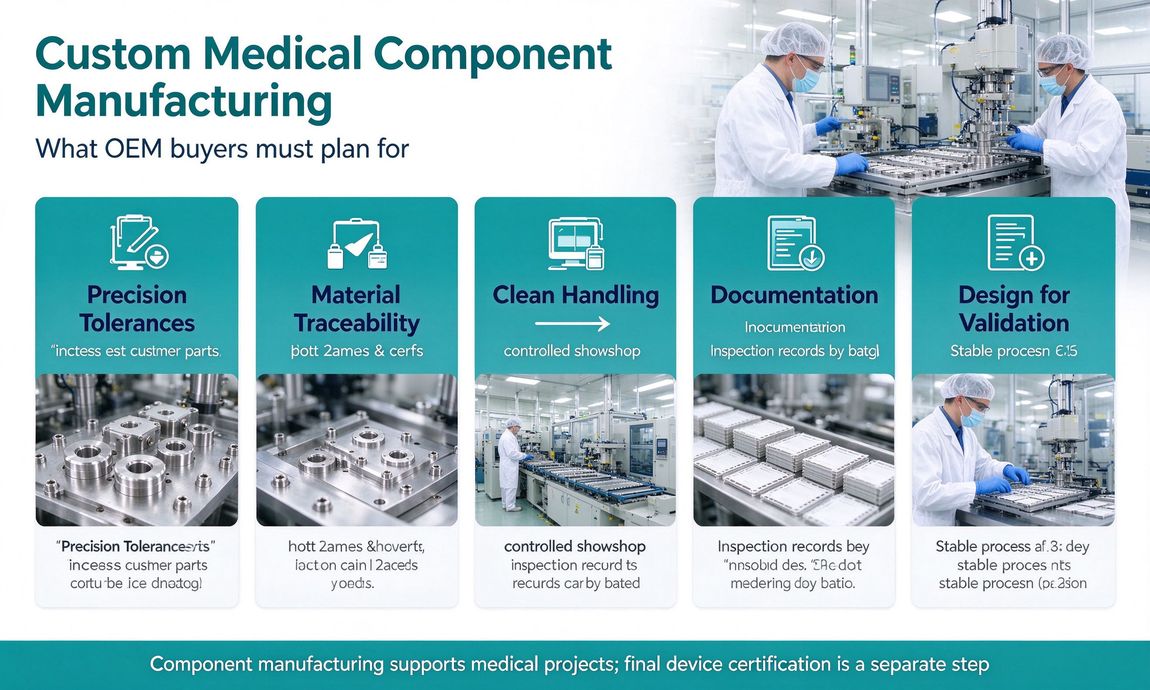
Medical components often carry tolerances tighter than consumer products — dimensions that must hold across thousands of parts, not just on the first sample. The challenge is keeping a tight tolerance stable across batches as tooling wears, material lots change and machines run long shifts. That stability comes from the mold, the process window and the inspection plan together, not from inspection alone. Expect the tolerance review to be part of the DFM conversation rather than an afterthought, because a tolerance that fights the process will be rediscovered on every trial.
In the medical sector, the question "what is this part made of" needs a documented answer. Traceability means material certificates, lot numbers and records that connect the resin to the part to the shipment. The challenge is that traceability is a system, not a single document: the supplier has to tag lots, store records and keep the chain unbroken across production and warehousing. Component suppliers with this habit built into the flow are easier partners than suppliers who treat it as paperwork they can produce on request. The record that matters is the one produced on the last batch, not the first — which is why Bailu keeps batch records on every medical-related order.
Medical-related parts may face cleanliness requirements even when they are not sterile products themselves. The challenge is the production flow: how parts are handled, stored and packed, and whether contamination is controlled at the points where it actually enters — raw material, molding, secondary operations and packaging. Clean handling does not require a cleanroom for every component, but it requires a defined flow and the discipline to keep it. Ask the supplier where the risk points are in the flow, and how a deviation would be caught. A supplier that can describe the flow precisely is more likely to control it.
Component manufacturers sit upstream of the final device, and their documentation has to support what happens next: validation, submissions and audits. That means inspection records with measured values, first-article reports, change records and batch-level summaries that a downstream customer can trust. The challenge is making documentation a habit across every order rather than an effort reserved for the first shipment. When the paperwork is automatic, the audit is a formality; when it is improvised, the audit is a negotiation.
Medical-related design constraints — material choices, biocompatibility considerations, inspection requirements — narrow the manufacturing window. DFM becomes more important, not less: the geometry, gate position and tolerance strategy have to work within the constraints of the approved material and process. A supplier that reviews the design for manufacturability before tooling is protecting the whole project, because rework in a regulated context is slower and more expensive than in consumer goods, and the changes arrive with more documentation attached.
Component manufacturers rarely work alone in the medical sector — they sit inside a longer chain that ends with the device maker, the regulatory submission and the market. That position changes what the supplier should do well: besides making the part, the component partner needs to document, respond and coordinate in ways that support the people downstream. Questions like what changed between batches, which lot went where, and whether this material matches the submission need quick, documented answers.
The practical test for a buyer is to run a mock traceability exercise: ask for the full record of a recent batch — material certificate, lot number, inspection results, shipment. If the record comes back complete, the chain is healthy; if it comes back with gaps, the gaps will surface at the worst moment downstream. The supplier's role is also to flag risks early — a material availability problem, a tolerance that will not hold, a process change that could affect the part — because upstream visibility is what lets the device team adjust while the change is cheap. Component manufacturing supports medical projects precisely by making those projects predictable, and predictability is built from records, not promises.
Component manufacturing for the medical sector is about precision, traceability, clean flow and documentation — and the right partner treats these as standard practice rather than special requests. It is worth being precise about the boundary: producing components supports medical projects, while certification of the final device is a separate step handled by the device maker and its regulatory partners. For component buyers, the practical checklist is a stable process, an unbroken record and a supplier that flags risks early — the core of medical device custom manufacturing China buyers should look for in a partner. The medical devices industry page describes the component scope Bailu works in, and the injection molding page shows the process discipline behind it. If you have a medical-related component in development, describe the tolerance and traceability requirements to Bailu Tech and the feasibility review will come back with the process plan attached.
Let us brighten your life with safety, efficiency,and expert craftsmanship.
Contact Us
Phone : +86-159 0682 2387
WhatsApp/Wechat: +86-159 0682 2387
Email : info@bailusolution.com
Copyright © 2026 Huzhou Bailu Technology Co., Ltd. All Rights Reserved. Design by BONTOP.