


Time:Nov 02,2026
By:Bailu
You send an email on Friday evening and by Monday morning nothing has moved — or worse, the workshop ran your drawing over the weekend and built the wrong revision. That is the real cost of the language and time-zone gap in a custom OEM project: not poor English, but decisions made on assumptions while everyone sleeps. A ten-hour difference plus a second language does not have to slow a project down; it gets expensive only when communication stays casual. This article lays out the working routines that overseas buyers use to keep a China OEM factory aligned without living on the phone at midnight.

The gap hides inside small messages. A question sent in the buyer's morning lands in the factory's evening inbox; by the time the engineer reads it, the batch on the line may already be running. Two hours of misunderstanding about a tolerance or a color can turn into a thousand parts that need rework. Language adds a second layer: technical terms get paraphrased, and a phrase like "glass finish" means something slightly different on each side of the call. None of this reflects bad intent. It reflects communication habits tuned to a shared office, stretched across continents, and the cure is a working routine rather than better phrases.
The first lever is paperwork. Buyers who settle every detail in chat leave themselves with no baseline, and chat threads drift; a written package removes most translation risk. The package includes the approved drawing with a revision number, the bill of materials, the color and surface references, the acceptance criteria, and the list of items that stay open. When both sides work from one numbered document, an engineer reading "rev C" knows exactly which drawing you mean. Huzhou Bailu Technology asks new buyers to send this package before quoting, because a quote built on an unclear file invites mistakes later. Writing things down also protects you when a question arises months later on the production floor.
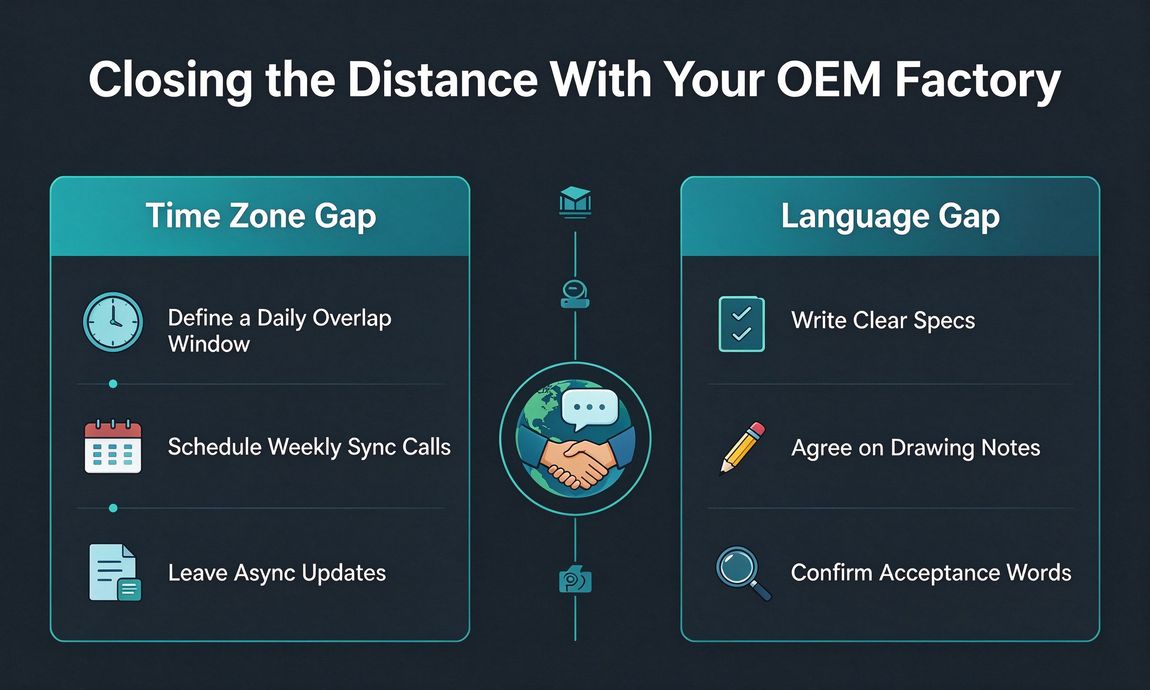
With a time difference of roughly ten hours, instant messages rarely overlap productively. The practical answer is a fixed short window: thirty to forty minutes once or twice a week, when the buyer is still at their desk and the factory's engineering team has started the morning. Inside that window you resolve open points, review samples on camera, and agree the next milestone. Outside the window, both sides leave written updates for the other to read when they wake up. When you start to work out how to find reliable OEM ODM manufacturer in China, the interview question worth asking is how they structure that sync rhythm — the answer tells you whether the team runs on a routine or on panic.
Verbal decisions made on a video call evaporate. After every sync meeting, the factory side sends a short written summary: what was agreed, what changes, and who owns the next step. The buyer replies with a simple "confirmed". That two-line exchange takes five minutes and prevents the classic nightmare where each side remembers a different version of the conversation. Revision control works the same way: every new drawing file gets a new number, old files get marked superseded, and the shared folder shows which revision the shop floor is actually holding.
Some errors survive friendly chat. Words like "tolerance", "draft angle" and "chrome" carry specific engineering meanings that casual English glosses over. A shared glossary of the terms your project uses removes that risk — pin your definitions next to the drawing notes. Numbers deserve extra care too: decimals, units and thread sizes are where confused drawings happen. When a drawing can be marked up, the factory can circle the ambiguous point instead of guessing, and you answer one question instead of discovering a mistake after molding has started.
In the opening weeks, the rhythm matters more than the tools. Week one is the written package and the NDA; week two brings the first samples reviewed on a scheduled video call; week three confirms the revision-control folder with clear access. A project that reaches this pattern early rarely accumulates surprises, because every later question references a document instead of a memory, and a disagreement resolves by opening a file rather than by arguing. Bailu sets this calendar at project kickoff — which drawing revision is approved, who sends the weekly report, and when the video review happens — so both teams know the next checkpoint before the current one ends. Buyers who let the first month run loose usually pay for it in the tooling stage, when a forgotten discussion becomes a mold change.

Before you sign anything, ask how the factory runs its weekly update, which hours overlap with yours, and how they send and track revisions. Bailu runs the routines above as standard practice: a weekly written report, a revision-controlled file folder, and one project contact who owns communication across the engineering, tooling and shipping teams. You can read more about that working rhythm on the contact page, and recent updates on the news page. Bailu Tech treats the time-zone gap as a scheduling problem with a fixed answer, not as a reason to stay up at night.
Let us brighten your life with safety, efficiency,and expert craftsmanship.
Contact Us
Phone : +86-159 0682 2387
WhatsApp/Wechat: +86-159 0682 2387
Email : info@bailusolution.com
Copyright © 2026 Huzhou Bailu Technology Co., Ltd. All Rights Reserved. Design by BONTOP.