


Time:Nov 02,2026
By:Bailu
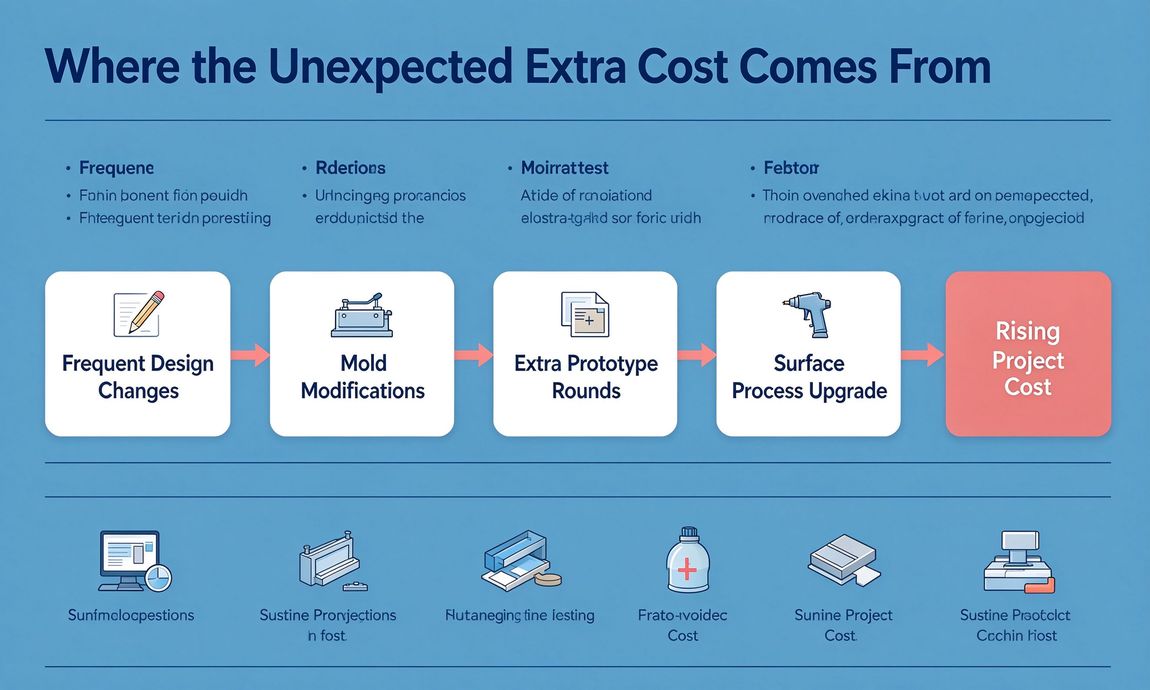
The quote you signed came in flat, but the final invoice arrived with three line items you did not approve — and each one traces back to a choice that happened weeks earlier. Custom OEM projects rarely go over budget because a supplier hid a fee; they go over because a small decision at the wrong stage multiplies into rework. A sober OEM project cost estimation China factories give out usually breaks the budget into the part price, the tooling and the service hours, and the surprises live in that third bucket. This article follows the causal chain so you can spot each driver before it becomes an invoice.

An OEM quotation is a snapshot of the information you sent. If the drawing arrives without a tolerance note, the factory prices a reasonable guess; if the color sample is missing, they price a generic finish. The guesses become part price, and everything you later refine — a tighter tolerance, a specific Pantone tone — becomes change work. The first rule of budget control is that extra cost is not created by the factory. It is created when scope changes after the number was locked.
A design change in the sketch phase costs an hour of CAD time. The same change after the mold is cut costs mold modification: removing and welding steel, re-machining cavities, re-polishing surfaces, and proving the tool again. Every week later in the project, the same idea costs more. The buyers who stay on budget treat the design freeze as a real event, with a checklist of open points closed before the tool is cut, instead of a polite suggestion they revisit when the first sample arrives. That discipline is cheaper than any negotiation, because a signed freeze date focuses the whole team.
Prototypes look cheap next to a mold, which is exactly what makes them dangerous. A buyer who asks for a second, third and fourth version — each time "just one small change" — pays for engineering, machining and shipping on every round, and delays the tooling start. The habit that prevents this is agreeing the purpose of each prototype before ordering it: concept check, fit check, or function check. When each round answers one named question, you stop treating the prototype as a preview of the product and start treating it as an experiment that retires a specific risk. Each prototype round also pushes the tooling start, and tooling start dates slide into shipping dates, which is a second cost the invoice does not show.
A matte texture, a brushed metal look or a soft-touch coating sounds like a finish detail chosen at the end, but it changes the cost structure of the part. Textured mold surfaces add machining time; anodizing versus painting changes the line and the inspection; overmolding adds a second material and a second cycle. Decided after quoting, these upgrades arrive as a surprise supplement. Decided before quoting, they enter the unit price where they belong, and you compare them against the budget with open eyes. Asking the factory to quote the finish in two levels — standard and upgraded — before the mold is cut gives you a number you can compare, instead of a request that arrives mid-project.
The sneakiest driver is the sequence of tiny requests: add a logo engraving, change the screw type, adjust the box print. Each request is reasonable and cheap on its own. Together they consume engineering hours, require re-setup on the press, and push the schedule. Keeping a numbered change log — date, item, impact on price and lead time — turns invisible tweaks into visible items, and most teams slow down their request rate once the log is visible to both sides.
A change log is the cheapest control on the whole project. Each row records the request, the date, the agreed price change and the lead-time impact, and both sides initial it. The log does not stop changes — changes are normal in custom manufacturing — but it stops silent ones. When a request lands in the log, the buyer sees its cost before approving it, and the factory records the extra hours so the final invoice matches reality. Bailu keeps this log inside the project folder and shares it at every weekly sync, which is why the supplement list at the end of a Bailu project reads like a summary rather than a surprise. Buyers who request the log mid-project are usually the ones staring at the surprise; buyers who start it on day one review it as a routine item.
The practical move is to ask the factory, at quotation stage, which items in your package are priced as assumptions rather than as confirmed requirements. Bailu lists those open points on the quote itself so the buyer can close them before tooling instead of discovering them on the invoice. You can send your drawing through the contact page for a transparent cost breakdown, and read how other buyers controlled surprises in the news page. Bailu Tech treats the surprise invoice as a planning failure, not a pricing failure, and the buyer who keeps the change log is the one whose final number matches the signed one.
Let us brighten your life with safety, efficiency,and expert craftsmanship.
Contact Us
Phone : +86-159 0682 2387
WhatsApp/Wechat: +86-159 0682 2387
Email : info@bailusolution.com
Copyright © 2026 Huzhou Bailu Technology Co., Ltd. All Rights Reserved. Design by BONTOP.