


Time:Oct 30,2026
By:Bailu
Your mold quote comes back higher than expected, and the supplier points at the geometry rather than the material — a hooked wall here, a deep side action there, walls that jump thickness halfway around the part. That is the moment most buyers realize that mold cost is set by the design, not by the steel. A plastic mold development manufacturer China teams work with prices the complexity of the tool, and complexity is something you control on the drawing board before the first cut. This article walks through the design changes that pay back the most, in the order you should make them.

A mold is a custom precision machine: two halves of tool steel carved into the inverse of your part, plus the pins, sliders, cooling channels and ejection system that make it repeatable. Every feature that prevents the part from opening in a straight draw direction becomes a moving part — a slide, a lifter, an angled pin — and moving parts cost money to design, machine, fit and later maintain. Thin deep ribs, tight tolerances stacked across features, and cosmetic faces that need hand polishing all add hours on the tool room clock. The takeaway is that each geometry feature carries a hidden tooling price, and DFM review is where those prices get visible.
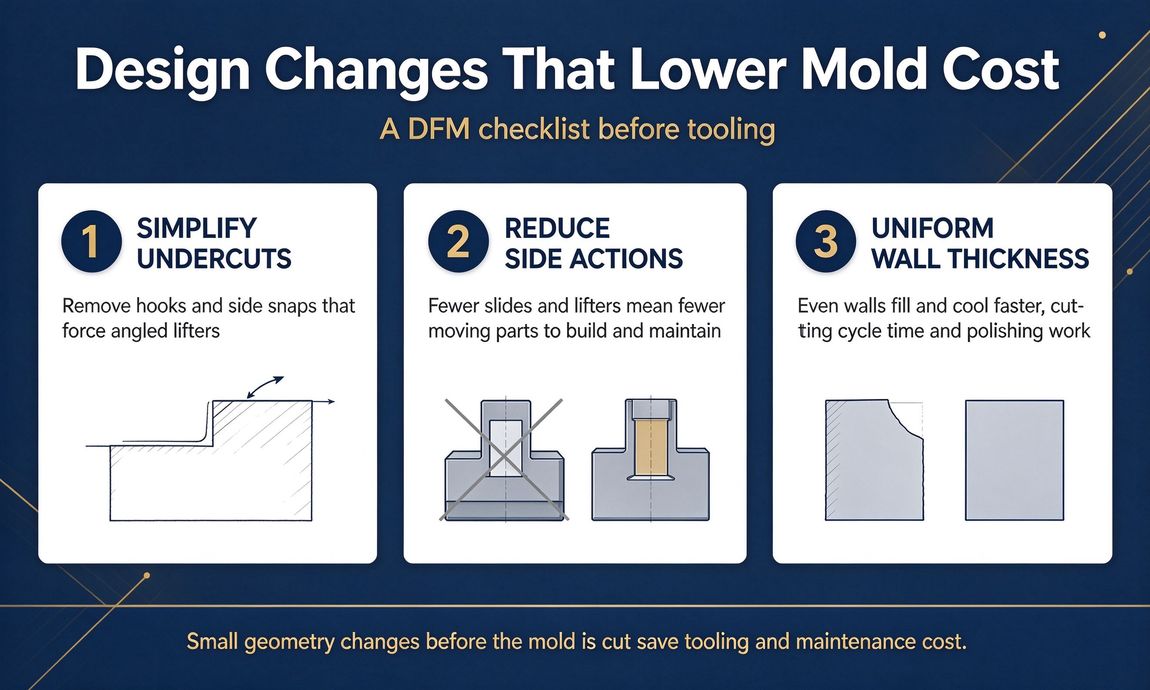
Undercuts are the single biggest cost driver on most quotes. A hook, a side snap, an internal thread or a window that the parting line cannot clear forces an angled lifter or an external slide — hardware that multiplies the machining hours and the leak paths on the mold face. You have three levers: redesign the feature so it releases in the straight draw direction, move it to the parting line plane, or replace the snap with an assembly detail such as a separate clip captured at final assembly. A hooked interior wall that becomes a capped boss, or a side snap that becomes a separate clip, removes the lifter from the bill of materials entirely. A molded snap that becomes a glued-in insert often pays back the change in the first quote round, and the rest of the production life shares the saving.
Each slide or lifter is a standalone subsystem: guide rails, wear plates, actuation, cooling cutouts and timing with the opening sequence. Two side actions on one mold are manageable; four or five start pushing the tool into a different cost class, and they also slow the cycle because the mold cannot close until every slide is home. Each slide also adds a leak path for cooling water and a wear surface that polishing later cannot fully restore. When a design needs several side features, ask the mold maker which ones can be merged onto a single angled direction, which can be moved to the parting plane, and which are better executed as secondary assembly steps. A careful conversation at this stage routinely removes one or two slides without touching the function of the product.
Uniform walls are not an aesthetic rule — they are a tooling and cycle-time rule. Abrupt thickness changes leave thick sections that sink, warp and take longer to cool, which means longer cycle times and more polishing to hide sink marks. The fix is gradual: taper into bosses, gate near the thickest section, and keep nominal walls in the range the material likes. Even walls also let the melt flow more predictably, which reduces short shots and weld lines that would otherwise demand cosmetic rework. The mold maker sees the same picture: a part that fills and cools predictably is a part that tolerances hold without extra engineering.
Over-specified tolerances are a quiet cost driver. A tolerance that the molding process cannot naturally hold forces hardened inserts, refined cooling, trim stations and inspection steps — all billed back into the tooling. A DFM review maps each critical dimension against the realistic capability of the process, and the buyer usually finds that a few tolerances can relax to standard without affecting assembly. The rule of thumb: tighten only the dimensions that mates with another part, and leave the cosmetic and non-functional dimensions at process default. Ask for a tolerance map before the mold is cut, not after the samples arrive. Bailu maps each critical dimension against realistic process capability during the DFM review, so the relaxation list comes back with a reason attached to every number.
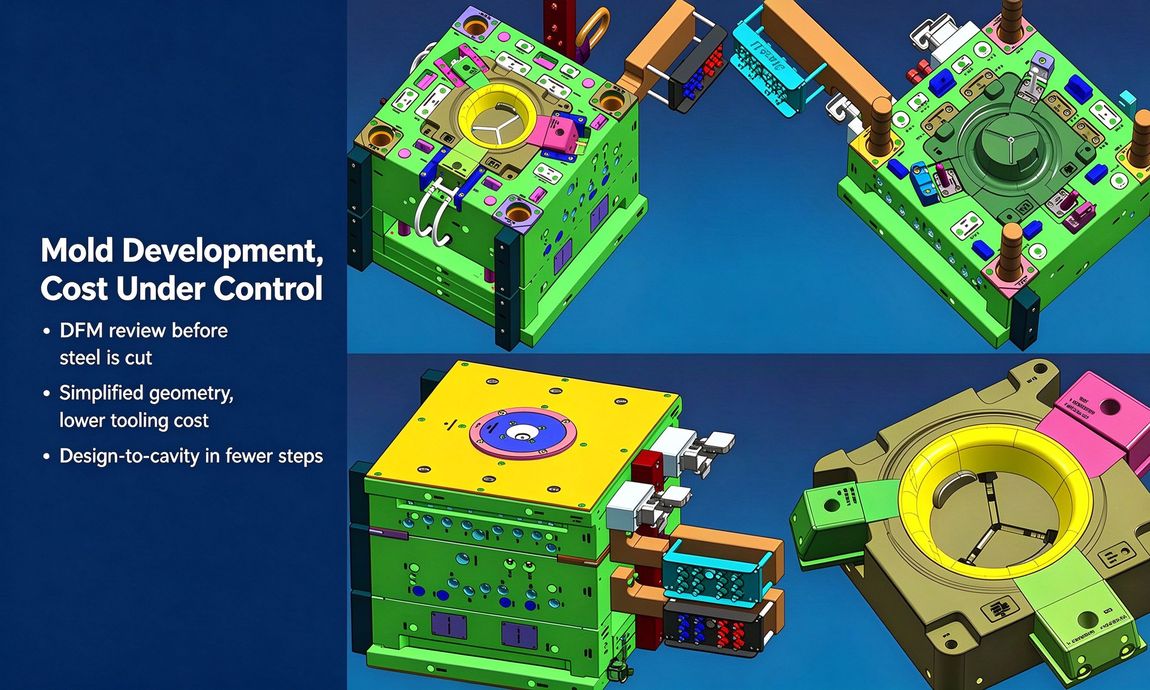
The working sequence is simple: send the CAD model with the functional requirements, ask the mold team for a DFM report listing every feature that adds tooling cost, then negotiate the design change by change. Each change carries its own price saving and its own functional trade-off, so you can see exactly what you are giving up. Working with an experienced injection mold maker China buyers can rely on means this conversation happens before steel is committed. Bailu runs product design, DFM and mold development in one shop, so the redesign does not bounce across vendors — see the mold development workflow and the injection molding process to see where the review lands. Bailu Tech prices the geometry first: the earlier you ask, the more of the quote is still movable.
Let us brighten your life with safety, efficiency,and expert craftsmanship.
Contact Us
Phone : +86-159 0682 2387
WhatsApp/Wechat: +86-159 0682 2387
Email : info@bailusolution.com
Copyright © 2026 Huzhou Bailu Technology Co., Ltd. All Rights Reserved. Design by BONTOP.