


Time:Oct 30,2026
By:Bailu
The mold bought fine two years ago, but the repair invoices keep climbing: worn cores, sticky ejectors, discolored cavities, polished surfaces that need re-polishing again. What turns a good tool into a money pit halfway through a product life? The answer is that maintenance cost is written into the mold early — in the steel grade, the gate design, the cooling layout and the material choice. Buyers who budget only the tool price discover the second invoice stream two years in, when the maintenance schedule turns out to have no owner. An injection mold maker China buyers work with prices the tool once, but the design decides what the shop floor pays for the next five years. Here is where the money actually goes.

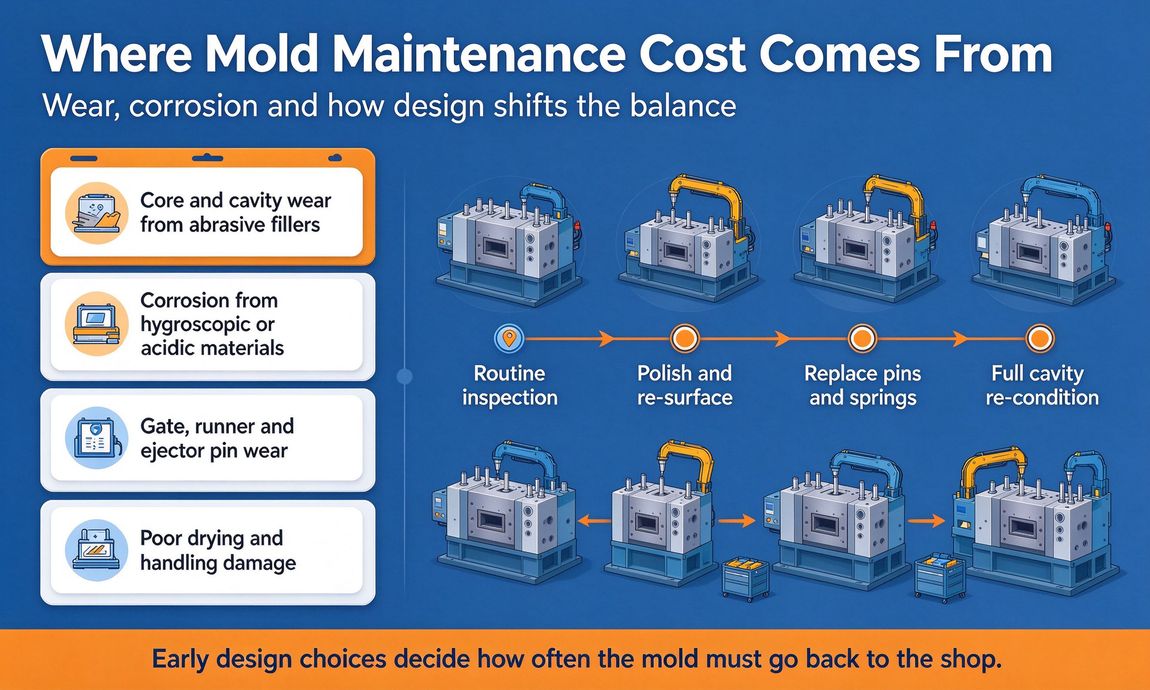
Filled materials — glass fiber, mineral fillers, flame-retardant compounds — act like abrasive grit as they flood through the cavity shot after shot. The flow core sees the fastest erosion: edges round off, fine details blur, and the polished face starts to show a matte finish where it used to be glossy. The countermeasure is chosen at tool design time: a pre-hardened mold steel for unfilled resins, a harder tool steel or surface treatment when the resin carries filler. Bailu upgrades filler-heavy programs to hardened inserts before the first sample run, because re-cutting a worn cavity mid-production is the expensive version of the same decision. Skipping that step is the classic maintenance trap — the mold looks fine on delivery, and the bill arrives twenty thousand shots later in re-polishing and insert replacement.
Nylons, acetals and many engineering grades release gases and acids as they heat and cool, and those by-products attack the cavity steel between cycles. Corrosion shows up as dull patches on the cosmetic face, rust spotting under the surface, and gradual pitting that polishing only masks for a while. Pitting that starts small tends to grow under the surface, which is why cosmetic faces rarely survive a bad storage cycle. The defenses start with steel selection and surface finish, but they continue on the shop floor: adequate material drying before the barrel, proper purging after runs, and rust inhibitor on the mold face during storage. A mold that sits wet overnight pays for it in the next sampling round.
The gate is the narrowest point in the melt path, so it takes the highest shear and the highest velocity. Gates erode first: the vestige grows, the gate blemish spreads, and eventually the runner system needs re-cutting. Ejector pins are the other wear point — they flex, they bind on misalignment, and their tips mark the part if the finish slips. Both wear points are predictable, which means they can be designed for: replaceable gate inserts, hardened pin sleeves, generous cooling around the gate region, and a pin layout that does not flex under ejection load. A maintainable mold treats these as service parts, not as permanent geometry. Vestige size and gate blemish grow together, which is why cosmetic housings usually gate on hidden faces and budget a small degating station in the line layout.
Not all wear comes from production. A dropped mold during transport, a cavity closed on a loose bolt, an undried hygroscopic resin run that leaves residue behind, or a mold stored open on a rack — each one produces a repair that could have been avoided. This is why maintenance cost is partly a process-discipline question: a written drying schedule, a mold closing checklist, torque marks on bolting, and a storage routine with inhibitor film. Suppliers running long production programs fold this into the operating manual they deliver with the tool, so the buyer's team does not reinvent the discipline.
A healthy mold runs on a planned rhythm rather than a panic repair: visual inspection after the first sampling, light polishing and cleaning at intervals set by shot count, scheduled replacement of pins and springs, and a deeper re-conditioning of the cavity face at major milestones. The interval numbers come from the material and the steel, which is why the DFM conversation before tooling should include an expected shot life and maintenance budget. That conversation also flags where hardened inserts or upgrades are cheap now and expensive later. Bailu writes the shot-count intervals, polishing notes and spare-parts list into the tool's operating manual, so the shop floor follows one routine instead of inventing it. Buyers who skip it discover the maintenance schedule only when the quality drifts.
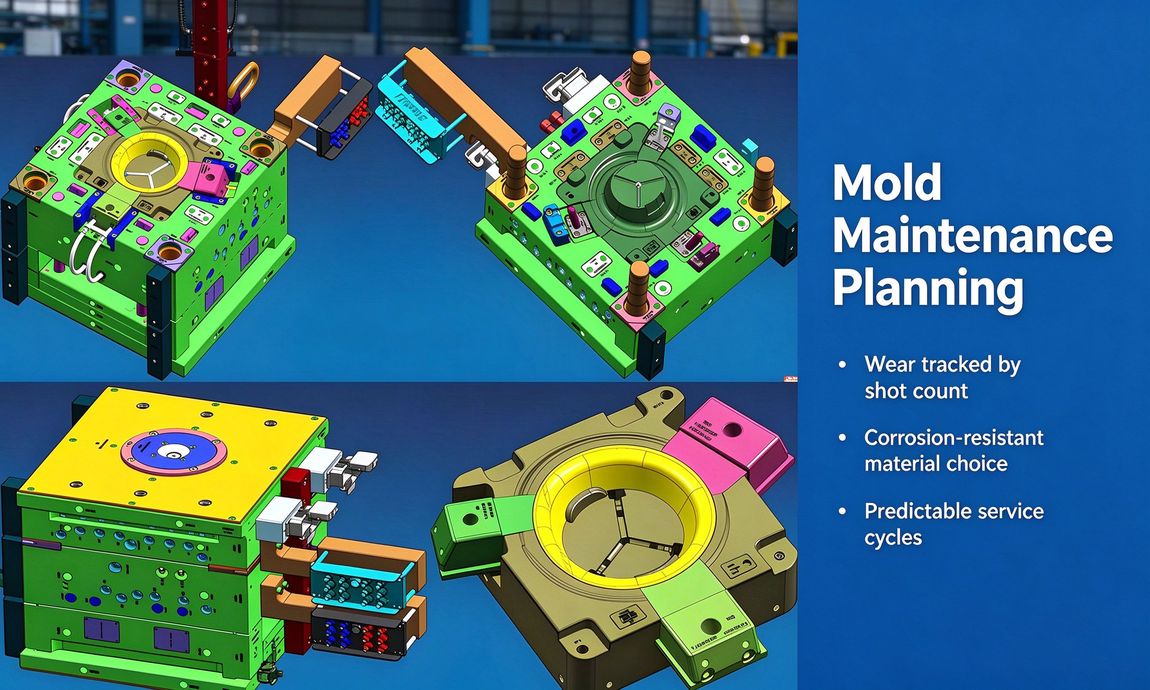
The pattern across every driver is the same: the expensive fixes happen after the mold is cut, and the cheap ones happen in design review. Steel grade matched to the filler level, gate inserts designed to be replaced, cooling that controls the thermal stress, drying and handling rules written into the operating manual — each is a small decision made once, amortized over the whole production life. Working with an experienced injection mold maker China product teams trust means these choices are on the table before quotes lock: see the mold development process and the injection molding workflow to understand how maintenance planning is built into the tool. Bailu Tech treats every mold as a serviceable asset, and the maintenance schedule is part of what you receive with the first samples.
Let us brighten your life with safety, efficiency,and expert craftsmanship.
Contact Us
Phone : +86-159 0682 2387
WhatsApp/Wechat: +86-159 0682 2387
Email : info@bailusolution.com
Copyright © 2026 Huzhou Bailu Technology Co., Ltd. All Rights Reserved. Design by BONTOP.