


Time:Oct 30,2026
By:Bailu
Your printed prototype clicks together, survives the drop test and looks close to the product you pictured — yet the first molded sample comes out warped, brittle or off-dimension, and no one on the team saw it coming. The root cause is usually a hidden assumption: that a 3D printed part behaves like the production part it represents. A product prototyping service China buyers order early in a project exists to retire specific risks, not to predict every property of the final molded part. This article lists the limitations worth knowing before you sign off a printed sample and move on to cutting steel.

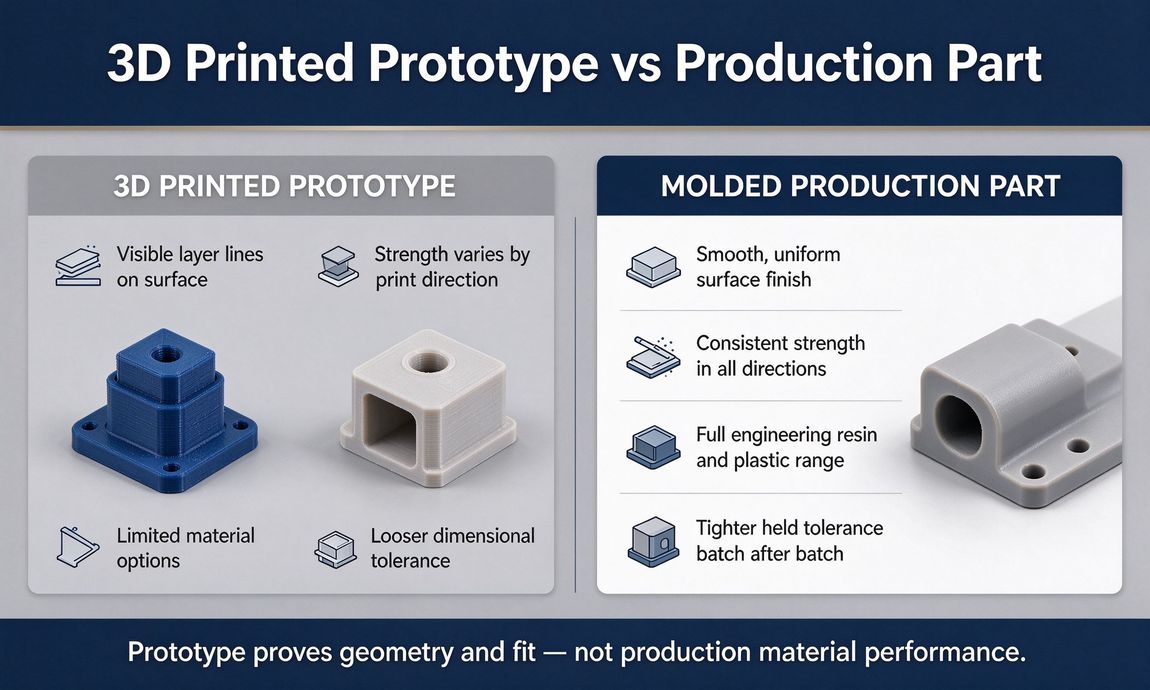
Printed resins and sintered nylon share a shape with ABS or PC, not their mechanical behavior. An SLA photopolymer is typically more brittle than an engineering molding resin, and its impact resistance drops quickly as the wall gets thinner. An SLS nylon part is tough, but it absorbs moisture differently and feels grainy compared with an injection-molded nylon of the same grade. When a printed part passes a hand-cycling test, it proves the geometry survives handling; it does not prove that the chosen molding resin will pass the same load cycle ten thousand times. Treat material questions as open until the production resin itself has been tested, and ask your prototyping partner which printed material sits closest to your target resin for each specific test.
3D printed parts are built in layers, so strength is anisotropic: a snap-fit arm may hold firm when flexed one way and split along the layer lines when flexed another. Molded parts behave differently because the molten material flows and cures as one continuous volume, giving roughly uniform strength in all directions. This matters whenever the design relies on a clip, a living hinge or a thin bracket. A printed hinge that opens and closes a hundred times may still mislead you if the molding grade was not validated for two thousand cycles. Ask the shop how the part was oriented on the build plate, and read any strength result as directional evidence rather than a global number for the production part.
A printed part typically lands within a few tenths of a millimeter of nominal, while a well-tuned mold holds tighter and more repeatable tolerances, cavity after cavity. That sounds like bad news for the prototype, but the practical risk runs the other way: buyers approve a tight interference measured on a loose-tolerance print, and then wonder why the molded version binds in the assembly. The gap between the two is normal. The fix is to draw your fit requirements on the CAD model with realistic production tolerances in mind, and use the prototype to confirm clearance and mating rather than to certify the tightest stack-up. When in doubt, build the test fit at the loosest tolerance the mold can deliver and check the worst case on paper first.
Layer lines, support marks and a matte grain are easy to ignore on a prototype because the part already reads as finished to the touch. Injection molding delivers a different surface texture, and the cosmetic route — painting, UV coating, pad printing — adds its own thickness, coverage rules and defect risks. A prototype can look production-ready while hiding decisions about gate location, ejector marks and parting-line position that will appear on every molded unit, including the faces the user stares at. When you approve the look of a printed sample, ask which mold marks will transfer and where they will land on the visible surface, so the finishing budget and the aesthetic target are planned together. Gate vestiges and ejector dimples follow the mold geometry, not the print, and none of them are visible on a clean printed sample.
Frame each prototype round around the specific risk it exists to kill. Early rounds answer: does the shape feel right in the hand, does the enclosure close, do the internal parts fit without interference? Later rounds answer: does the snap arm hold under load, does the seal compress evenly, does the assembly survive repeated use and shipping vibration? Keep each round tied to a question, and write down what it proved and what it left open. That handoff note is what turns a folder of samples into an engineering record that a mold team can actually build from. Suppliers that run a product prototyping service alongside molding, as Bailu does, carry that note straight into the mold discussion instead of restarting the conversation from a photo of the part.
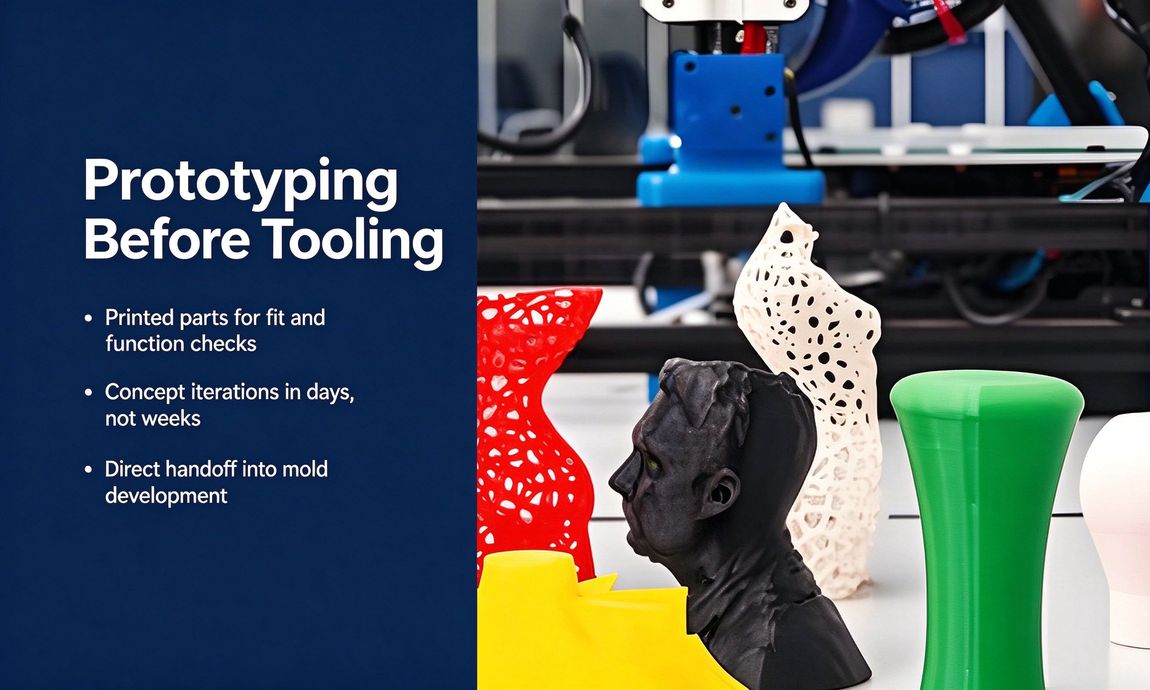
Three habits remove most of the mismatch. First, list the loads and environments the part must survive, and make sure the prototype test covers them, using production material where a hand test is not enough. Second, set fit tolerances against what a mold will hold, not what a printer delivers. Third, budget one validation round with the actual molding resin before large production begins. Bailu runs custom product design service, prototyping and tooling inside one flow, so the printed sample you approve is reviewed against the mold it will become — see the prototyping service scope and the product design process to understand how the handoff is structured. Bailu Tech will tell you plainly which questions the prototype answered, and which ones still need the steel to settle.
Let us brighten your life with safety, efficiency,and expert craftsmanship.
Contact Us
Phone : +86-159 0682 2387
WhatsApp/Wechat: +86-159 0682 2387
Email : info@bailusolution.com
Copyright © 2026 Huzhou Bailu Technology Co., Ltd. All Rights Reserved. Design by BONTOP.