


Time:Oct 30,2026
By:Bailu
Two buyer specs, same enclosure, same geometry — one chooses ABS and sells a glossy consumer gadget, the other chooses PC and survives a warehouse drop test, and both think they picked the obvious option. Why does material choice feel obvious in the pitch and get disputed at the factory? Because the right resin is decided by the environment the housing lives in, not by how it looks on a shelf. An injection molding manufacturer China product teams choose can only tune the process to the resin you pick; the choice itself is where the risk sits, and the supplier cannot reshape the chemistry after the order is placed. Here is how to work through it in the right order.

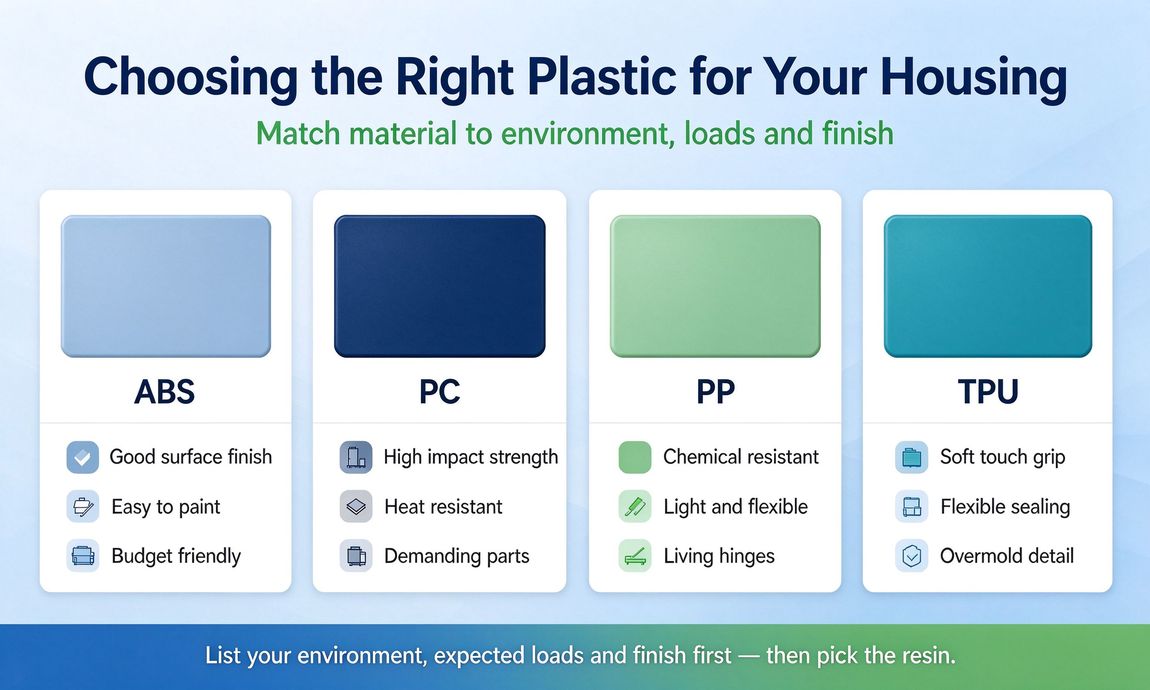
Start with the conditions the housing will actually meet, not with a preferred grade. What temperature range does it see — inside a closed device on a hot shelf, outdoors through a winter, next to a heat source? Which chemicals touch it — cleaners, sunscreen, oils, fuels? What mechanical loads apply — a handheld product dropped on concrete, a housing stacked on pallets, a part clipped onto a moving machine? What cosmetic target do you need — painted gloss, soft-touch feel, textured matte, transparent? When that list is on paper, each candidate resin answers it with facts, and the shortlist shrinks fast. Bailu starts every housing project with that condition list in writing, not with a preferred grade. Most housing failures come from answering this step by habit instead of by environment.
ABS is the default for consumer enclosures because it flows well, machines smooth, and takes paint, chrome and plating beautifully. It carries decent impact strength at room temperature, good stiffness, and a price point that leaves room for the rest of the product. Its limits are equally clear: it softens under continuous heat beyond around seventy degrees, it is sensitive to UV when left outdoors, and chemicals like solvents and many cleaners attack the surface. ABS suits indoor, room-temperature, cosmetic housings where appearance and budget matter more than extreme load — think chargers, small appliances, consumer electronics and decorative covers.
Polycarbonate is the step up when the housing must survive abuse. It is significantly stronger, nearly unbreakable under typical drop tests, and keeps its shape at higher temperatures — which is why transparent and safety-critical parts favor it. The trade-offs: it is more expensive, it scratches more easily unless coated, and it is sensitive to stress cracking when exposed to solvents. PC also demands more drying before molding, which shows up in process cost and in maintenance on the mold. Choose PC for housings that carry real loads, see heat, or live in rough environments — industrial enclosures, visible safety parts, outdoor equipment covers. The finish reads well, but the family ages faster outdoors and fades under UV, which is why interior cosmetic covers favor it while exterior panels look elsewhere.
Polypropylene is the quiet option people underestimate. It resists chemicals well, stays light, flexes without fatigue, and is the natural choice for living hinges, snap tabs and containers that wash clean. It feels less rigid than ABS, has a soft surface that takes texture well, and it costs less per part. Where it falls short: it warps more easily on thin walls, it is not the pick for glossy cosmetic faces, and its dimensional stability is looser, so tight fits need design compensation. PP fits storage housings, appliance interiors, caps and lids, and anything that meets chemicals or repeated flexing. Bailu often pairs PP with a textured mold finish, since the soft surface hides the scratch marks that glossy faces would show.
Thermoplastic polyurethane is rarely the main housing — it is the layer on the housing. It gives the soft grip on a power tool handle, the sealed gasket around a port, the bumper that absorbs a drop edge. Overmolded TPU onto a rigid shell combines the structure of ABS or PC with the tactile and sealing benefits of elastomer in one assembly step. Overmolding adds a second cavity and a second shot to the mold, so expect the tooling quote to reflect that before the project is approved. If your housing needs grip, sealing, or a soft appearance, plan for overmolding early, because it changes the mold design and the quoting structure. TPU is not a material for the whole enclosure; it is the detail that upgrades one.
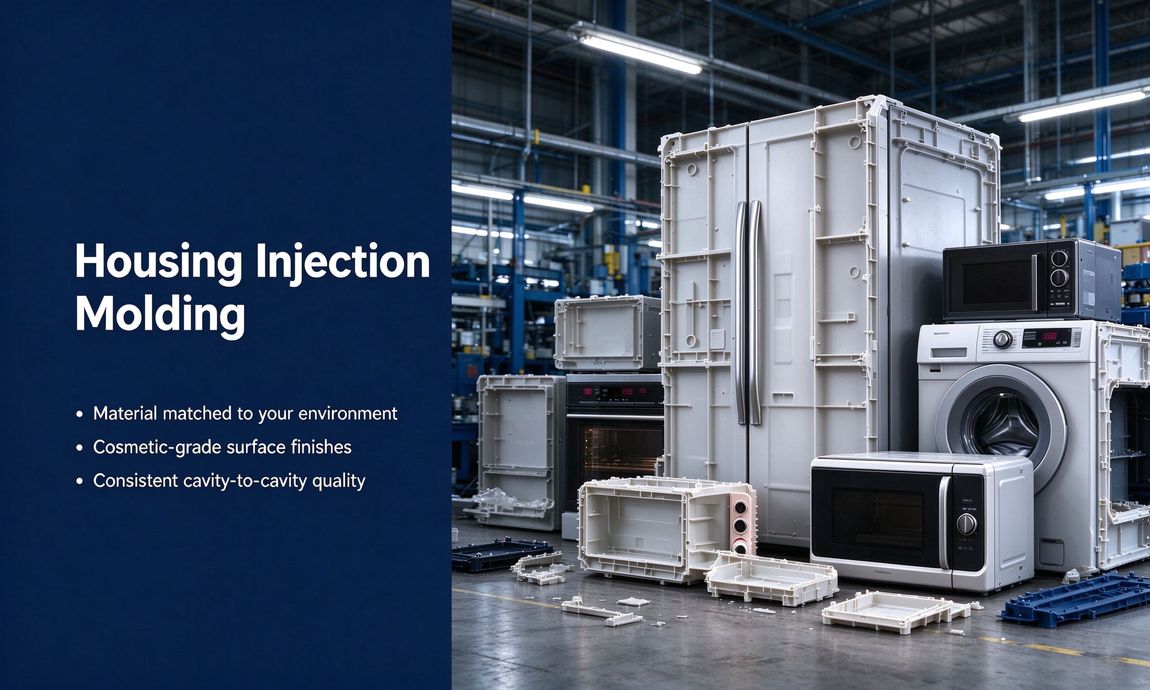
The last check is manufacturability. Each resin flows differently, shrinks differently, and asks different things of the tool: drying requirements, mold temperature, cooling time, gate sensitivity. Drying temperature, mold temperature and cooling time each shift the cycle cost, and each resin grades differently on scrap rate at start-up. A glossy ABS face needs a well-vented, polished cavity; a textured PP part wants generous draft. This is why material selection should land before DFM review, not after — the mold design follows the resin. When you work with a custom plastic parts manufacturer China teams rely on, the material shortlist and the mold design move together: see the injection molding process and the mold development workflow for how the sequence runs. Bailu Tech recommends the resin against your environment list first, then tunes the mold around it — the two decisions are one conversation, not two.
Let us brighten your life with safety, efficiency,and expert craftsmanship.
Contact Us
Phone : +86-159 0682 2387
WhatsApp/Wechat: +86-159 0682 2387
Email : info@bailusolution.com
Copyright © 2026 Huzhou Bailu Technology Co., Ltd. All Rights Reserved. Design by BONTOP.