


Time:Oct 30,2026
By:Bailu
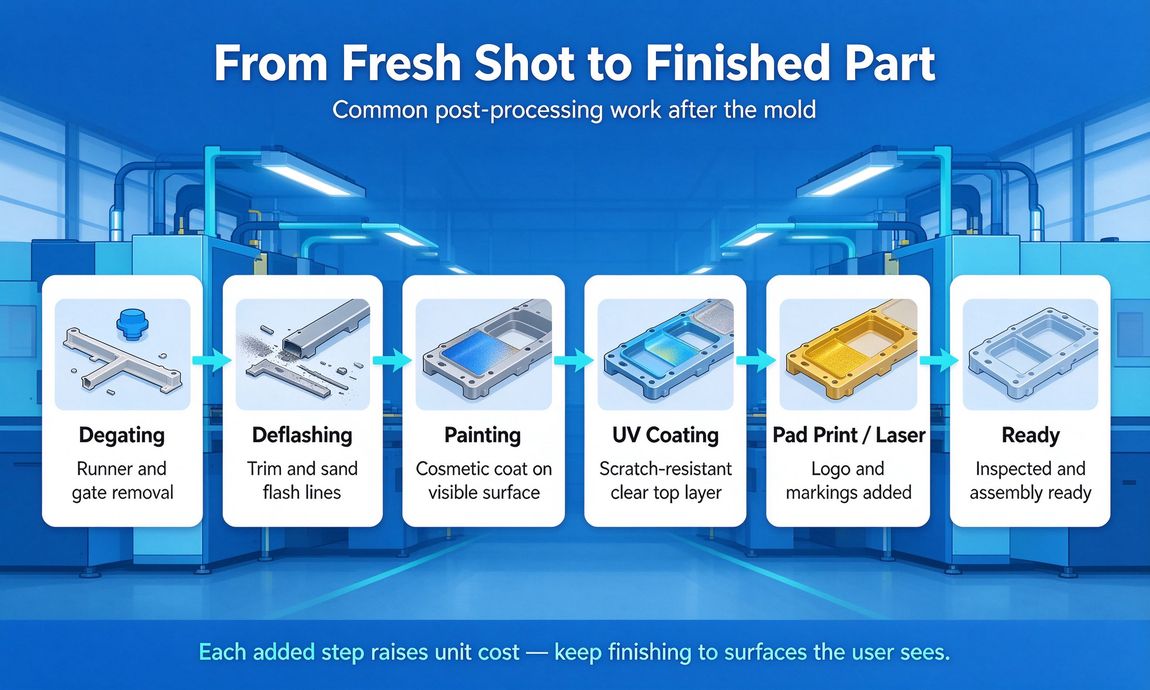
The molded samples arrive and the shape is right, but the surface is not what your render promised — gate marks visible, flash lines along the parting plane, no logo in sight. At that point buyers discover that the molded part is not the finished part, and the finishing line is where the product actually comes together. The mold produces one shape; the finishing line produces the product you ship. An injection molding manufacturer China customers work with quotes the molding separately; the post-processing steps chosen after the shot decide how the product looks, and how much each unit costs. Here is the standard route from fresh shot to shippable part.

The part comes out of the mold still attached to the sprue and runner — the plastic channel that fed the melt into the cavity. The first operation is degating: snapping, cutting or milling the gate off, then trimming the vestige flush with the part face. Gate design decides how much of this remains: a pinpoint gate leaves a tiny mark that hides on internal faces, while a larger edge gate leaves a visible nub that needs sanding. This step is routine and cheap, but the quality of it shows on every visible surface, which is why gate placement is planned around appearance early in mold design. Hidden gates make this fast; visible gates make it a bench job.
A small amount of flash — a thin feather of plastic squeezed along the parting line — is normal, and it has to be removed before anything cosmetic happens. Operators trim the flash with knives or tumbling, then sand the parting line and the gate area until the face reads smooth. This is the hand-labor step that surfaces on the unit cost, especially on large or highly cosmetic parts, and it scales with part size rather than with volume. The cleanest mitigation happens upstream: a tight mold fit, clean tool edges and even walls keep flash thin and easy, so the sanding bench has less to repair. Parts headed for painting need this step at a higher standard, because paint magnifies every scratch.
Painting is how a molded part takes a color or texture the resin cannot give it — metallic finishes, two-tone effects, soft-touch coatings. The process is a primer, color coat and sometimes a clear layer, cured in controlled batches. It is also where defect rates climb: dust nibs, orange peel, adhesion loss on the wrong resin. Bailu treats paint lines as a station budget from the quote stage, because the defect rate there sets the production cost. ABS and PC paint well; PP is harder to coat without flame or plasma treatment. Expect painting to be one of the larger per-unit costs, and design the part so the painted face has few edges and recesses that trap overspray. Two-tone parts need masking stations between coats, which multiplies the labor on the cosmetic face. The rule buyers learn late: every painted face is a station, not a finish.
UV coating is a clear acrylic layer cured under ultraviolet light, applied over a painted or molded surface. Its job is protection — scratch resistance, chemical resistance, a tougher gloss that survives handling. It is common on touch surfaces, consumer electronics shells and parts that ship against other components. The cost sits between painting and hard plating, and the cure station adds throughput time. UV coating is worth adding where the user touches the part daily; on hidden internal faces, it is money that does not show. Bailu quotes the UV station as an optional line, so buyers can see exactly what the upgrade costs before approving the cosmetic spec.
Markings arrive after the cosmetic surfaces are settled. Pad printing transfers a small image onto curved or flat faces; silk screen covers larger areas; laser engraving etches the logo directly into the resin, which survives where print wears off. Each method reads differently at production scale: pad printing excels on curved small faces, silk screen on flat panels, laser engraving on parts where the marking has to survive wear and cleaning. Each method has a cost tier and a quality trade-off: pad printing is flexible for odd geometry, silk screen is economical for flat panels, laser engraving is permanent but changes the surface texture. For regulated products such as toys, the marking stage is also where material-safety and labeling compliance details are documented, so the test records stay tied to the batch.
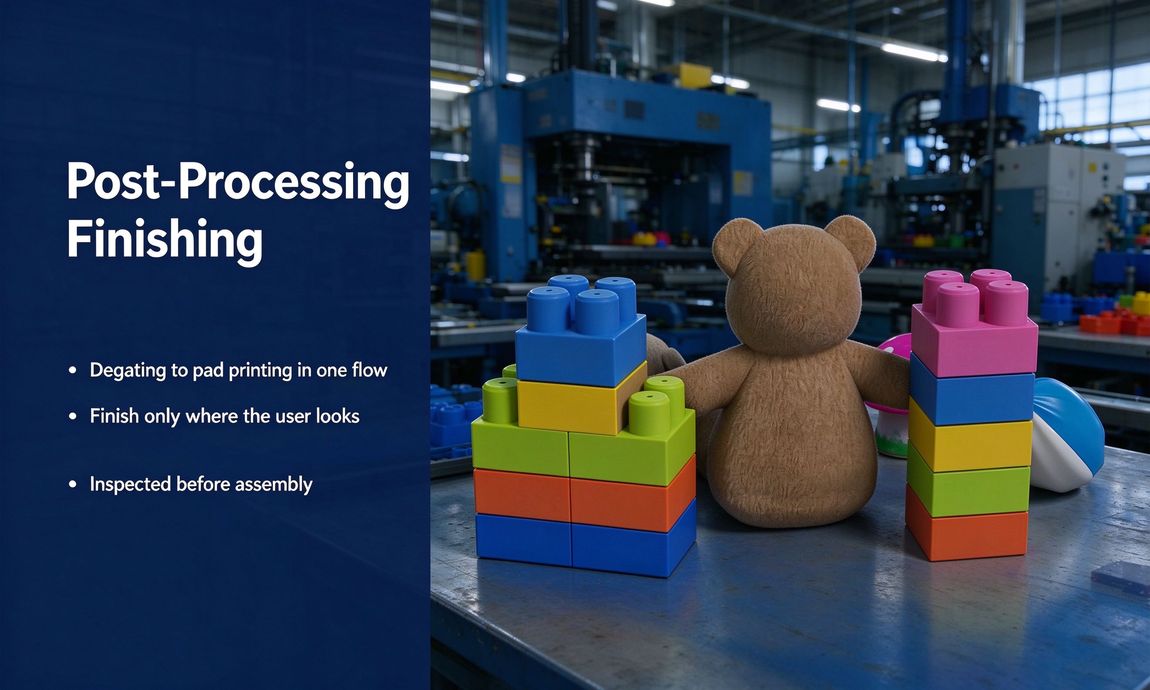
The pattern across all steps is simple: each added station raises unit cost slightly, and each cosmetic choice you remove removes a station. The discipline is to finish only the surfaces the user actually sees — paint the front housing, not the inner tray; print the logo where it faces the customer; leave the hidden faces as-molded. When you work with a custom plastic parts manufacturer China teams trust, the finishing route is planned with the mold: see the injection molding process and the mold development workflow to understand how gate and parting-line design feed the finishing bill. Bailu Tech sizes the finishing route against your render from day one, so the per-unit cost you quote in the project plan is the one you actually pay at the end.
Let us brighten your life with safety, efficiency,and expert craftsmanship.
Contact Us
Phone : +86-159 0682 2387
WhatsApp/Wechat: +86-159 0682 2387
Email : info@bailusolution.com
Copyright © 2026 Huzhou Bailu Technology Co., Ltd. All Rights Reserved. Design by BONTOP.