


Time:Oct 30,2026
By:Bailu
A mold quotation depends on information the same way a recipe depends on ingredients: leave out one item and the result changes. Buyers who send a bare 3D file and ask "how much is the mold" get a number that will move later; buyers who send a complete input package get a quote that holds. This article lists what a plastic mold development manufacturer China supplier needs from you, and why each item changes the tooling price and the schedule.

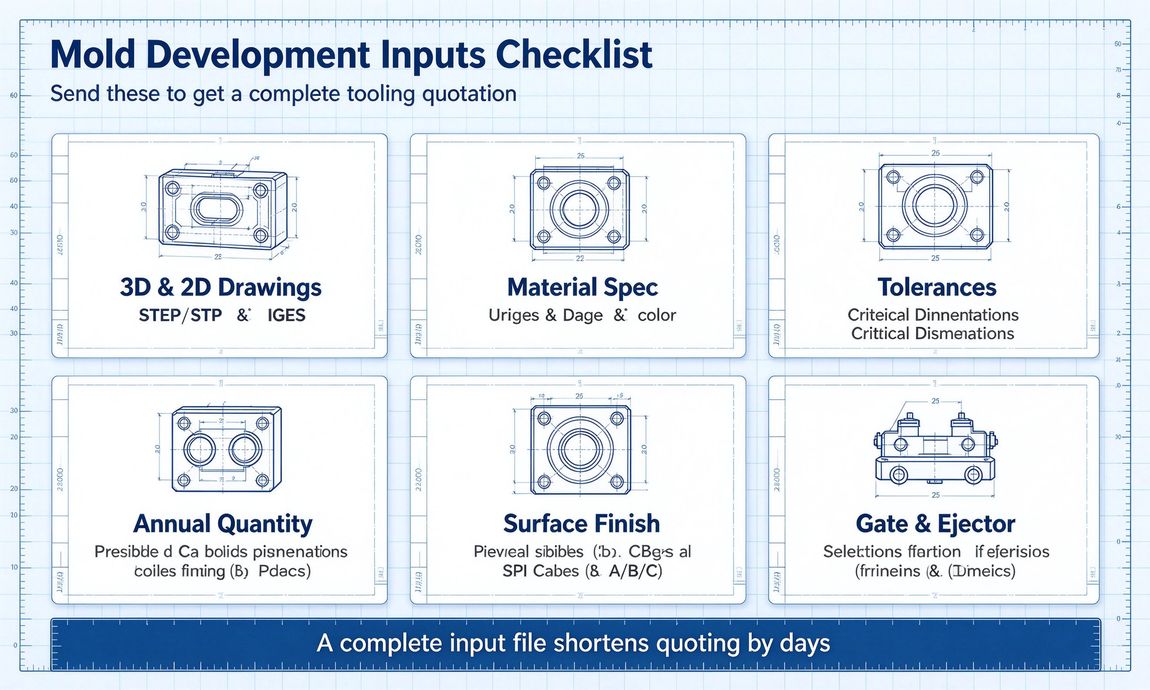
The 3D model is the geometry, but the 2D drawing is the contract: dimensions, tolerances and datum references that the 3D file does not carry. Send both, in a neutral format like STEP or IGES alongside PDF drawings. The supplier needs to know which dimensions are critical, because critical tolerances drive mold construction, steel choice and trial depth. A drawing with marked critical dimensions is worth more than a model without them — and it is the first thing Bailu's tooling engineers check when a quote request arrives.
The resin grade you choose affects the mold: glass-filled materials wear steel faster, high-shrinkage grades complicate dimensioning, and some resins need hot runners or special cooling layouts. Name the exact grade and the color standard, not "ABS-like". The material also sets the shrink factor baked into the cavity, so a wrong or missing material means a mold that may not hit the target dimensions after the first trial. If the application has mechanical or thermal requirements, list them — the material choice belongs to the project, not to the moment the mold is ordered.
Quantity decides how many cavities the mold needs and how durable the tool must be. A part at ten thousand pieces a year can run a single-cavity tool; a part at a million needs multi-cavity construction, hardened steel and faster cycles. Give the projected annual volume and the expected life of the program — the supplier uses these numbers to balance tooling cost against per-part cost, and that balance is the core of the quotation. The same part quoted for ten thousand pieces and for a million will come back with different molds, and both answers are correct.
The SPI finish class — A, B, C or D — tells the tool maker how much polishing the cavity needs. A glossy Class A finish on a visible surface costs more in polishing time and inspection; a textured finish uses a texture specification instead. If your part has a visible surface, say which one it is, because polishing effort is concentrated there and the rest of the mold is built to a different standard. A finish specification written early is what separates a mold built to a product from a mold built to a drawing.
Experienced buyers have preferences: where the gate sits, how the part ejects, whether they want a hot runner, whether inserts or slide actions are acceptable. If you have no preference, say so — the tool maker will propose a standard layout. But if you know the visible side, the parting line and the assembly constraints, write them down. These details change the mold construction significantly, and they are the difference between a mold that fits the product and a mold that fights it.
Behind every mold quotation sits a trial plan that the price and the schedule both depend on. The first trial, usually called T1, produces the first sample shots and the dimensional report; the rounds after that close the gap between the sample and the drawing. A realistic plan names how many trial rounds are included, what each one verifies, and what happens if a round fails — because a failed trial is a cost event, not a surprise. Ask for the trial plan in the quotation: the number of rounds, the steel grade and cavity arrangement, and the dimensional targets for sign-off.
Buyers who see the trial plan before ordering can judge whether the tooling budget is honest. The plan also protects the timeline, because trials are where the schedule is actually consumed. When a mold needs extra rounds, the delay is visible against the plan instead of appearing as a vague adjustment. A quotation that includes the trial plan and the acceptance targets is a quotation built for the project rather than for the sale. The same document becomes the validation record later — the T1 report, the revised settings and the final sign-off travel with the mold into production, which is how the tooling knowledge survives the handover.
A complete input package — STEP, 2D with tolerances, material grade, annual quantity, SPI class, and gate or ejection constraints — lets the tool maker quote once and hold the number. Missing items do not disappear; they come back later as change orders and cost surprises. For a plastic mold development manufacturer China buyer, the discipline of completing the package before sending the RFQ is the cheapest insurance in the project. The mold development page lists the input checklist Bailu uses, and the injection molding page shows how the tooling choices carry into production. Send the files to Bailu Tech and you will get a mold quotation with the cavity count, steel grade and trial plan spelled out, plus the variables you can still move before the steel is cut.
Let us brighten your life with safety, efficiency,and expert craftsmanship.
Contact Us
Phone : +86-159 0682 2387
WhatsApp/Wechat: +86-159 0682 2387
Email : info@bailusolution.com
Copyright © 2026 Huzhou Bailu Technology Co., Ltd. All Rights Reserved. Design by BONTOP.