


Time:Nov 02,2026
By:Bailu
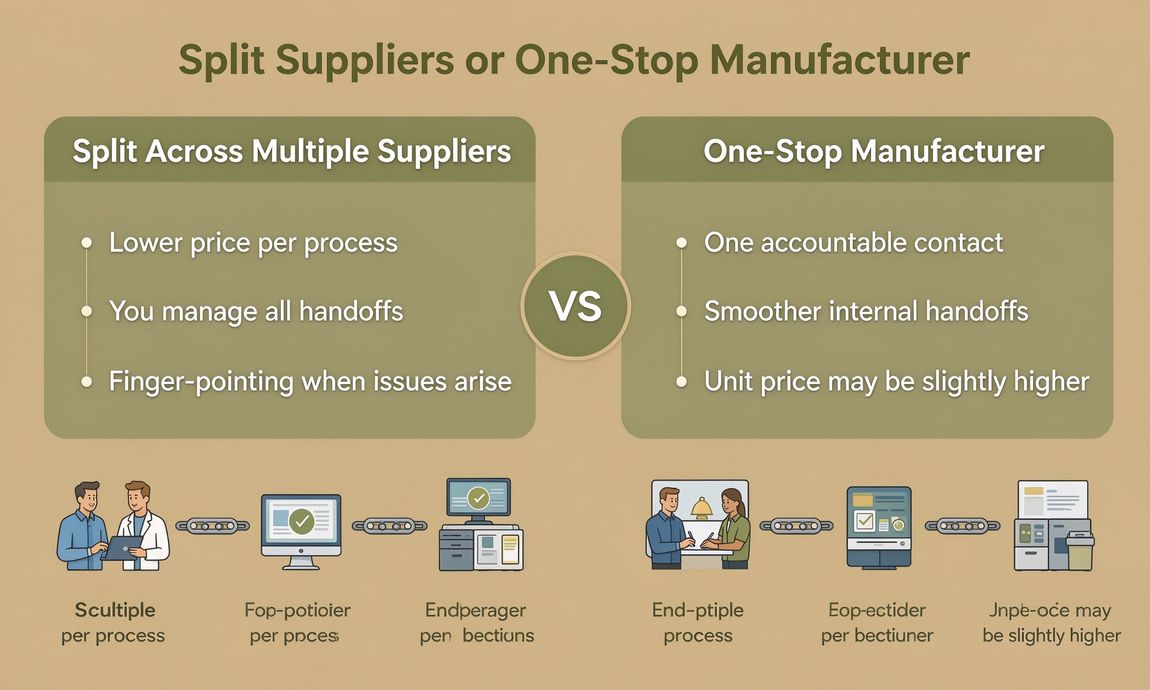
Your product mixes five processes — sheet metal, injection molding, assembly, printing and packaging — and the tempting move is to hand each one to the specialist who does it cheapest. On paper the numbers look lower. On the shop floor, the handoffs between those specialists become your new job. The real question is not which supplier is cheapest per process, but who carries the responsibility when two parts that were made in two factories do not fit together. This article compares the two models by what actually happens after the order is signed.

When you split the project, you become the project manager. You send drawings to three factories, chase three sample schedules, and you are the person who notices that the molded housing and the sheet-metal bracket leave a two-millimeter gap. Fixing that gap means negotiating between two suppliers who each insist their drawing was correct. The parts you inspect are fine individually, but the assembly fails on your desk. The unit prices were competitive; the rework, the freight between factories and your time are the bill nobody quoted. Add the freight between factories, the inspection you repeat on each batch, and the meetings on your calendar, and the spreadsheet quietly balances. Multiply that by the number of processes in the product, and the savings you noticed per supplier start to look like the cost of managing them.
Splitting is not wrong in every case. It earns its place when the product has genuinely independent pieces: a cosmetic cover that a specialist finishes to a high standard, paired with a structural part made by a second shop, when those pieces do not touch each other. It also suits a buyer with engineering staff who can manage vendors, and a second order where the processes are already proven. If you already run a supply chain office and your product is simple, splitting may save real money.
An end-to-end OEM ODM solution China buyers increasingly use bundles the processes inside one project team. The factory owns the handoff: the housing and the bracket are designed against each other, the mold trial and the metal bending happen under one schedule, and one person answers when the assembly fails. That internal coordination is invisible in the unit price, but it is why a project with five processes finishes without three months of buyer-side fire-fighting. For the buyer, that means one schedule to track, one quality record to review, and one number to reconcile at shipment — the coordination cost shows up as confidence rather than as line items.
The one-stop model is not free. Its unit price per process can sit above the cheapest specialist, because the bundle includes coordination labor, quality systems and a margin on passing work between departments. The questions worth asking before deciding: how many of your processes actually interact, how much engineering bandwidth you have, and what a week of delay costs your launch. For a first custom product, a late launch usually costs more than the price difference. A week of delay on a launch window dwarfs a small unit-price difference, and that comparison is where the one-stop model earns its premium. For a mature second source, the specialists may win on cost.
The deepest difference is accountability. With split suppliers, a quality problem becomes a negotiation: factory A blames the material, factory B blames the fit, and you hold the complaint. With a single supplier, the problem has one owner who can walk to both machines and compare the parts. That single line of accountability is what converts a crisis into a fix, and it is the reason Bailu organizes multi-process products as one project rather than a list of purchase orders. That difference shows up in the first sample review: a single team walks over, compares the parts, and schedules the adjustment in the same week.
Whichever way you lean, the questions are the same. Ask how many of your parts physically interact — a single housing that holds everything argues for one team; a set of independent accessories argues for specialists. Ask who will own the assembly trial, because that trial is where split sourcing fails and one-stop sourcing quietly earns its price. Ask how the supplier handles a defect that crosses two processes, and listen whether the answer starts with an internal handoff or with you. Bailu answers that question internally: the assembly trial runs in the same facility that cut the mold, so a fit problem gets fixed at the source instead of in a buyer's inbox. The answer you want is a named person who can pull both processes together, not a promise that coordination will be arranged later.
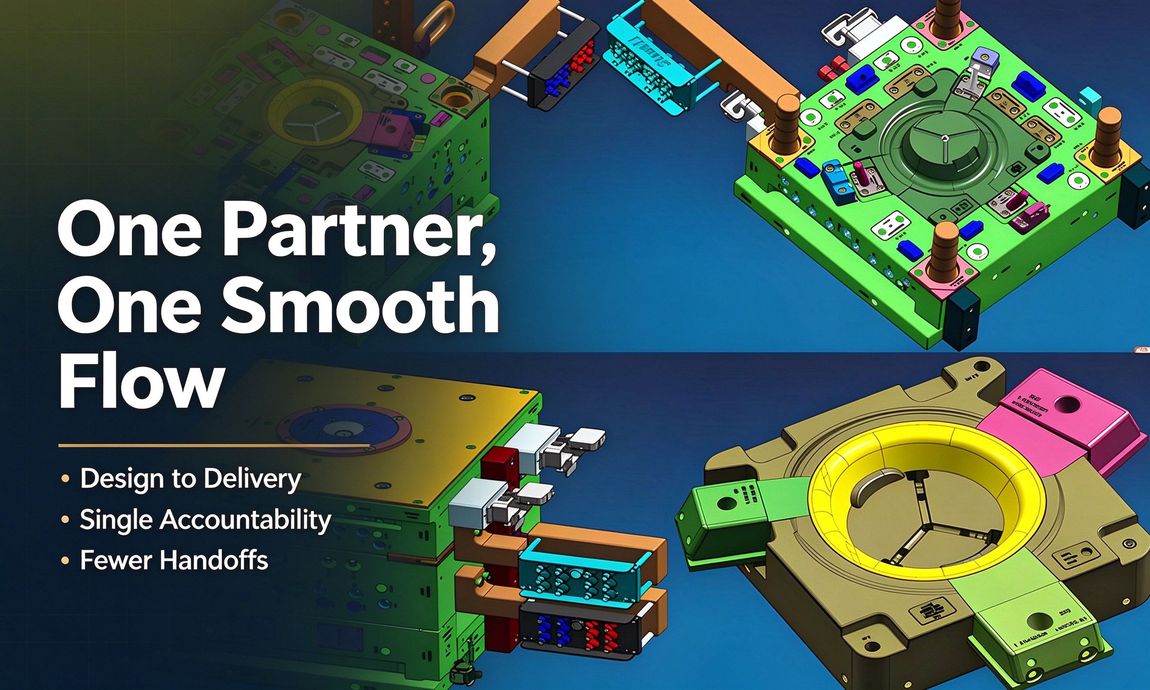
A practical rule: run the first product through a one-stop shop to de-risk the interaction between processes, then revisit splitting once the design is frozen and the handoffs are documented. You can talk through your product's process mix on the contact page, and read how similar projects were structured in the news page. Bailu Tech handles design, tooling, molding, assembly and packaging inside one team, so the buyer compares a single accountable flow against a multi-vendor spreadsheet instead of deciding on unit price alone.
Let us brighten your life with safety, efficiency,and expert craftsmanship.
Contact Us
Phone : +86-159 0682 2387
WhatsApp/Wechat: +86-159 0682 2387
Email : info@bailusolution.com
Copyright © 2026 Huzhou Bailu Technology Co., Ltd. All Rights Reserved. Design by BONTOP.