


Time:Oct 30,2026
By:Bailu
The budget allows one move: pay for prototypes now or pay for a mold now. Choosing wrong is expensive in opposite directions — prototyping first can feel like a delay when the design seems ready, while going straight to tooling can turn a small design flaw into a steel mold that needs rework. The answer depends on how settled the design is and how much volume you plan to run, and it is worth deciding deliberately before any money moves. Bailu Tech has watched both routes succeed and both routes fail, and the pattern behind the failures is usually the same.

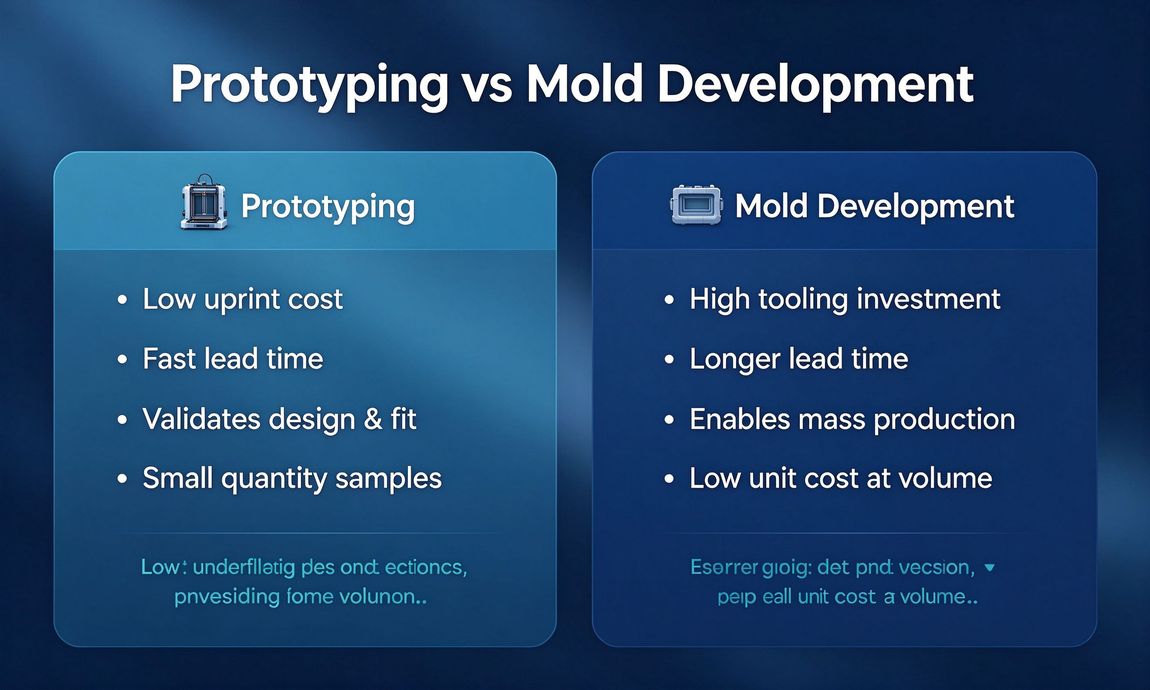
Prototypes answer three kinds of questions: does it fit, does it look right, and does it work well enough to test. Fit covers assembly, clearances and snap features; appearance covers color, texture and surface quality; function covers moving parts, airflow, or how a housing holds a circuit board. A product prototyping service China suppliers offer can use CNC machining, 3D printing or soft tooling depending on the material you need to test. Prototypes are not the final product — they do not fully replicate injection-molding conditions — but they catch the mistakes that would otherwise be baked into a mold and repeated ten thousand times. In short, prototypes move a project from "probably fine" to "confirmed", which is exactly the state a mold contract demands — and a good product prototyping service China provider will say which method fits your material and your deadline before quoting.
A mold is a fixed investment with a long memory. Once steel is cut, changing the design means welding, cutting inserts, or in the worst case building a new tool. Mold development also runs on a longer schedule than prototyping, typically four to eight weeks before the first trial samples, and the cost scales with complexity — side actions, sliders, lifters and surface texture all add to the tooling price. Opening a mold is effectively a statement that the design is frozen and the volume is real, so the decision deserves the same seriousness as a purchase order.
The classic failure is a design that looks complete in CAD but fails in reality: an interference between two parts that only shows up when both are made, a wall too thin to fill properly in a large part, or a snap feature that breaks after ten cycles. When this is discovered after tooling, the fix requires mold modification or a new tool, and the delay eats the launch date. Prototypes are cheap insurance against exactly this class of problem, which is why experienced buyers treat a prototype round as a fixed line in the plan rather than an optional extra. The cost of one prototype round is usually a fraction of one mold modification.
A simple framework covers most cases. If the design is still changing, the volume is below a few thousand units, or the product has never been physically tested, start with a product prototyping service China supplier can run quickly. If the design is frozen, the volume justifies tooling, and the key functions were already validated on a similar product, going directly to mold development is reasonable. Between these two ends sits the common middle: one prototype round to confirm fit and appearance, then straight into tooling with the confidence that the hard questions are already answered.
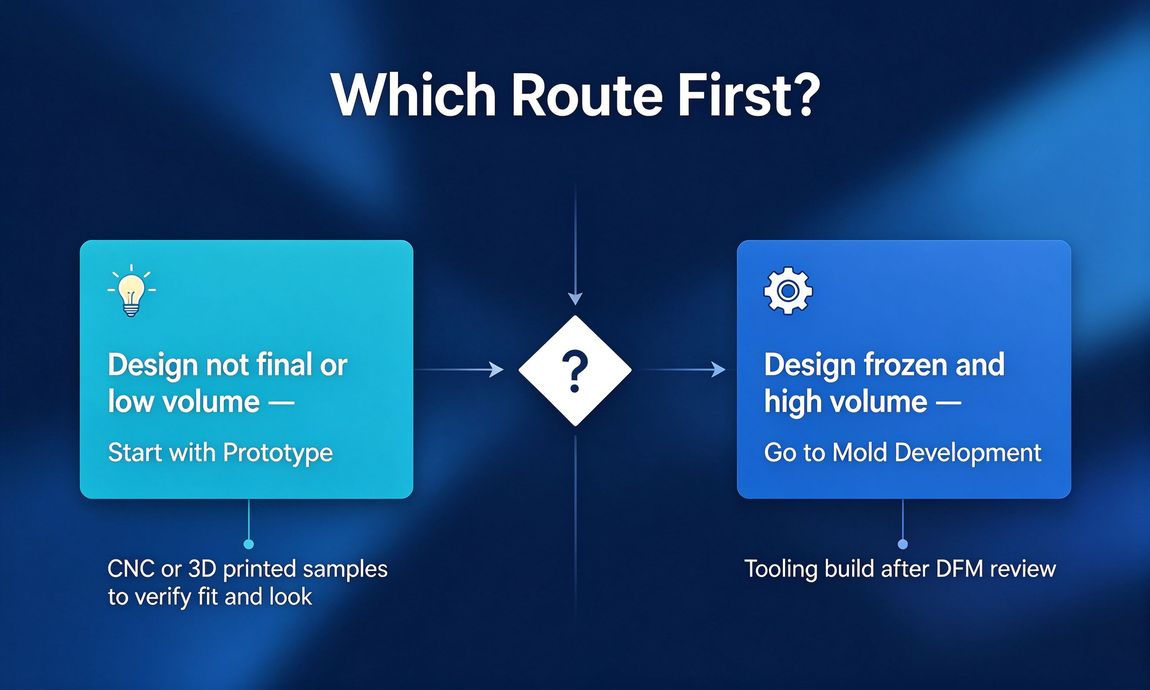
Direct tooling is the right call more often than many buyers assume. Mature products with small changes — a resized enclosure, a new colorway, a modified bracket — may not need a new prototype at all, because the risks were resolved in a previous project. Low-risk cosmetic parts with generous tolerances also travel well into tooling. In these cases the prototype stage adds lead time without adding information, and the efficient move is to go straight to the mold after a DFM review. It is the route Bailu recommends for well-validated product refreshes. The decision framework only works if you are honest about whether the design risk is actually new or already retired.
Most of the projects Bailu Tech runs use a hybrid: a quick appearance prototype for sign-off, a DFM review on the production design, and then tooling. The prototype is treated as a decision gate, not as a deliverable to be repeated. Sometimes the same design is prototyped in two materials — one for appearance, one for mechanical testing — before the tooling decision. This keeps the total timeline short while still catching the expensive errors, and it is the pattern behind most successful custom product design service projects that move into volume production.
If you are unsure which route fits, share the design and the volume with a manufacturing partner and ask them to recommend a path with reasons. A supplier that pushes straight to tooling without asking about design maturity is a signal to slow down; a supplier that asks about testing, volumes and timelines before recommending anything is thinking about your project rather than their order book. The choice between prototyping and mold development should be a technical decision made with evidence — and if a factory cannot explain why they recommend one route over the other, that is worth knowing before you sign anything. Most experienced buyers treat this conversation as a free engineering consultation, and it sharpens their own decision even when they disagree with the recommendation.
Let us brighten your life with safety, efficiency,and expert craftsmanship.
Contact Us
Phone : +86-159 0682 2387
WhatsApp/Wechat: +86-159 0682 2387
Email : info@bailusolution.com
Copyright © 2026 Huzhou Bailu Technology Co., Ltd. All Rights Reserved. Design by BONTOP.