


Time:Oct 30,2026
By:Bailu
A housing that would be a welded assembly of six sheet metal pieces arrives as one smooth, ribbed casting from the shot — and then the buyer discovers porosity pinholes at the machining stage. Aluminum die casting is a process of strong contrasts: it does things no sheet metal route can, and it refuses things you would assume are trivial. This article lays out both sides honestly, so you can decide whether your custom OEM metal part belongs in the die or on the brake.

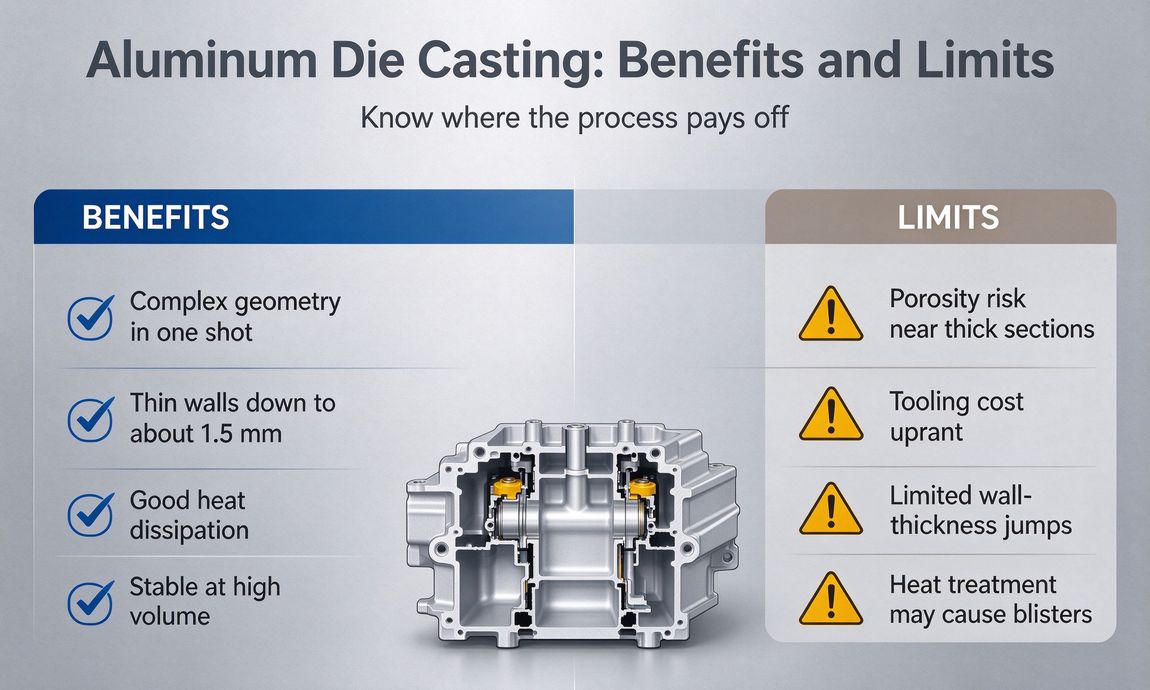
The headline benefit is geometry. Molten aluminum flows into the die under pressure, so complex shapes — thin ribs, intricate internal passages, uniform walls, integrated bosses and mounting points — come out of one mold with little machining. That collapses an assembly of several stamped and welded pieces into a single component. Next comes surface quality: cast surfaces take a smooth finish directly, and flash trim leaves few seams. Volume economics follow: after tooling, each shot is fast, repeatable and low-labor, so per-part cost drops steeply at high quantities. Thermal performance matters too — aluminum conducts heat away from electronics, which is why cast housings surround motor and controller compartments. OEM die cast aluminum parts earn their place wherever a strong, light, geometrically complex housing replaces a fabricated one. The same logic flips the product economics: a part that would be welded from five pieces with hours of labor per unit becomes a casting that leaves the station nearly complete, and the assembly errors that come with many pieces disappear from the failure list.
Die casting wants uniform wall thickness, and it fights abrupt jumps. The melt flows cleanest in a band typically around 1.5 to 3 mm; much thinner and the flow front freezes before filling, much thicker and the aluminum shrinks internally as it solidifies, leaving porosity. Ribs should be thinner than the walls they attach to, bosses need generous transitions, and heavy bosses that will be drilled should be machined after casting rather than cored to size. The design lesson is to spread load through ribs and shape rather than through extra mass — the opposite of machining, where extra thickness is a safe habit. Designers counter thick sections by breaking heavy bosses into thin ribs, shifting heat loads to the outside walls, and asking the foundry where the die cooling should sit. A wall sketch drawn on paper — thickness arrows included — is worth more than a verbal discussion before tooling starts.
Porosity is the process's signature limitation: tiny gas or shrinkage bubbles trapped inside the solidified metal, concentrated near thick sections, gates and slow cooling spots. It is invisible on the surface until a machining cut crosses it, or a leak test finds it. The countermeasures are design-side (uniform walls, no heavy sections, cooling channels in the die) and process-side (machine parameters, venting, vacuum assist). For parts that must hold pressure or pass leak tests, the drawing should say so at RFQ — because a pressure-tight casting may need a higher-spec process variant than a structural bracket. Asking about porosity after machining discovers it is the expensive version of this conversation. For decorative housings, porosity is mostly a cosmetic worry solved by the right paint system; for hydraulic or pneumatic parts, it is a specification issue settled at the process-selection stage.
Die casting wins when the part is reasonably complex, the quantity is in the thousands or more per year, and the geometry beats fabrication: gearbox housings, motor end shields, automotive brackets and vent frames, lighting housings, equipment casings that need both strength and heat dissipation. It is also the route when a bolted sheet-metal assembly is rattling or seeping at seams. The common thread is volume plus complexity: below a few hundred pieces, the tooling amortization does not pay back, and the buyer is better served by CNC-machined or fabricated parts. The foundry will also want the annual forecast, because the quote structure rewards volumes that justify the die in the first place.
Die casting is the wrong answer for large, simple flat panels — sheet metal does them faster and cheaper. It is wrong for tiny one-off brackets that could be laser-cut and bent. It is wrong for parts that need fully dense, heat-treated structural properties across a heavy section, because porosity limits what heat treatment and machining can clean up. And it is wrong when the annual quantity cannot carry the mold cost. The alternative route is usually the sheet metal fabrication line: single pieces versus assemblies, fast prototypes versus slow tools, and quotes that make the break-even obvious.
The upfront tooling cost is the real gatekeeper, and it comes in two pieces: the die itself, and the development shots that tune fill and cooling before production starts. Both are justified when the geometry saves assembly labor and field failures over years. Bailu quotes tooling and per-unit cost together so the break-even volume is visible on one page; the die-casting processing service covers everything from prototype shots to volume production. Huzhou Bailu Technology has seen buyers over-commit to casting for parts that fabrication would have served, and Bailu Tech will say so at the quoting stage — because a recommendation that loses a quote now usually wins a customer for the next project. A complete project file usually names the material grade, the critical tolerances, and the expected annual quantity — three numbers the quote should quote against, not estimate.
Let us brighten your life with safety, efficiency,and expert craftsmanship.
Contact Us
Phone : +86-159 0682 2387
WhatsApp/Wechat: +86-159 0682 2387
Email : info@bailusolution.com
Copyright © 2026 Huzhou Bailu Technology Co., Ltd. All Rights Reserved. Design by BONTOP.