


Time:Oct 30,2026
By:Bailu
You need a bracket, and the supplier asks one question that decides the entire quote: which material? Pick cold-rolled steel and the part is cheap but rust-prone; pick stainless and the bill jumps; pick aluminum and the weld behaves differently from both. Material choice is the highest-leverage decision in a sheet metal project — it sets strength, weight, corrosion behavior, weldability, surface finish and price all at once. This article covers the three materials that cover the vast majority of custom sheet metal OEM components, where each one fits, and the surface treatment that usually goes with it.

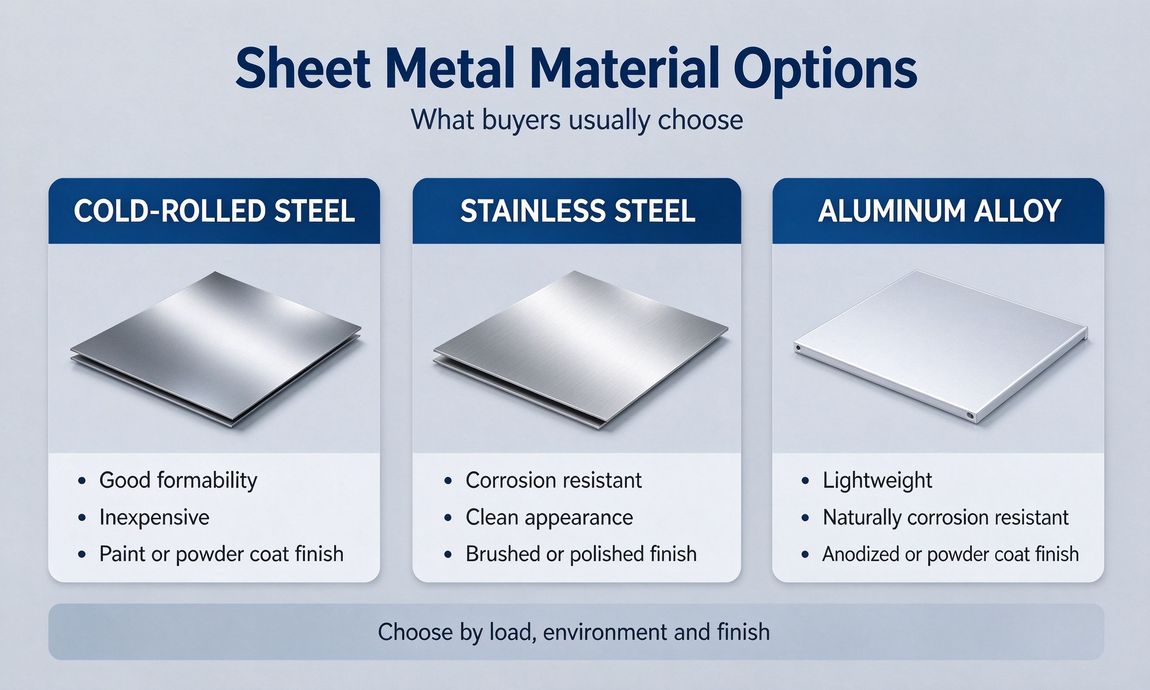
Cold-rolled steel sheet is the workhorse of the industry: low cost, good formability, easy to weld, and friendly to every standard finish. It is the material when the part carries load indoors, hides inside an enclosure, or lives inside equipment protected from outdoor exposure. Its weakness is corrosion: bare steel rusts where water sits, and cut edges corrode first. That is why cold-rolled parts typically ship with a zinc-plated, powder-coated or painted finish — the finish is not decoration but the corrosion barrier. Typical uses: internal brackets, chassis plates, equipment frames, appliance housings. Stock commonly runs from thin sheet around 0.8 mm for panels up to 3 mm for load-bearing brackets, and shops usually keep common thicknesses in stock, which keeps lead times short. For a buyer comparing quotes, expect this material to be the price benchmark against which the others are measured.
Stainless steel trades cost for durability: it resists rust without a paint layer, survives washdown environments, and keeps a clean appearance for years. Common austenitic grades cover food equipment, medical enclosures, outdoor housings and architectural trim; harder grades add wear resistance but bend less forgivingly. The trade-offs are price — several times the sheet cost of cold-rolled steel — and fabrication behavior: work-hardening during bending means radii must be generous, and the surface scratches easily enough that brushed finishes are specified to hide handling marks. Finish options are mostly brushed or polished rather than painted, because the corrosion resistance lives in the alloy itself. Grades differ in what they tolerate: common 304 handles damp and food-contact environments, while 316 adds chloride resistance for coastal or chemical-exposed equipment. The choice between them is driven by the environment rather than the appearance, and the price gap between the two is small compared with the failure cost of the wrong one.
Aluminum sheet is the answer when the part must be light: portable equipment, outdoor fixtures, panels on vehicles. It forms easily, conducts heat, and forms its own protective oxide layer in air, so corrosion is rarely the issue. The price you pay is mechanical: lower strength per millimeter, softer edges that dent, and welding that needs a different skill and filler rod. Finishing usually means anodizing for wear and appearance, or powder coating for color; both also cover the weld discoloration that aluminum arcs leave behind. Anodized layers can be dyed in a range of tones, and the alloy takes laser engraving cleanly, which helps when panels need identification marks or branding. The trade-off against steel remains strength, so mounting bosses should be designed generously rather than tightly. Sourcing sheet metal fabrication China buyers routinely request usually comes down to this triad, with every other alloy a niche exception.
The finish decision follows the material, not the other way around. Cold-rolled steel wants plating or powder coat for corrosion protection; stainless wants brushing to mask handling; aluminum wants anodizing where wear and appearance matter. Color, salt spray and scratch requirements should be written on the drawing, because 'painted' without a process leaves the shop to choose the cheapest route. Vague finish requests are where quotes drift: one shop interprets 'paint' as electrostatic powder coat, another as wet spray, and the durability difference is visible within a year outdoors. A supplier quoting work that way will usually propose the standard finish for each material — the buyer's job is to confirm the environment: indoor dry, indoor damp, outdoor UV, washdown, or contact with food or chemicals.
A quick decision path: if the part lives indoors and hidden, cold-rolled steel with powder coat; if it lives exposed or washed, stainless; if weight matters or the product moves, aluminum. When the choice is close — two materials both plausible — the tie-breaker is usually the assembly: steel pairs naturally with welded frames, stainless with hygienic designs, aluminum with bolted structures. Bailu guides this trade-off at RFQ, and the sheet metal fabrication page lists the materials and finishes the shop actually runs, which keeps the conversation grounded in available stock rather than catalog theory.
Material choice also changes which secondary processes make sense. Stainless brushes well but welds visibly; aluminum anodizes beautifully but its welds discolor; cold-rolled steel powder-coats evenly but rusts at every bare edge. A design that mixes materials — a stainless outer panel on a steel frame — needs compatible design that avoids galvanic contact between the two. For metal projects that also use castings nearby, the die-casting processing line Bailu runs alongside sheet metal means brackets and cast housings are quoted with the same tolerance logic. Bailu Tech recommends the material and finish as one package rather than two separate choices, and Huzhou Bailu Technology will push back when a drawing specifies stainless for a hidden bracket — usually in the customer's budget, and usually before the steel is cut.
Let us brighten your life with safety, efficiency,and expert craftsmanship.
Contact Us
Phone : +86-159 0682 2387
WhatsApp/Wechat: +86-159 0682 2387
Email : info@bailusolution.com
Copyright © 2026 Huzhou Bailu Technology Co., Ltd. All Rights Reserved. Design by BONTOP.