


Time:Oct 30,2026
By:Bailu
Your assembly line has twelve screws, three clips and a vibration-test failure every Friday — and the fix may not be a better fastener but a different molding process. Insert molding and overmolding both replace loose hardware and multi-part assembly with a single bonded piece, but they solve two different problems. One locks in metal inserts that must stay where the product is assembled; the other coats a rigid core with a soft material where hands touch. This article explains when each process earns its place in a custom plastic OEM project, and what changes in the mold and the bill of materials when you choose one.

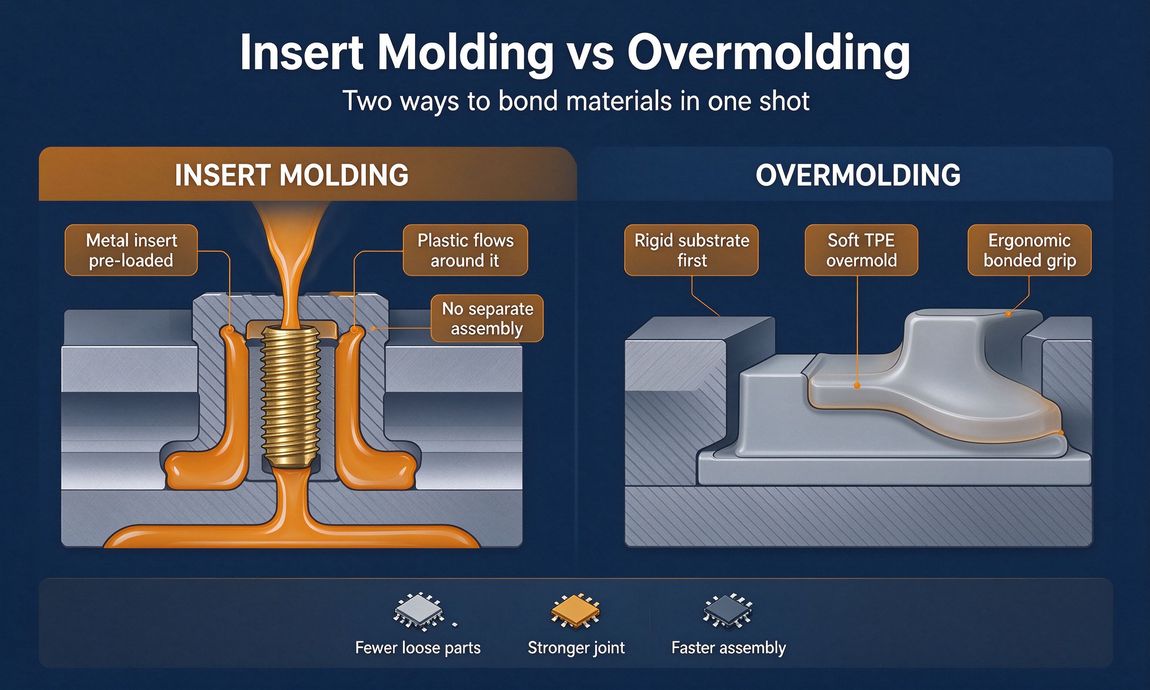
Insert molding starts with a pre-placed piece — a threaded brass insert, a metal sleeve, a magnet, a connector pin — sitting inside the mold before the plastic is shot. The melt flows around the insert and solidifies against it, so the two pieces leave the press as one unit. The value shows up anywhere a loose fastener would otherwise cost assembly time or fail in service: threaded holes in thin housings, sealed wire entries, hinges that pin two halves together. Every molded-in insert removes one fastener, one torque spec and one vibration-loosening risk from the field. For a buyer working with an injection molding manufacturer China teams routinely specify, the decision point is usually not strength but whether the insert needs to be serviceable later.
Overmolding starts from the other end: a rigid substrate — usually a hard engineering plastic such as ABS or PC — is molded first, placed into a second mold, and then a softer material, commonly a TPE or TPU, is shot over it. The result is a part that is hard where it must hold shape and soft where a hand squeezes it: tool handles, grips on power appliances, foot pads, buttons that return with a tactile click. Because the two plastics bond at the interface rather than mechanically clipping together, the soft layer does not peel, slide or glue on later. The design questions center on which substrate carries the load and which TPE hardness matches the grip feel, since the mold has to match the melt temperatures of both materials.
Reach for insert molding when the geometry demands hardware inside the plastic: threaded bosses that will carry repeated torque, bearing surfaces, electrical contacts, shielding cans, or any metal feature that a separate fastener would leave loose in the field. The typical payback case is a product that currently buys a housing plus a bag of inserts and spends operator time pressing them in — a common failure point on consumer electronics shaken in transit. The trade-off is handling: each insert has to be placed, either by hand or by a feeder, so cycle time and labor rise with insert count. A supplier's mold shop will usually quote a hand-loaded insert mold for small runs and a rotary or magazine-fed mold for larger ones.
Reach for overmolding when the problem is surface, grip or sealing rather than hardware: a handle that must stay comfortable after a hundred thousand cycles, a bezel that needs a soft gasket built in, a button whose tactile feel is part of the product promise, a foot that must not scratch a floor. Overmolding also solves sealing where a two-part clip would leak — the TPE layer flows around the perimeter and closes the seam in the same shot. It is not the right tool for pulling metal into the part, and it costs more than single-shot molding because the part passes through two molds. The useful question to ask early is whether the soft touch is a marketing want or a functional need, because the process is expensive enough that it should earn its place on functional grounds.
Both processes rewrite parts of the design checklist. Insert molding needs draft and radius around the pocket so the plastic locks mechanically as well as thermally; inserts that sit too close to the parting line shift during injection, and thin webs near the insert pack poorly. Overmolding needs compatible material pairs — substrate and TPE chosen for bond strength rather than cosmetic match — plus generous fillets at the soft layer's edges, since sharp transitions delaminate under bend testing. Wall thickness should stay uniform, and gates should land away from the interface so the two materials do not wash each other apart mid-flow. These details are exactly what a DFM pass in the mold-development stage catches before steel is cut; the mold development service at Bailu reviews insert placement and gate strategy together with the tooling plan.
Neither process is free, and the cost changes in predictable places. Insert molding adds an insert-handling step and a more careful mold with locating features, but removes purchased fasteners and assembly labor; the payback shows up when annual volume clears a few thousand units. Overmolding adds a second mold and a second press cycle, so the per-part cost climbs noticeably against single-shot molding — the offset is the elimination of gluing, wrapping or sleeving operations and the warranty cost of peeling grips. The honest way to compare quotes is the full landed cost: parts, assembly time, and expected field returns, not the molding line price. Bailu quotes both processes against the same assembly assumption, so a buyer sees the two paths on the same page.
Before tooling, ask a few specific questions: how are the inserts located and held, and what happens to a misplaced part? Is the overmolding pair tested for bond strength, and under what cycle? What is the quoted volume where the insert-fed mold becomes worthwhile? The injection molding service page lists the materials and process options Bailu runs under one roof, and that matters because insert molding, overmolding and standard molding share the same quality bench. Huzhou Bailu Technology treats both processes as normal extensions of the molding line, which is why those questions get practical answers instead of hand-waving.
Let us brighten your life with safety, efficiency,and expert craftsmanship.
Contact Us
Phone : +86-159 0682 2387
WhatsApp/Wechat: +86-159 0682 2387
Email : info@bailusolution.com
Copyright © 2026 Huzhou Bailu Technology Co., Ltd. All Rights Reserved. Design by BONTOP.