


Time:Nov 03,2026
By:Bailu
Your assembled product snaps together in the studio, but on the factory line it takes four minutes of fumbling per unit, and loose washers start showing up in the final packing box. That gap between a hero assembly and a producible one is exactly what a DFM review for a multi-component custom OEM assembly is supposed to close — yet buyers often send CAD files straight to tooling and discover the problems when they are expensive to fix. The encouraging part is that most assembly difficulty is designed in, which means it can be designed out before the mold is cut, and the methods are well understood by any experienced product development team.

A product made from twenty parts carries twenty sets of tolerances, twenty packaging lines and twenty chances for the factory to mix up components. Every screw, snap fit and locating pin also hides an assembly cost that quietly eats into unit margin. The point of DFM here is not to restyle the product — it is to shrink the number of decisions an operator has to make during assembly. When a custom product design service reviews an assembly from the factory's point of view, the questions sound simple: which part is picked first, where does the hand go, and what happens when two toleranced dimensions land on the same joint. Answers that live only in an engineer's head are exactly where assembly defects come from.
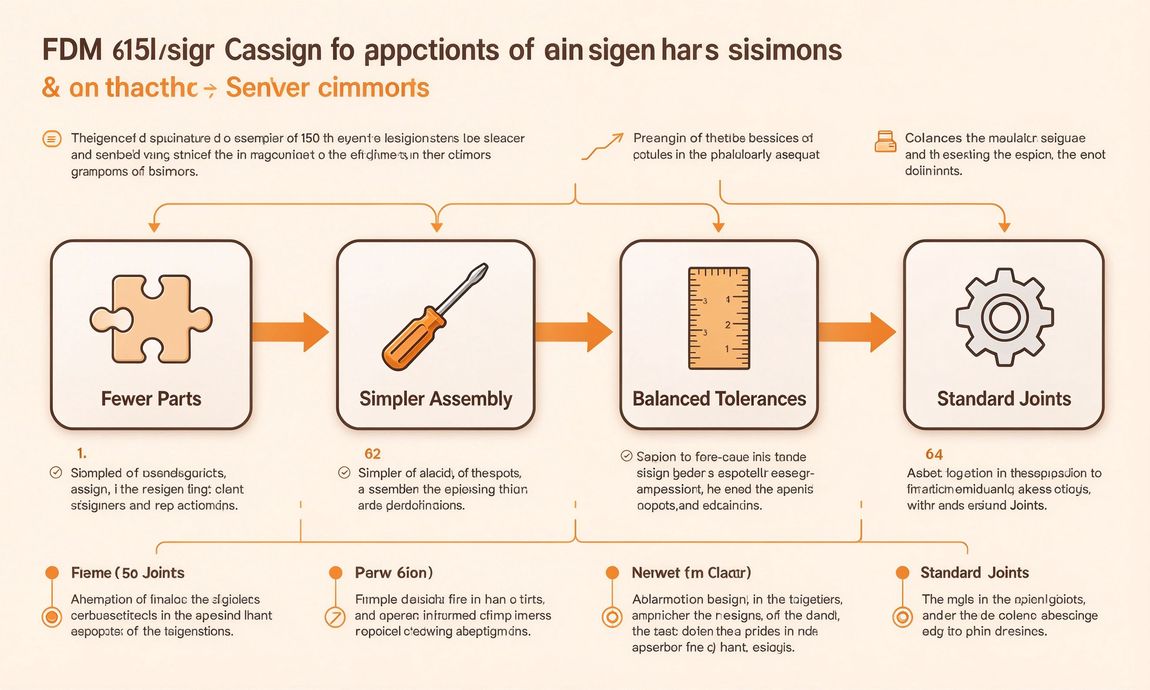
The highest-leverage DFM move is removing a part, not refining one. A separate clip that holds a cosmetic cover can be redesigned as an integral snap fit in the housing. A loose gasket can become a molded sealing lip. A sheet-metal bracket and a machined spacer might merge into one die-cast piece. Every removed part deletes its own tolerance stack, its own supplier, its own inspection step and its own assembly motion. Some parts genuinely need separation for service or material reasons, but the default question at the sketch stage should be why two parts exist at all, not how the two parts will fit together. Buyers who push this question early usually come back with a BOM that lost ten to twenty percent of its line items.
Before any dimension is fixed, draw the assembly sequence as a stack of operations: base housing down, electronics in, screws at these points, cover on, clips closed. Sketching the sequence exposes geometry that looks fine in CAD but fights a real hand. A screw hidden under a component that has to be mounted later; a clip you cannot reach once the neighboring part is installed; a cover that only fits from one direction while the conveyor carries it from the other. Bailu runs this sequence walkthrough during the design phase because rerouting a single assembly motion on screen costs a few hours, while fixing it after tooling costs weeks of mold modification and revalidation.
Engineers react to fit problems by tightening tolerances across the board, which pushes up machining cost without solving the stack-up. The better move is to identify the few dimensions that actually govern the joint — the locating boss and the hole it enters — and let the non-critical faces breathe. A fit that depends on three floating dimensions will wander unit to unit; a fit built on one precise locating feature and two generous ones repeats. DFM teams call this tolerance chain analysis, and for assembly-heavy products it is where most of the measurable fit variance is explained. It also tells the factory which dimensions actually belong on the inspection sheet, instead of measuring everything.
Hand assembly absorbs error through adjustment: the operator shifts the part, forces the clip, adds a shim. Repeatability dies the moment adjustment becomes the norm. Design features that locate the part by geometry instead of by feel — molded locators, self-aligning chamfers, snap fits that click into a defined position — so every unit lands in the same place without operator judgment. Bailu Tech treats this as a core review item because an assembly that needs an experienced pair of hands does not scale to a production line staffed by rotating shifts. The check is deliberately concrete: can a new operator complete the joint without asking a colleague how much force to apply.
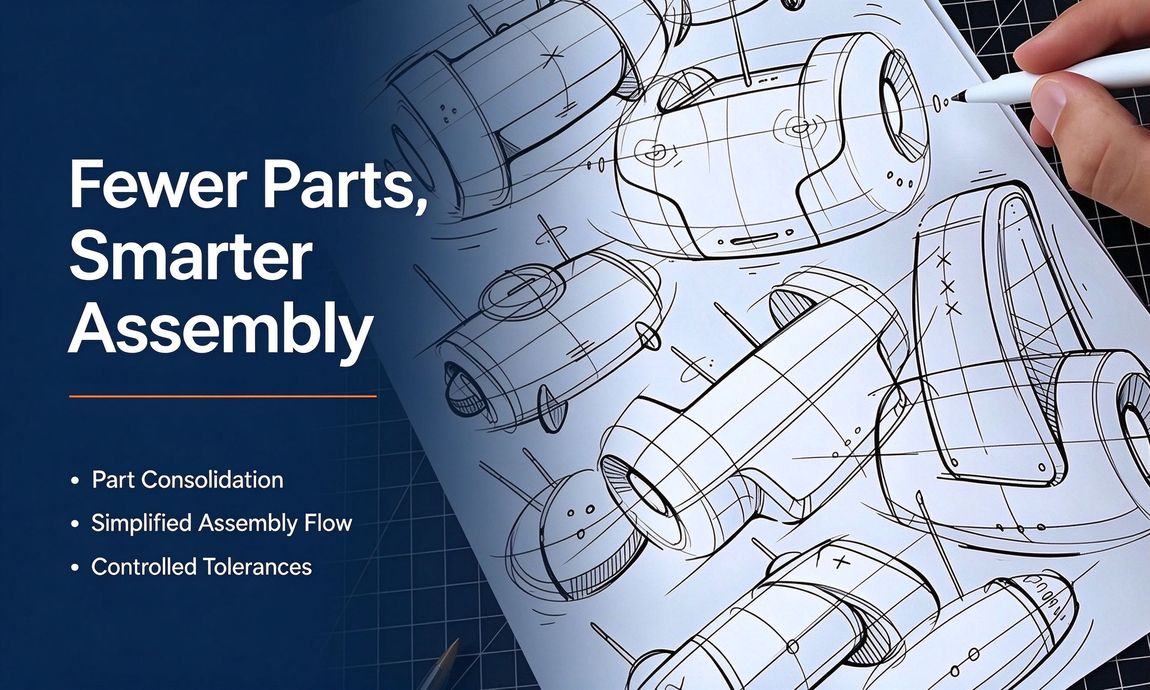
A structured review for assembly-driven products typically flags the same categories: parts that cannot be assembled in the order the mold allows, fasteners too small or too long for tool access, undercuts that ask the operator to hold a spring during insertion, and orientation markers missing where two near-identical parts sit in the same tray. The product design page shows how Bailu runs geometry review against the intended assembly flow, and the prototyping service lets you test actual snap fits and joint clearances before the steel is cut. Catching these on paper means the pilot run measures real variation rather than revealing that the design cannot be assembled as drawn.
The instinct is to build a prototype and check assembly afterwards. By then the geometry is already committed, and the prototype becomes proof of a design rather than a test of one. Huzhou Bailu Technology recommends running the assembly DFM pass at the CAD stage, using prototypes to confirm only the few joints that the review deliberately left open. That order is what turns a complex multi-component product from a line-balancing headache into an assembly routine the factory repeats every shift — and it keeps the custom product design service stage focused on decisions that the factory can actually build.
Let us brighten your life with safety, efficiency,and expert craftsmanship.
Contact Us
Phone : +86-159 0682 2387
WhatsApp/Wechat: +86-159 0682 2387
Email : info@bailusolution.com
Copyright © 2026 Huzhou Bailu Technology Co., Ltd. All Rights Reserved. Design by BONTOP.