


Time:Nov 03,2026
By:Bailu
You send a beautiful CAD file to a shop for a CNC prototype, and you get back a part that looks right on the outside — but the thin internal rib you designed has been replaced by a thicker stub, the deep cavity in the middle has flat bottoms it should not have, and a feature the tool simply could not reach quietly disappeared. CNC prototyping is the most accurate way to hold tight dimensions on a prototype, but it is a machining process, and every machining process has geometry it cannot reach. Knowing those limits before you quote saves the disappointment of a first sample that does not actually test your design.

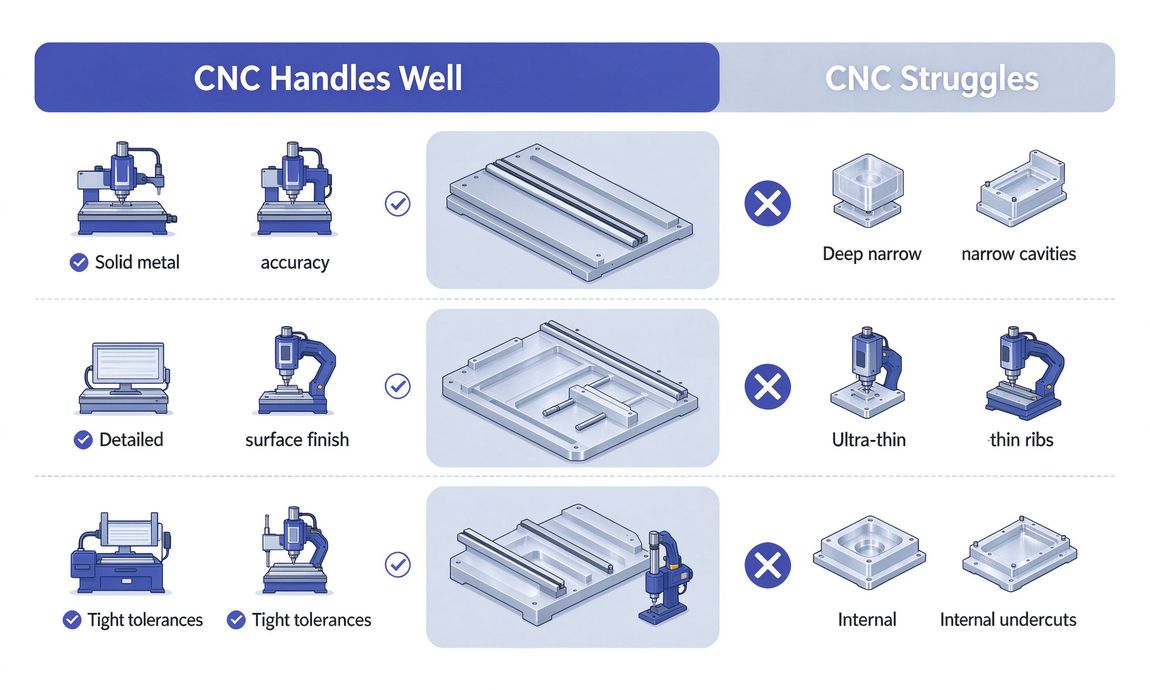
A CNC machine removes material with a rotating cutter, and the cutter has a diameter, a length and a corner radius. Any feature narrower than the smallest available bit, deeper than the bit's reach, or sharper than the corner radius cannot be cut as drawn. Internal corners become radiused automatically, deep slots carry the taper of a long slender tool, and fine details below roughly half a millimeter disappear into process tolerance. For a consumer product covered in small snaps, vents and cosmetic texture, this means the prototype tests your design at a scale the cutting tool tolerates, not at the scale your CAD file promises.
Deep narrow cavities are the classic victim. A cooling fin array, a narrow grip recess or a tall thin wall needs a long small-diameter tool that flexes as it cuts, which produces chatter marks, drifting dimensions and an elevated breakage rate. The shop often compensates by picking a stouter tool, and suddenly your thin wall is thicker on the sample. A product prototyping service China buyers use regularly will flag this trade-off in writing before cutting, instead of handing you a corrected shape and hoping you will not notice. When the cavity is both deep and fine, CNC simply is not the honest test.
Internal undercuts, hidden channels and enclosed pockets are outside the process entirely. A cavity that opens only through a small hole, a snap feature on the inside face of a shell, or a vent path buried inside the part has no tool access from any direction. Shops work around this by splitting the prototype into pieces and bonding them, which proves the outer form but not the internal function — the bonded seam carries tolerance that a molded production part would not have. This is the structural reason CNC prototypes overestimate how cleanly a complex interior will work out in the mold.
CNC prototyping starts from a solid block, so material choice is bounded by what comes in standard bar and plate sizes. Tiny features in engineering plastics warp when the cutter heats them, and thin flexible walls vibrate while being milled. For very thin-shelled consumer housings — the kind designed to be injection molded later — a CNC version ends up thicker and stiffer than the real part will be, which means drop tests, flex tests and assembly fit checks on that sample are testing a different product than the one going to tooling. Bailu regularly quotes clients both the CNC version and a printed version of the same housing precisely because the two behaviors diverge.
None of this means CNC is the wrong first choice. It holds tight tolerances on machined faces, reproduces real engineering materials like aluminum, stainless and ABS at full strength, and gives you a surface you can polish, anodize or paint to production grade. For a bracket, an enclosure frame, a metal knob or any structural load-bearing part, a CNC sample behaves the way production will. The honest use is choosing CNC for the geometry it can reach and accepting that the rest of the design needs a different validation route.
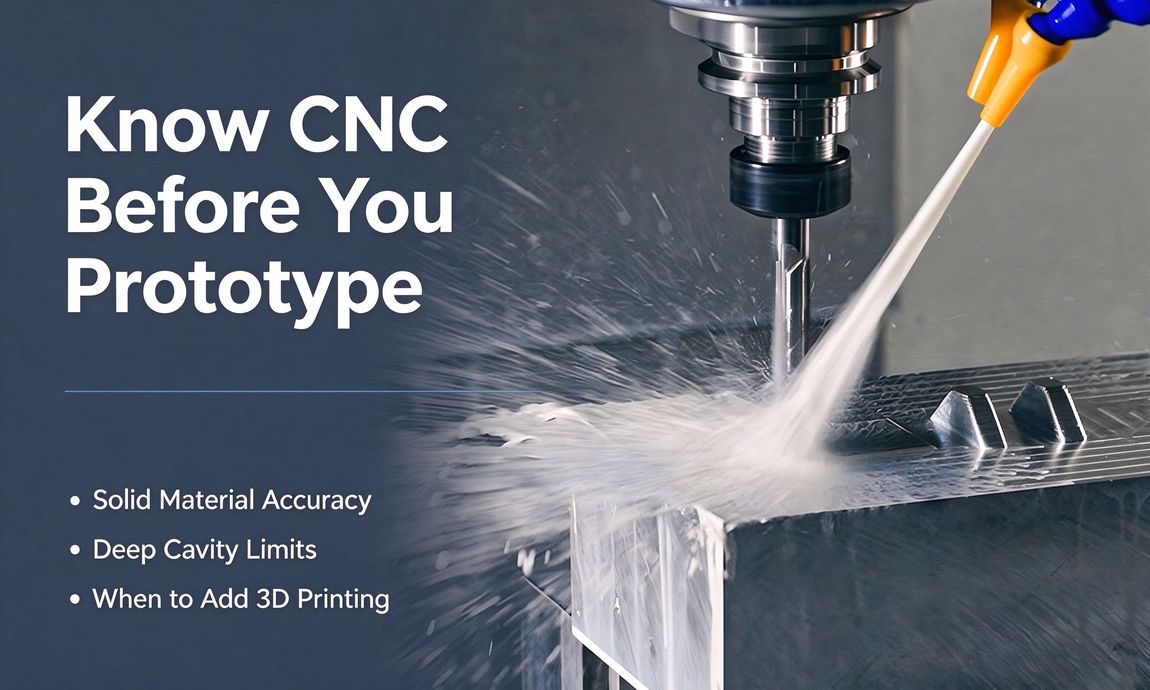
Mature product development treats CNC and 3D printing as complements rather than rivals. Bailu Tech builds functional prototypes that way — CNC the structural chassis and the mating faces, 3D print the fine shell, the deep vent array and the snap-fit set, then assemble the hybrid and test the real interference between them. Bailu calls this a hybrid prototype, and it is the default approach for consumer products whose geometry mixes load-bearing frames with fine internal features. The prototyping service page explains this combined-process approach in detail, and the product design page shows how geometry is designed around each process's reach from the start. Designers who already know the limits draw features that fall on the CNC-friendly side of the line, and reserve the hard geometry for validation methods that can actually reproduce it.
Before approving a CNC-only sample, ask: what is the smallest tool that will reach my deepest feature, will the thin walls survive cutting without flexing, and which internal undercuts will be split and bonded? A supplier who answers on the quote — with adjusted dimensions or a process mix — is telling you they have read your CAD file against real machine constraints. For complex custom consumer products, that conversation up front is what turns the first sample into an accurate test of the design instead of an expensive approximation, and it usually avoids a second prototype round that nobody budgeted for.
Let us brighten your life with safety, efficiency,and expert craftsmanship.
Contact Us
Phone : +86-159 0682 2387
WhatsApp/Wechat: +86-159 0682 2387
Email : info@bailusolution.com
Copyright © 2026 Huzhou Bailu Technology Co., Ltd. All Rights Reserved. Design by BONTOP.