


Time:Nov 03,2026
By:Bailu
The welded frame arrived from the shop and every joint looks strong, except the two flanges no longer meet and the mounting holes sit 3 mm off where the heat pulled the steel. Weak welds are rarely the reason an assembly fails; distortion, bad fit-up and poor seam finish are. Bonding quality in sheet metal fabrication is not decided at the welding torch alone. It starts at the laser-cut blank, continues through fixturing and weld sequence, and ends at the grinding bench. This article walks through the chain that decides whether a welded OEM assembly fits, looks right and holds up over time.

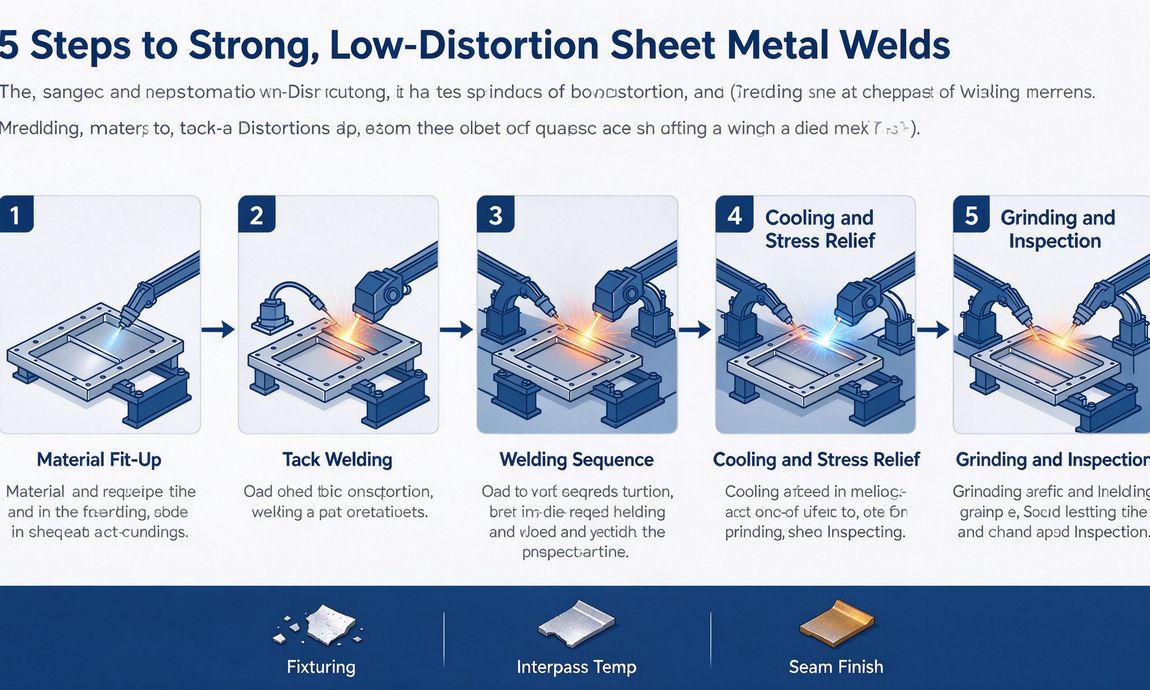
A weld can only bridge a gap within a narrow window. If the laser-cut edges are out of tolerance, if the bend angle drifted, or if the two flanges sit crooked on the table, the welder compensates with extra fill metal and higher heat, and distortion follows. Good bonding starts before the arc: flat, clean parts cut to the designed edge tolerance, bends checked against the fixture, and joints that touch instead of gap. Shops that quote welding as a standalone process often skip this check, while shops that run the whole sheet metal fabrication chain keep cut, bend and weld on the same inspection loop, so the blank that arrives at the torch already fits the joint it was designed for.
Heat shrinks metal. Every weld bead pulls the surrounding sheets toward itself, and an unclamped frame will bend the moment you start the second seam. The fix is mechanical: a welding jig or fixture that holds every blank at its designed position, with clamps placed opposite the weld lines so the shrinkage force has nowhere to go. The weld sequence matters as much as the clamp layout. Experienced welders stitch joints in small alternating sections rather than running one long bead, stepping around the frame and backstepping so heat input stays low and balanced. Long continuous seams on thin sheet are the classic distortion trap, and splitting them into 30 to 50 mm stitches usually removes the bowing without slowing the job down.
Bonding quality on thin sheet is largely heat management. The right wire size, current and travel speed keep the pool small and the heat-affected zone narrow; running too hot burns through the zinc layer on galvanized sheet, warps the flanges and leaves brittle welds. Interpass temperature matters on frames with many joints: letting the part cool between seams prevents heat buildup that bends the whole assembly out of plane. Material choice ties in here too. Common carbon steel welds predictably, galvanized sheet needs ventilated fume control and slightly higher current, and aluminum needs a clean wire feed and oxide-free prep. A shop that asks about your material grade before quoting welding is treating the job as a process, not a spot job.
The weld bead is only the start of the seam. Spatter, crown and undercut need cleaning before any powder coat or assembly, and that cleaning is where many OEM assemblies pick up hidden problems. Grinding too hard removes the reinforcing throat of the weld and leaves a seam weaker than the bead looked. Grinding too little leaves spatter that chips off in transport and rough edges that scratch the coating. The practical standard is a seamless, flush transition on visible surfaces and a cleaned, continuous bead on structural ones, with the grinding direction consistent so the finishing texture reads clean. Bailu keeps a dedicated bench for seam finishing, because a good weld hidden under uneven grinding is the complaint that arrives six months after delivery.
Bonding gets harder the more the materials differ. Welding steel to stainless invites galvanic reaction at the seam unless the joint is designed around it. Welding aluminum to steel is rarely done by fusion at all, and designers switch to bolted or bonded interfaces instead. Even mixing thick laser-cut brackets with thin folded panels needs stepped joint design, because the thin sheet heats faster and burns through while the thick section is still cold. Where the design also integrates cast nodes, shops familiar with die casting processing can line up the cast-to-sheet interfaces so the weld lands on machined faces rather than as-cast skin, which is porous and holds air that contaminates the weld pool.
A welded assembly should be checked in layers. First the jig check: every fixture stop still mates and the part seats fully. Then visual: no undercut, no cracks at the bead toes, no porosity on the seam face. Then dimensional: diagonals, hole positions and flatness measured on the surface plate while the part is still fixtured, so you catch distortion before it leaves the station. For load-bearing frames, a small sample set undergoes pressure or load testing at the pilot stage, so the weld schedule is proven before mass production. Product assembly service China buyers typically ask for these inspection records alongside the sample, and a shop that cannot show a seam log has not standardized the process.
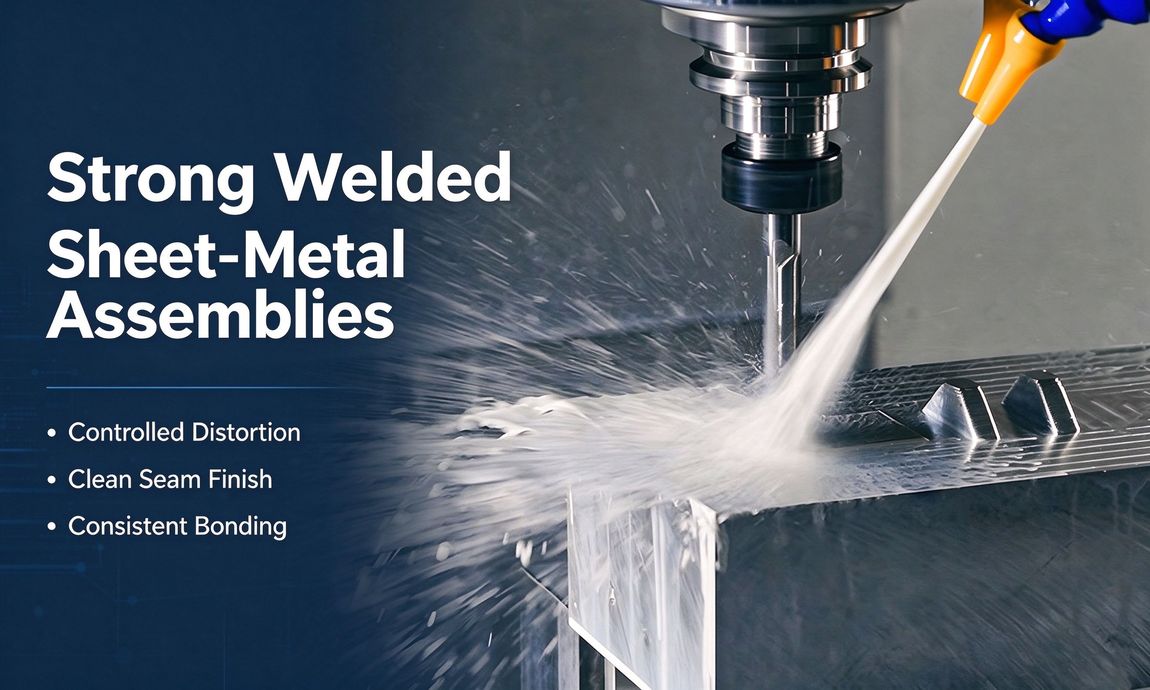
Give the shop more than a PDF of the frame. Send the assembly drawing with weld symbols marked, call out which seams are structural and which are cosmetic, specify the grinding standard, and state the flatness and hole-position tolerances the assembly must hold. Ask whether the welding jig will be retained for repeat orders, and how the weld schedule changes between pilot and mass run. For a sheet metal fabrication China program, that fixture-retention question matters more than it sounds. Bailu Tech treats the weld fixture as project tooling, documented and stored with the job, so a reorder two years later lands on the same jig with the same sequence. Huzhou Bailu Technology has found that assemblies briefed this way skip the entire first round of distortion complaints that unbriefed jobs need to work through.
Let us brighten your life with safety, efficiency,and expert craftsmanship.
Contact Us
Phone : +86-159 0682 2387
WhatsApp/Wechat: +86-159 0682 2387
Email : info@bailusolution.com
Copyright © 2026 Huzhou Bailu Technology Co., Ltd. All Rights Reserved. Design by BONTOP.