


Time:Nov 03,2026
By:Bailu
The die-cast bracket comes out of the mold looking like a finished product, then the customer asks for a satin silver finish and the plating house refuses the order sight unseen. That happens because raw die-cast aluminum is a porous, skin-covered surface, and not every finishing process agrees with it. Choosing the right treatment for OEM die cast aluminum parts starts with understanding what the casting surface actually is, which processes tolerate it and which ones need the part redesigned first. This article walks through the common options, their limits and the practical way to pair a treatment with your part.

As-cast aluminum carries a thin skin, flow lines from the die, ejector witness marks and micro porosity just below the surface. That skin is not a ready substrate: paint applied over it chips because the skin releases, and plating baths seep into pores and bleed out later, blooming on the finish. The first treatment is therefore usually a preparatory one. Shot blasting or vibratory grinding removes the skin, evens out flow lines and leaves a matte, texture-free surface that subsequent finishes grip. This is also why two castings with the same geometry can finish differently: the one with a denser skin and lower porosity responds far better once the preparatory step is done well.
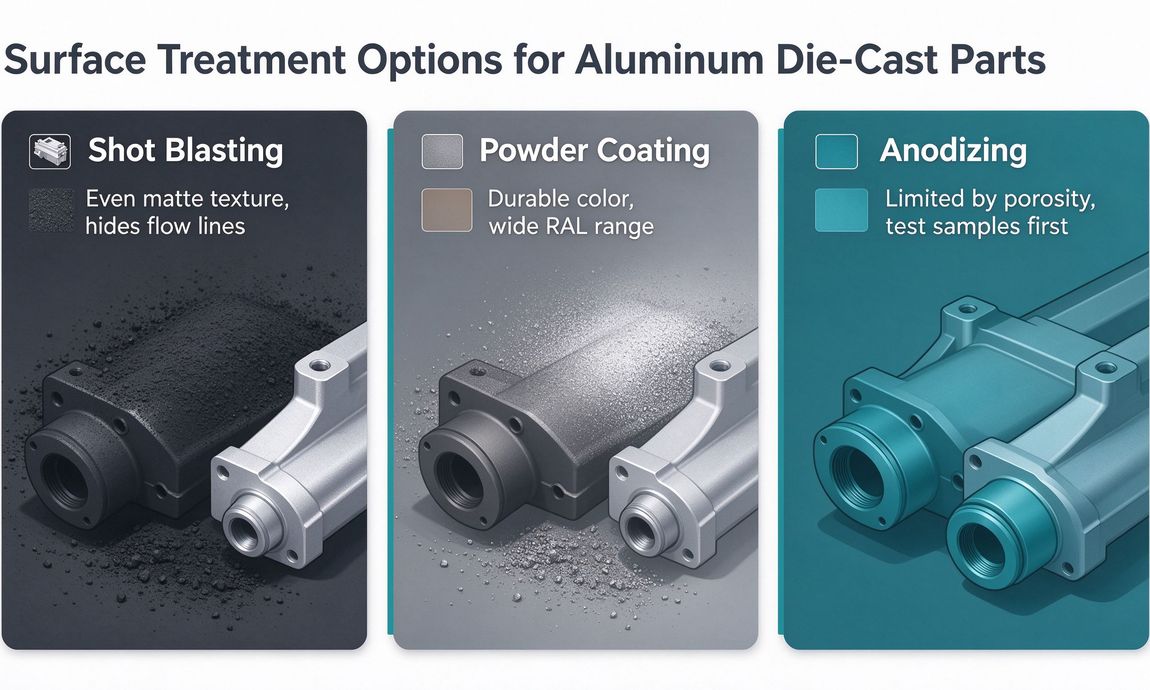
Shot blasting is the default answer when the requirement is an even, functional matte texture. Fine glass bead or steel grit blasted under controlled pressure removes die lines, softens sharp edges left by the mold and gives the part a consistent satin look that hides minor surface variation. Vibratory grinding, with ceramic media and compound, suits smaller, more delicate castings where blasting would round off fine features. Both processes double as cleaning steps, and both are cheap per part, which makes them the workhorse treatment for structural brackets, machine bases and covers where color is not required. Bailu runs blasting in-house after the die casting processing line, so the shot-blasted texture can be tuned against a customer-approved sample before any color process is added.
Powder coating is the most common colored finish on die-cast aluminum. After blasting and a chromate or phosphate conversion wash, the charged powder adheres well, cures in an oven and delivers a thick, chip-resistant film in almost any RAL color. It tolerates the small imperfections of a casting far better than liquid paint, because the film thickness covers minor dips rather than highlighting them. Wet painting sits below it in durability but stays useful when a thin, smooth decorative layer is needed. Both routes hide porosity to a degree, which is why they are the safe choice for parts that cannot be re-tooled to reduce blowholes. The cost driver is the pretreatment line, not the spray booth.
Anodizing is the process buyers request most and the one casting shops warn about first. On wrought aluminum extrusions it produces a beautiful, hard, self-healing oxide layer, but on die-cast aluminum the alloy itself is the problem. High-silicon casting alloys form dark, non-conductive silicon particles during anodizing, leaving streaks and blotches, and any subsurface pore opens during the process and absorbs electrolyte, which stains the part. The result is not a uniform silver but a mottled gray. Light cosmetic castings in carefully selected alloys can be anodized after sample trials, but for most functional OEM parts the realistic advice is to treat anodizing as a special case, prove it on the first sample, and expect porosity-related rejects that powder coating would not have.
Chromate conversion and zinc-phosphate coatings are rarely the visible finish; they are the adhesion layer underneath powder coat or paint. Their job is to convert the reactive aluminum surface so the film above bonds and the whole stack resists corrosion. Electrophoretic coating, e-coat, goes one step further, laying a uniform base coat that covers complex geometries evenly, and it is often specified under powder coat for outdoor parts. For buyers sourcing sheet metal fabrication alongside castings, the conversion coating step is also what lets a mixed metal assembly share one finishing line without color mismatch between the stamped and cast components.
The practical decision tree is short. If the part is structural and uncolored, shot blasting alone covers it. If it needs color outdoors, blasting plus powder coating is the standard answer. If appearance is premium and the alloy is favorable, test anodizing on a pilot sample and price the reject rate into the program. If the part will see chemicals or coastal air, add e-coat under the top layer. Hiding porosity is a different question from decorating: where pores are the visible risk, denser casting practice in the mold stage beats any treatment choice, and the DFM review should target porosity before the finishing step is chosen.
Ask which aluminum alloy is being cast and whether it is compatible with the finish you want. Ask what porosity level the current process holds, because that number predicts the anodizing reject rate. Ask whether blasting and pretreatment run in-house, since outsourcing the preparation step is where texture drift happens between batches. Bailu Tech reviews the finish requirement against the casting sample at the DFM stage, flagging incompatible requests before tooling is cut rather than after the first finished batch comes out blotchy. Huzhou Bailu Technology recommends treating surface finish as part of the casting specification, with a locked sample that both sides approve before mass production starts.
Let us brighten your life with safety, efficiency,and expert craftsmanship.
Contact Us
Phone : +86-159 0682 2387
WhatsApp/Wechat: +86-159 0682 2387
Email : info@bailusolution.com
Copyright © 2026 Huzhou Bailu Technology Co., Ltd. All Rights Reserved. Design by BONTOP.