


Time:Nov 03,2026
By:Bailu
Your thick plastic handle keeps showing a sink mark on the grip even after three rounds of machine tuning, and the mold shop's answer is to live with it or cover it with texture. The part does not have to stay that way. Gas-assist injection molding was developed for exactly this geometry: sections too thick to cool evenly, where ordinary packing pressure cannot fully eliminate surface dents. The process injects a controlled pulse of nitrogen gas into the molten shot, hollowing out the thick sections from inside and pushing the melt outward against the mold wall. This article explains how it works, which custom parts gain the most, and what design constraints you have to plan for before tooling starts.

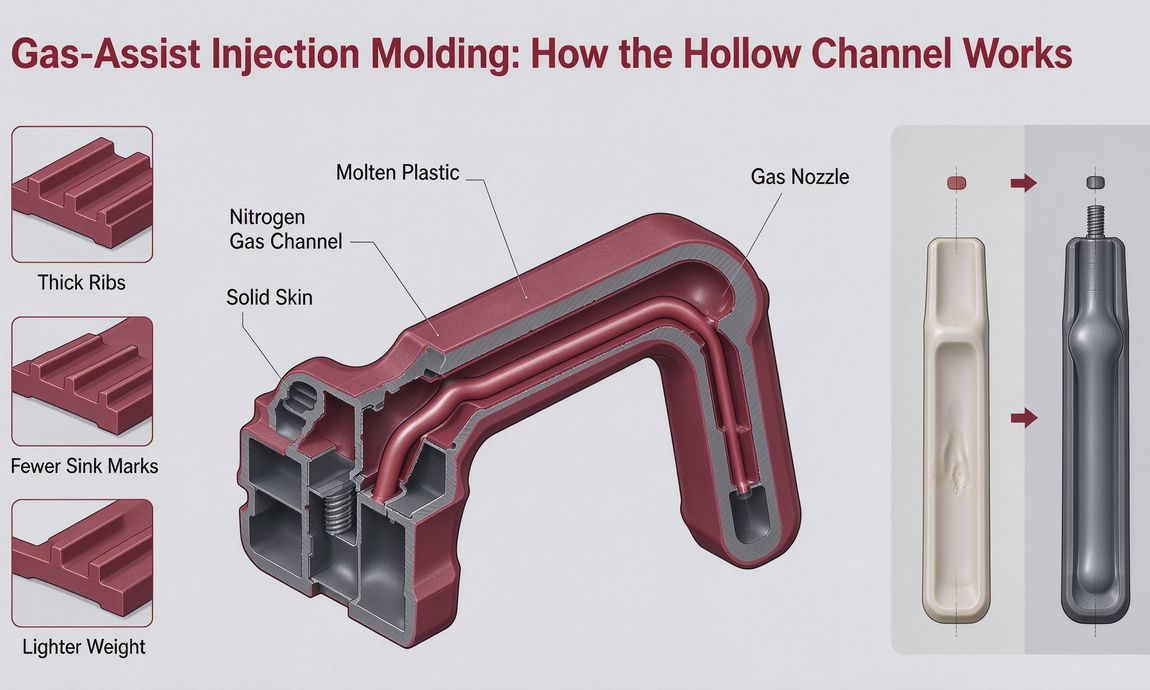
Normal molding packs the cavity full of melt and holds pressure until the skin freezes. In a thick section, the center stays liquid long after the surface has solidified, and as that center shrinks it pulls the soft surface inward, leaving a sink mark. Gas assist changes the sequence. The machine injects a short shot rather than a full cavity, then blows nitrogen through a nozzle into the thick region. The gas follows the path of least resistance, which is the still-molten core, and forms a continuous hollow channel. Pressure inside that channel pushes the remaining melt outward and feeds the shrinkage from the inside, so the surface stays flat and the wall freezes uniformly. The result is a part that looks solid on the outside but carries a controlled cavity in its ribs and bosses.
Three defects drive most buyers to gas assist. The first is sink marks on thick ribs and bosses, the cosmetic enemy of handles, knobs and appliance housings. The second is warpage: uneven packing in varying wall thickness bends the part as it cools, and gas assist balances the internal pressure across the whole section. The third is weight and material: a hollowed rib uses less resin than a solid one, and shorter cooling times follow because there is less molten material in the center to freeze. Cycle time often drops by 20 to 40 percent on thick parts, which matters when the annual volume runs in the tens of thousands. The same mechanism also lowers clamp tonnage needs, since the cavity is not fully packed the way conventional molding is.
Gas assist fits parts where a thick structural section meets a thin cosmetic wall. Door pull handles, vacuum-cleaner housings, armrests, ladder rails, TV stands and seat structures are typical targets. It is also used for one-piece hollow shapes that would otherwise need two shells welded or snapped together, because the gas channel can run through the whole body and replace the assembly step. Parts with heavily varying wall thickness, where a rib is three times the adjacent wall, are natural candidates. Conversely, thin-wall parts with uniform sections gain nothing: the gas has no thick core to travel through, and adding the hardware only raises the cost per shot.
The gas channel is part of the product design, not a machine setting. It needs a predictable path, roughly circular cross-sections in the 8 to 15 mm range, following the ribs and thickest sections with gradual transitions so the gas does not break through into the cosmetic surface. Ribs that feed the channel should stay thick enough to guide the gas but not so thick that the skin collapses. Venting at the far end of the channel is required, because the displaced melt has to go somewhere, and the mold needs gas nozzles, typically one or two per cavity, plus the gas control unit. A supplier experienced in mold development will lay the channel out during the DFM phase, before steel is cut, because relocating the gas path after tooling means cutting a new mold.
Expect two cost movements in opposite directions. The mold and machine carry a gas injection unit, nozzle hardware and more complex gating, so tooling cost runs higher than a conventional mold of the same size. Per part, however, material use falls, cycle time shortens, and secondary work like hiding sink marks with texture or paint becomes unnecessary. The crossover is volume: for low volumes the extra tooling rarely earns its keep, while for parts running 30,000 units a year or more the per-part savings and the quality improvement usually cover the difference. At Bailu, the review starts with the wall-thickness map of each project, because gas assist is only justified where the thick sections are large enough to matter.
The usual sequence looks like this. The buyer sends the CAD model and the required cosmetic standard, the manufacturer flags every thick section in the DFM report, and both sides decide which sections get the gas channel. A short-shot trial runs first, measuring how the gas front travels, then a few T1 samples come off with the gas pressure curve tuned. From there the sample approval is the same as for any injection molding project: dimensions, appearance, assembly fit and function tests. Bailu Tech keeps the gas parameters documented with the mold, so a repeat order two years later starts from a proven setup instead of a new trial.
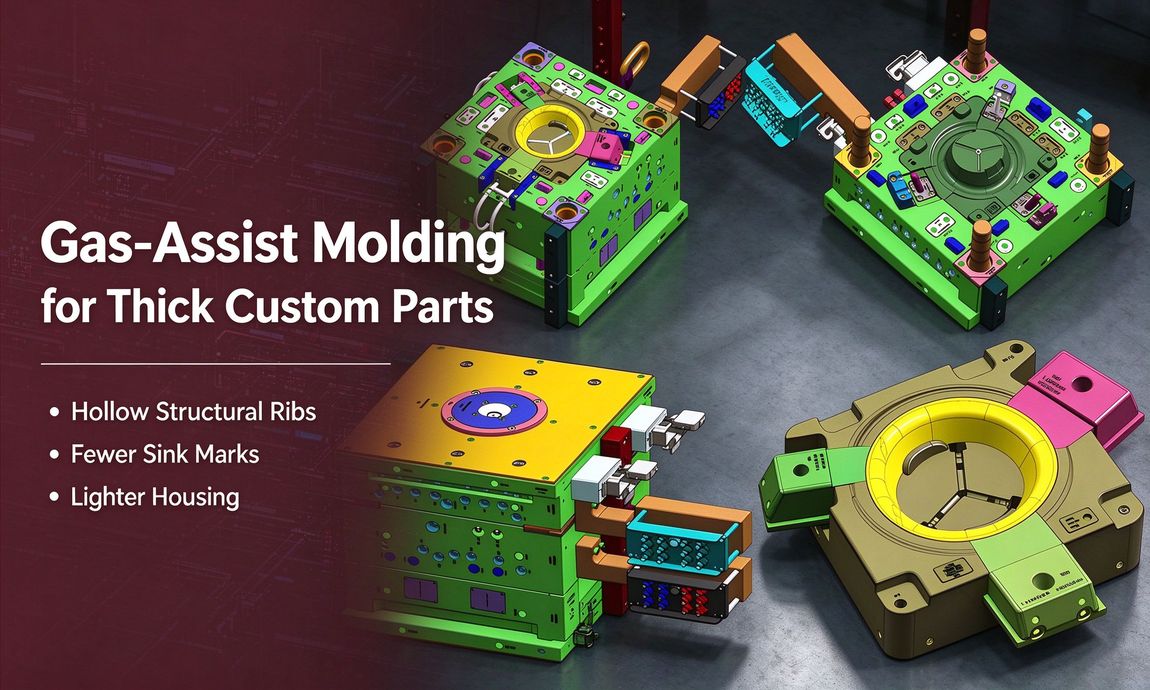
Before committing, ask how thick the gas channel in your part will be and where exactly the nozzle sits, because that decides which surface carries the gate witness mark. Ask whether the channel layout was simulated or proven on a similar part, and what the scrap rate looked like on the last comparable program. Ask how the weld line at the gas nozzle will be hidden. A qualified injection molding manufacturer China buyers work with treats these as normal DFM questions rather than surprises, and Huzhou Bailu Technology would rather spend a week on channel layout than two months fixing a sink-mark complaint after launch.
Let us brighten your life with safety, efficiency,and expert craftsmanship.
Contact Us
Phone : +86-159 0682 2387
WhatsApp/Wechat: +86-159 0682 2387
Email : info@bailusolution.com
Copyright © 2026 Huzhou Bailu Technology Co., Ltd. All Rights Reserved. Design by BONTOP.