


Time:Nov 03,2026
By:Bailu
The housing comes out of the mold round and flat, sits on a shelf for a week, and becomes a cupped rectangle that will not close against its mating part. Warpage in large injection-molded housings is the most common reason a first-shot sample goes back to tooling — and the frustrating part is that the machine can rarely fix it after the mold is cut. The geometry and cooling design decide the outcome long before the press runs. Here is where the risk actually lives, and what to change at each stage.

Plastic shrinks as it cools, and it shrinks more in some directions than others — especially with fiber-filled materials where the fibers align with the flow. Warpage appears whenever two regions of the same part shrink by different amounts while still locked together. On a small bracket, the part has enough rigidity to hold its shape against that stress. On a large, thin, open housing, the same internal stress has plenty of room to bend the wall into a cup or twist the flange flat. Size and thinness are what turn an ordinary shrinkage difference into a visible defect.
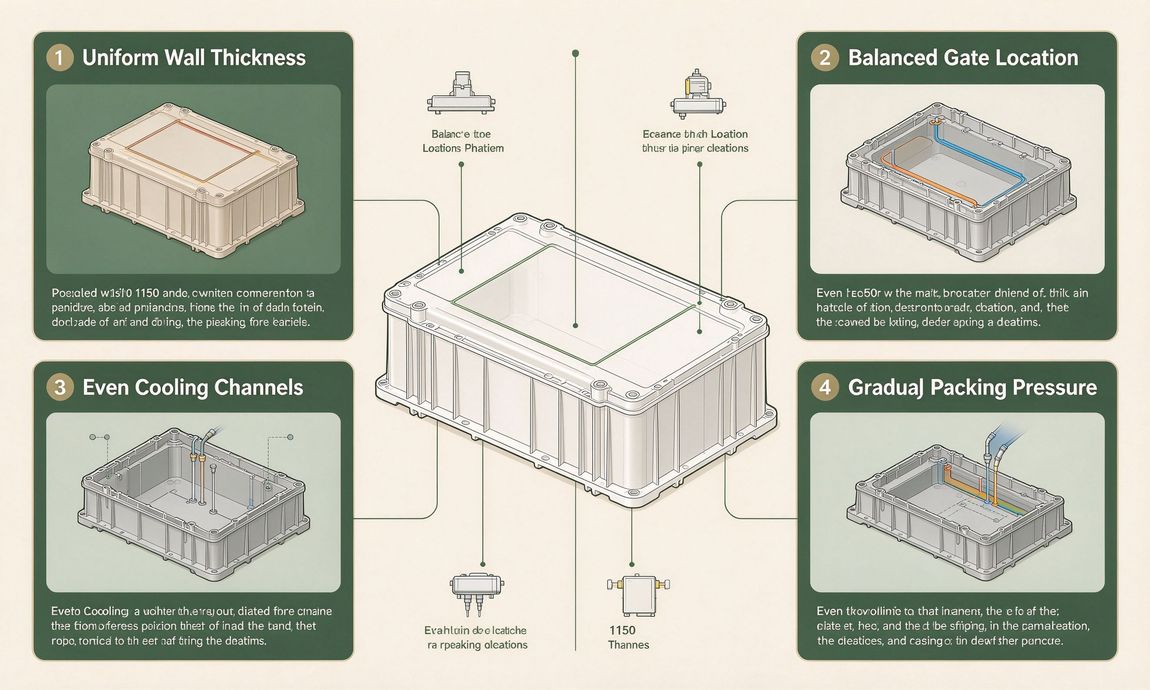
The single largest lever sits in the part design. Where the wall jumps from two millimeters to four, the thick section cools slowly, shrinks more, and pulls the thinner section toward it as it solidifies. A large housing should hold a consistent nominal wall across the whole form, with gradual transitions at every change of section. Ribs and bosses must be scaled down to roughly sixty percent of the wall thickness, not added as separate thick islands. Bailu reviews wall-section maps at the CAD stage because rebuilding a housing's thickness after the mold is cut means re-cutting steel — the fix costs ten times more there than on screen.
Gate location sets the flow direction, and flow direction sets fiber orientation, which sets the shrinkage direction. A large housing fed from a single corner fills across the part on a long sweep, and the result shrinks differently along the flow than across it — the classic twist. Centered or multiple gates balance the flow fronts so the entire cavity fills from the middle outward, shortening flow length and equalizing orientation. For very large enclosures, a three- or four-gate layout is not a luxury: it is what keeps the shrinkage symmetric. Where the geometry still forces a long flow path, designers sometimes split the housing into two aesthetic halves assembled later, so each half fills evenly and joins flat. An experienced injection molding manufacturer China buyers consult will simulate fill direction before the steel is cut rather than testing twist on the first sample.
Uneven cooling is the second major warpage source, and it lives inside the mold. If one cavity half runs cooler than the other, the side that solidifies first shrinks against a side still molten, and the part bows toward the hotter half. Cooling lines need to follow the housing's contour, sit at a consistent distance from the wall on both core and cavity sides, and include baffles or bubblers where deep ribs leave no straight channel. The mold development page shows how cooling layout is planned alongside cavity geometry, because a gorgeous wall design with lazy cooling channels still comes out bowed.
When the first samples warp, the instinct is to change material. More often the process is pushing uneven packing: a long housing packed to the end creates a density gradient from gate to far end, and that gradient shows up as differential shrinkage. Gradual packing profiles, controlled hold pressure and modest injection speed reduce frozen-in stress, which is the residual strain that unfolds into a cup as the part ages. The injection molding page covers how press parameters interact with mold design — the point being that process tuning absorbs small residual risk, while geometry and cooling carry the main load.
If samples warp despite good design, measure where: a cup shape points to unequal wall thickness or one-sided cooling, a twist points to flow-direction imbalance, and a flange that curls toward the gate points to over-packing near the gate. Bailu Tech asks for those measurements before proposing a fix, because each pattern points to a different lever, and the wrong intervention — say, adjusting temperature when the gate location is at fault — burns weeks without moving the part. A mechanical fixture for gentle stress-relief cooling after ejection is sometimes added as a final trim, but it treats symptoms, not causes.
The realistic program for a large custom housing is: map the wall thickness in CAD, choose gate placement from a fill simulation, design symmetric cooling into the mold layout, and define a packing profile before trial shots. Huzhou Bailu Technology runs these four checks as a standard review for large enclosures, so the first samples arrive closer to flat and the later press adjustments are fine-tuning rather than rescue. For buyers who have been through a cupped first sample, the lesson is simple: warpage control is a design and tooling conversation, held months before the molding begins.
Let us brighten your life with safety, efficiency,and expert craftsmanship.
Contact Us
Phone : +86-159 0682 2387
WhatsApp/Wechat: +86-159 0682 2387
Email : info@bailusolution.com
Copyright © 2026 Huzhou Bailu Technology Co., Ltd. All Rights Reserved. Design by BONTOP.