


Time:Nov 03,2026
By:Bailu
Every unit your operator assembled by hand came out slightly different: the bracket tilted by a degree on one, the gasket sat off-center on another, and the customer's tolerance drawing no longer matches reality. Hand assembly works for the first ten units, and it is exactly where consistency starts to leak out. The fix is tooling jigs, not better operators. The right set of fixtures converts judgment calls into repeatable positions, so the tenth thousandth unit sits the same as the first. This article lists the jigs a complex custom OEM assembly actually needs, and when dedicated tooling is worth the spend.

Human hands are good at adaptability and poor at repetition. A part placed by eye lands within a few millimeters, which is fine when parts are clamped to each other and the tolerance is wide. The moment an assembly carries precision interfaces, like mating enclosures, aligned shafts, sealed gaskets or torque-controlled fasteners, eye placement introduces scatter that each later step amplifies. Tooling removes the scatter at the source: the fixture locates the part to a hard stop, the operator's job becomes placing, pressing and fastening, and the position error drops to the repeatability of the jig rather than the person. A professional product assembly service China buyers work with designs the jig first and the line second, and Bailu starts every new assembly project by sketching the fixture layout before quoting the line rate.
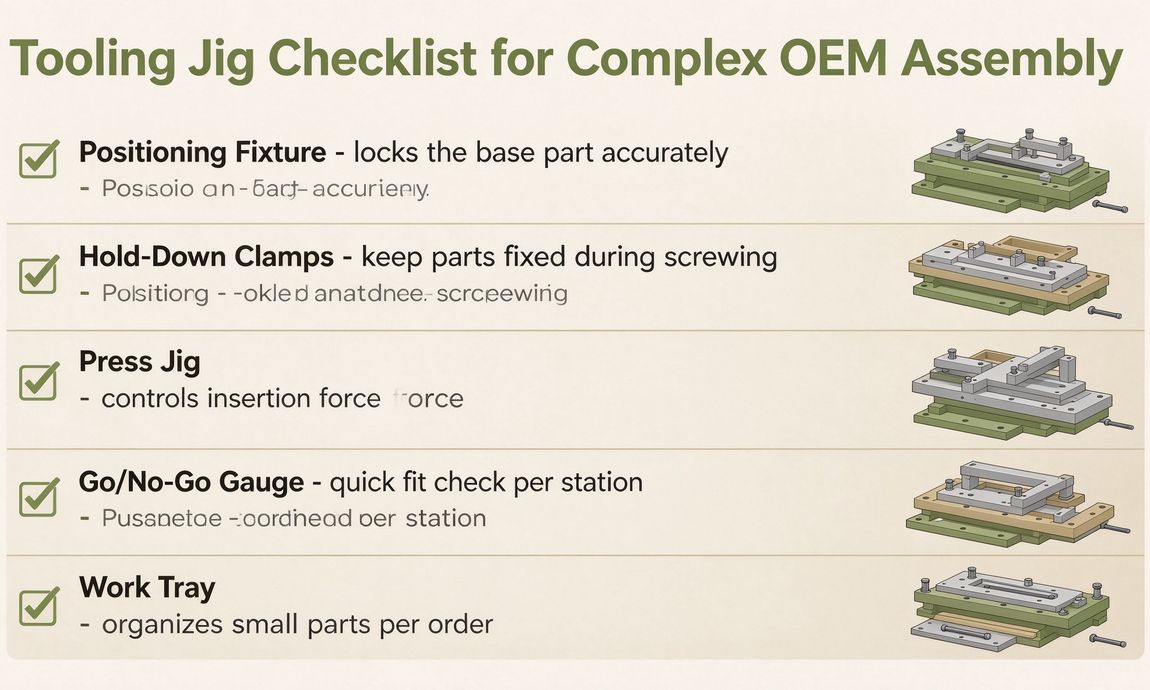
The positioning fixture is the anchor of every station. It holds the base part at its designed coordinates with precision-pin locators on the part's own datum features, so the assembly builds outward from a known reference rather than from visual judgment. Good fixtures use the part's own locating holes or machined pads as locators, not decorative surfaces, and they carry quick-release pins so loading takes seconds. The fixture is also where the process sequence is encoded: which features align first, which screws go in hand-tight before final torque, and where the operator's hands move next. For a multi-step assembly, one master fixture that holds the base through every station keeps the whole build on the same datum.
Once the part is located, it has to stay still while the work happens. Hold-down clamps at non-critical edges keep flexible sheets, thin housings and large panels flat during screwing, so a warped panel does not get forced into alignment by the screw torque itself. Fastener stations then standardize the torque sequence: the jig layout marks which screws go in which order, and a torque tool set to the joint spec makes every fastener identical. For assemblies with many screws, a simple template strip that maps the screw positions removes the moment of hesitation where an operator skips one or double-tightens another. Small stations like this cost almost nothing and remove a surprising share of field complaints.
Press fits, heat-set inserts, bearings and sealing rings are the operations that hand tools handle worst. A press jig guides the insertion axis perpendicular to the surface, controls the force through a pneumatic or hand press, and stops at a mechanical stop so the insert seats to the designed depth rather than until the operator feels resistance. Without it, inserts go in at angles, sealing rings twist, and the failure shows up weeks later as a leak or a loose joint. The jig also makes the operation safe: hands stay out of the press zone, and the force is repeatable unit to unit. For low-volume programs, a simple drill-press style jig covers most insertion jobs without dedicated automation.
A go or no-go gauge at the end of the line turns inspection into a two-second check. The gauge carries the critical interface dimensions as hardened pins and slots: if the assembled unit slides onto the gauge, the hole positions, protrusions and gaps are within tolerance; if it binds, the station stops and the unit goes to rework. These gauges catch the drift that accumulates across stations before the customer does, and they give operators immediate feedback instead of a QC report arriving days later. For assemblies that ship as finished goods, the gauge set is also what makes logistics and shipping planning predictable, because every carton leaves with the same verified geometry rather than a sample-checked average.
The quiet consistency killer is part mix-up. A tray with molded pockets for every component in the bill of materials, laid out in the assembly order, means an operator cannot fasten the wrong screw or skip a seal without the tray showing it empty. Kitting trays also compress training time: a new operator follows the tray instead of asking which part goes where. For mixed-model programs, color-coded trays per variant prevent cross-line contamination, and the kitting step upstream becomes a controlled station rather than a pile of parts in a bin. These tools are cheap, and they pay back in reduced rework and faster onboarding.
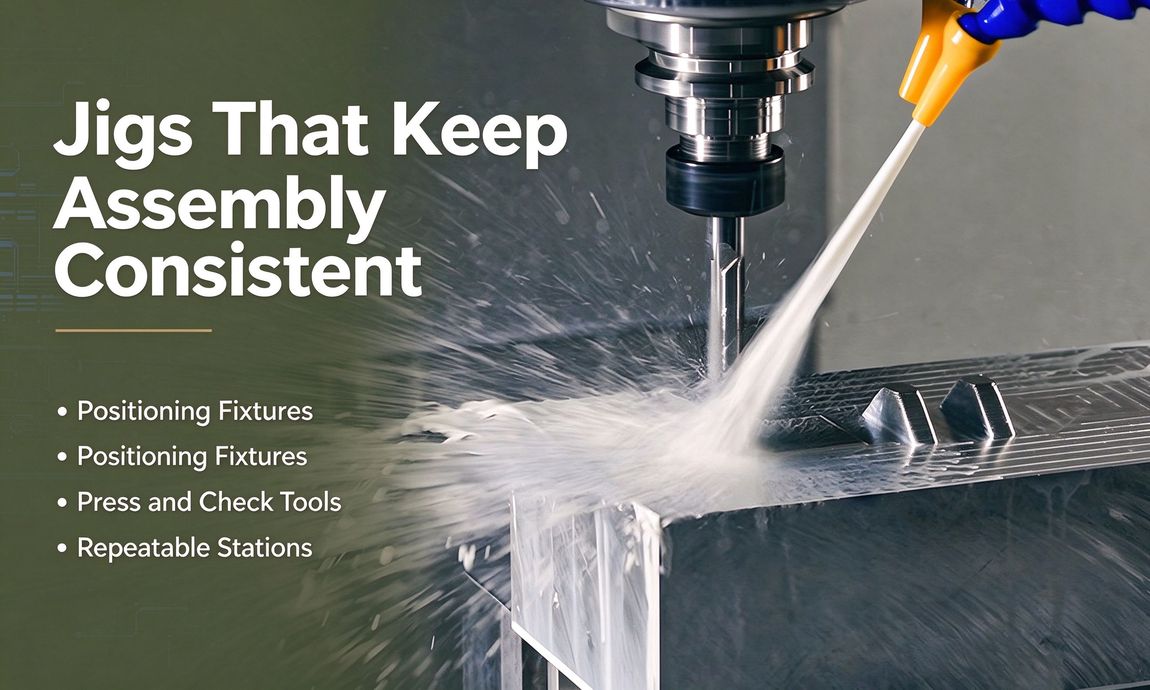
The honest answer depends on volume. For a one-time run of a few hundred units, soft tooling, 3D-printed locators and simple drill-jig plates cover the need without a big spend. For a product that will run for years or in tens of thousands, hardened steel fixtures, dedicated press jigs and gauge sets earn their cost quickly, because each station's error rate drops and the line speeds up. Bailu Tech sizes the tooling package against the annual volume at the project planning stage, proposing soft tooling for pilot runs and upgrading to hardened fixtures when the repeat order is confirmed. Huzhou Bailu Technology recommends keeping every fixture documented and stored with the project, so a reorder restarts on the same hardware instead of rebuilding the learning curve.
Let us brighten your life with safety, efficiency,and expert craftsmanship.
Contact Us
Phone : +86-159 0682 2387
WhatsApp/Wechat: +86-159 0682 2387
Email : info@bailusolution.com
Copyright © 2026 Huzhou Bailu Technology Co., Ltd. All Rights Reserved. Design by BONTOP.